What Would Your Business Look Like if Every Meeting Automatically Changed the Operating Plan?
55% of workers say next steps after meetings are unclear, and memory fades fastest in the first hours. A 60-second capture can turn every meeting into a changed plan.
Short Answer
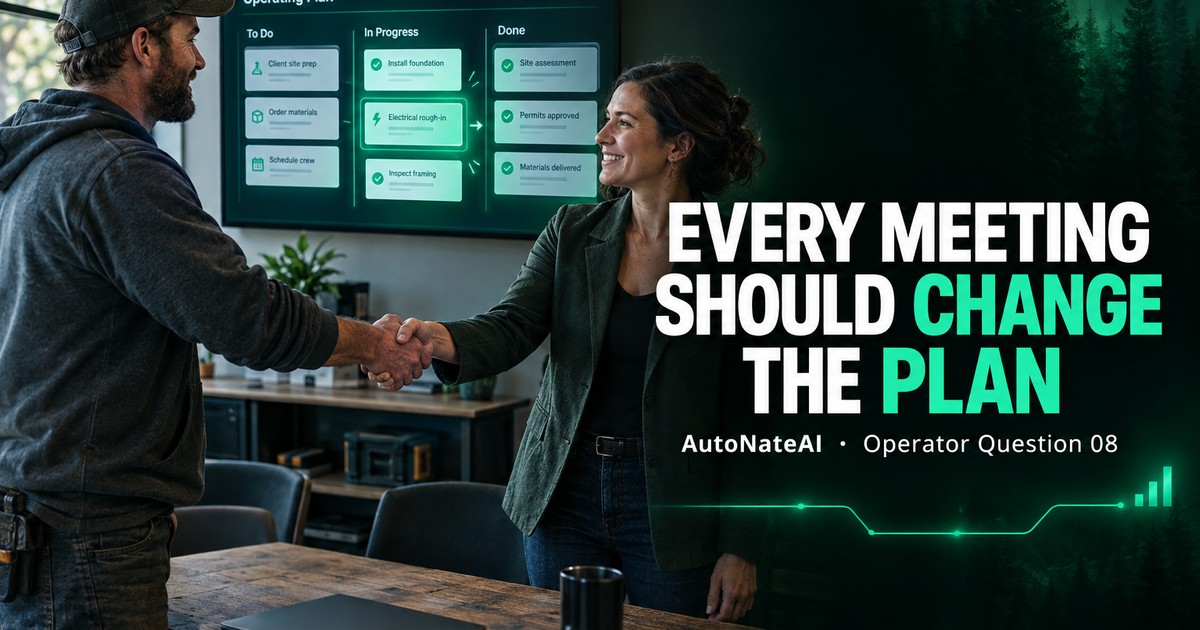
It would stop leaking commitments. Right now most meetings end with good intentions and zero change to what anyone actually does next. In Microsoft's 2023 survey of 31,000 workers, 55% said next steps at the end of meetings are unclear, and inefficient meetings ranked as the number-one productivity disruptor. Memory research going back to Ebbinghaus says much of what you heard is gone within a day. If every meeting (a client call, a site walk, a crew huddle, a coffee with a partner) automatically became updated records, new tasks, changed goals, and a rewritten tomorrow, the plan would always reflect reality. That's the plan you're operating from, not the one you made last Sunday. In a small business, that's the difference between "I thought I told you" and "it's already on Thursday."
The Meeting Ends. Now What?
You just walked a job with a property manager. It went great. In twenty minutes she told you:
- she has four more buildings with the same aging rooftop units
- her budget cycle closes November 15
- she wants a written maintenance proposal, not just a quote
- her facilities guy, Raymond, is the one who'll actually call you when something breaks
- she's frustrated with her current vendor's response times
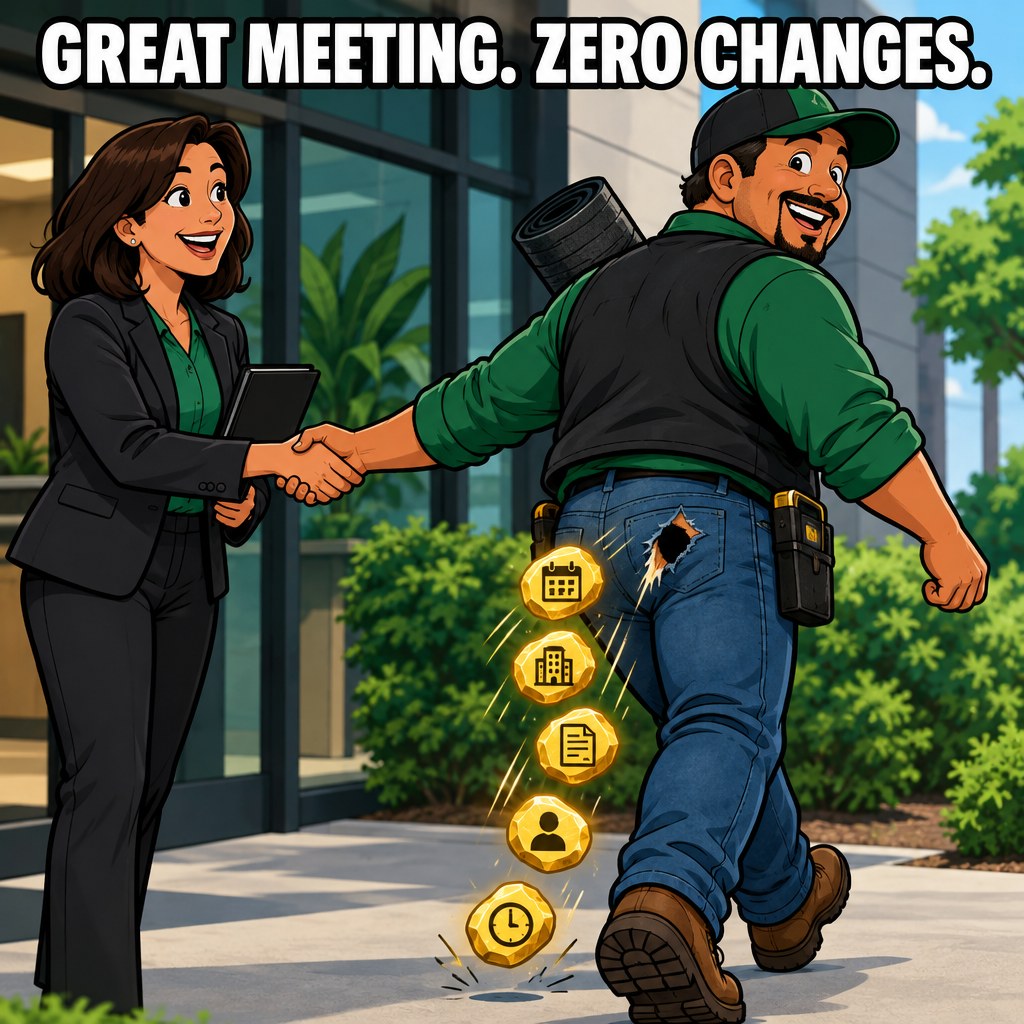
That's five pieces of gold: a bigger opportunity, a deadline, a deliverable, a new relationship, and the exact pain to solve.
Here's what usually happens to them. You get in the truck. The phone rings. You drive to the next job. By dinner you remember "four buildings" and "proposal." By next week, "November 15" is fuzzy and Raymond's name is gone. The proposal goes out late and generic, and it doesn't mention response time, the one thing she actually cared about.
The meeting was a success. The plan never changed.
Why Meetings Leak
People say it out loud
Microsoft's 2023 Work Trend Index surveyed 31,000 people in 31 countries and analyzed Microsoft 365 usage data:
- Inefficient meetings were the #1 productivity disruptor people reported
- 55% said next steps at the end of meetings are unclear
- 56% said it's hard to summarize what happened in a meeting
- the average employee spends 57% of their time communicating (meetings, email, chat) versus 43% creating
Those are corporate workers with meeting notes, shared drives, and project managers. A small-business owner's meetings happen in driveways, on roofs, and in parking lots, with none of that scaffolding.
Your memory is working against you
In the 1880s, Hermann Ebbinghaus measured his own forgetting and produced the famous forgetting curve: memory for new material drops steeply in the first hours, then levels off. It's one of the oldest results in psychology, and it has held up. A 2015 replication by Murre and Dros (PLOS ONE) reproduced it closely, and even found a small bump in retention around the 24-hour mark, likely from sleep.
Real conversations are more memorable than nonsense syllables, so you'll keep more than this. But the shape is the point: the steepest loss is in the first hours. That's exactly when you're driving to the next job instead of writing anything down.
Meetings are expensive even when nobody bills for them
Organizational psychologist Steven Rogelberg, who has done much of the modern research on meetings, estimates meetings eat roughly 15% of an organization's personnel budget. In a small business, meetings don't show up on a budget line at all. They show up as the owner's time, and a meeting that doesn't change anything is the most expensive kind.

The Loop: From Conversation to Changed Plan
Here's what "every meeting changes the plan" means mechanically. This is the loop AutoNateAI runs on, and it's the one we install:
open_with Drag nodes to rearrange, tap one for the evidence behind it — pinch or scroll to zoom.
Three details make this work in the real world:
- Capture is the only manual step, and it's talking. A one-minute voice note in the truck: "Walked the Oak Street property with Lena. Four more buildings, same units. Budget closes November 15. Wants a maintenance proposal. Raymond's her facilities guy. Hates her current vendor's response times." That's it.
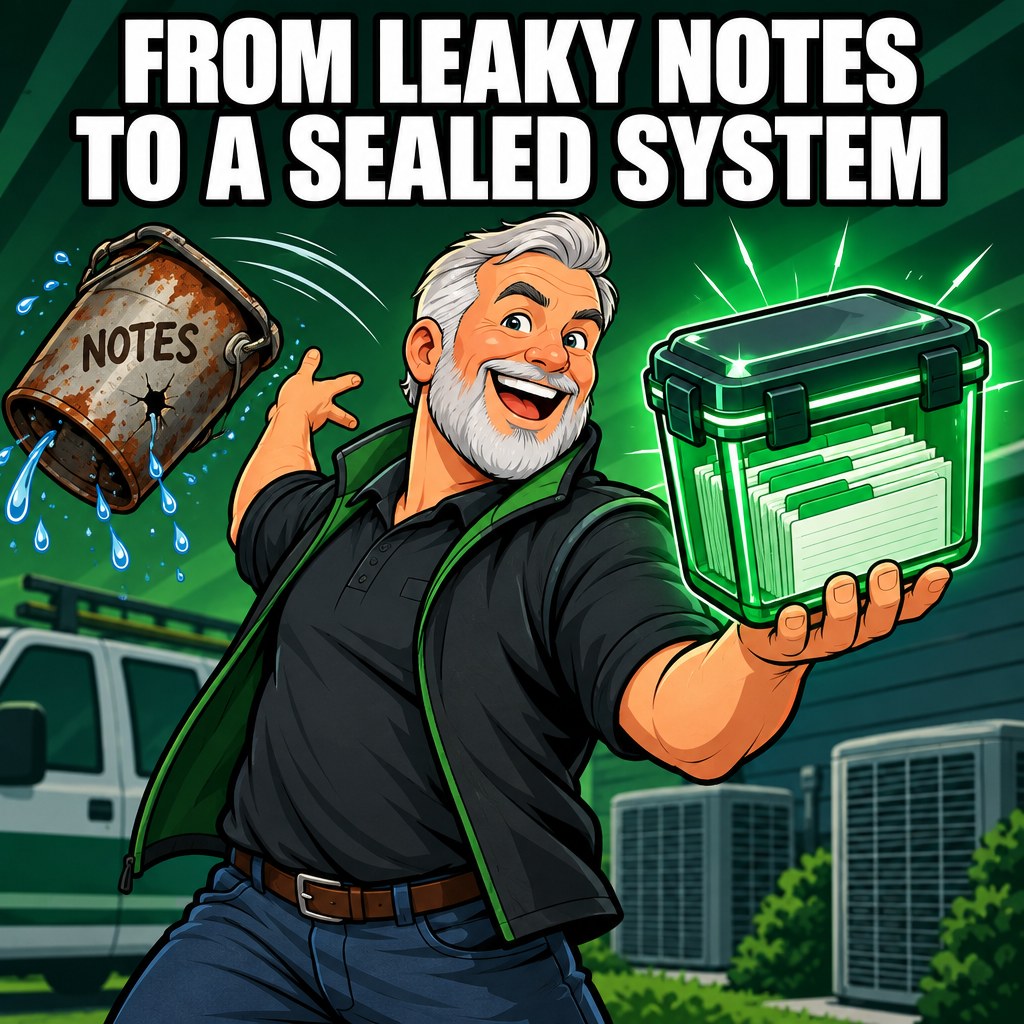
- Extraction writes to structure, not to a notes app. The AI doesn't just summarize. It creates Raymond as a person, links him to Lena's organization, upgrades the goal from one job to five buildings with the November dates, and creates three scheduled tasks.
- The plan changes where you'll see it. Tomorrow's timebox now has "Draft Oak Street maintenance proposal, lead with response-time guarantee" in your 7:15 revenue block. You didn't have to remember to remember.

What It Looks Like From the Inside
I'll describe how this works at AutoNateAI, since it's the example I can speak to honestly.
Every week starts with an attention graph: the objective, the relationships in play, and tasks spread across time blocks. Every night there's a reflection. It's a conversation, not a form: what moved, what took longer than expected, what changed, what's tomorrow's first build?
One Sunday reflection took a Monday that had thirteen planned tasks and found that five of them were really the same piece of work written five ways. They collapsed into two. A research branch that was fascinating but not urgent got moved to the backlog instead of stealing Monday morning. That wasn't discipline. The conversation surfaced it, the graph got updated, and the plan changed before Monday started.
That's the whole idea: the plan is always one conversation away from matching reality.
Run Your Own Numbers
A quick estimate of how many commitments your meetings leak each week. My assumptions are in parentheses. Replace them.
| Input | Your number |
|---|---|
| Meetings, calls, and site walks per week (12) | |
| Commitments or key facts per meeting: things someone owes, dates, names (3) | |
| Share that never get written anywhere useful (30%) | |
| Commitments leaked per week | 12 × 3 × 30% ≈ 11 |
Eleven dropped commitments a week is over 550 a year. Some are small, like a name you'll need later. Some are the November 15 budget deadline that turns a $1,200 repair into a $40,000 maintenance agreement. You don't get to pick which ones leak.
With a capture-and-extract loop, the leak rate depends on one habit: the 60-second voice note after every meeting. Everything after that is the system's job.
What the Research Doesn't Tell Us
Microsoft's data comes from mostly corporate knowledge workers, and it's a vendor survey. The forgetting-curve data measures memorized nonsense syllables, not conversations. That tells us the shape of forgetting, not how much of a client meeting you'll recall. Rogelberg's 15% figure is an organizational estimate. We don't have published data on commitment leak rates in small service businesses. The 30% in the table is a planning assumption, so measure your own.
A Note on Recording
If you record calls to generate transcripts, know your state's consent law. Some states require every party to agree to a recording, and the safe habit is to ask every time. A voice memo you dictate yourself after the meeting avoids the issue entirely, and it's often better anyway, because you're capturing what mattered, not all of it.
Moral of the Story
- Adopt the 60-second rule. Before you start the truck, record a voice memo covering who you met, what they want, any dates, anyone new, and what they're frustrated with. Even without any system, this beats the forgetting curve.
- End every meeting with one sentence out loud: "So I'll send you X by Y." Unclear next steps is the most-cited meeting failure in the research, and one sentence fixes most of it.
- Write down every new name. The facilities guy, the assistant, the partner's cousin. Relationships you can't recall are relationships you can't use.
- Check tomorrow against today. Before bed, look at tomorrow's plan and ask: did anything I learned today change this? If your plan never changes, it's not a plan. It's a wish.
- Want every meeting to update your business automatically? That's the discovery call. We'll show you the capture-extract-plan loop running live.
Sources
- Microsoft — 2023 Work Trend Index: "Will AI Fix Work?"
- Murre & Dros — "Replication and Analysis of Ebbinghaus' Forgetting Curve," PLOS ONE (2015)
- Rogelberg — The Surprising Science of Meetings, Oxford University Press (2019)
- Geimer, Leach, DeSimone, Rogelberg & Warr — "Meetings at work: Perceived effectiveness and recommended improvements," Journal of Business Research (2015)
Book a 20–30 minute discovery call.
We'll show you a live Operator OS cockpit and tell you straight whether it fits.
Related questions
 Published
Why Does Adding Another CRM Often Increase the Owner's Cognitive Load?
A CRM stores information. It doesn't carry it. Add one more tool that doesn't share memory and you've added pairs to reconcile, and the owner is still the integration layer.
 Published
What Should Happen Automatically After a New Prospect Enters Your Business?
Six things should happen automatically in the first 48 hours: capture, recognize, acknowledge, research, route, follow up. In most shops the owner does all six by hand, hours late.
 Published
Can a 5-Person Company Operate With the Information Discipline of a 50-Person Company?
Big companies pay whole teams to keep information straight. Small ones pay with the owner's evenings. AI finally makes the clerical half of that discipline affordable.