How Do You Rank 500 Prospects Without Asking the Owner to Inspect 500 Rows?
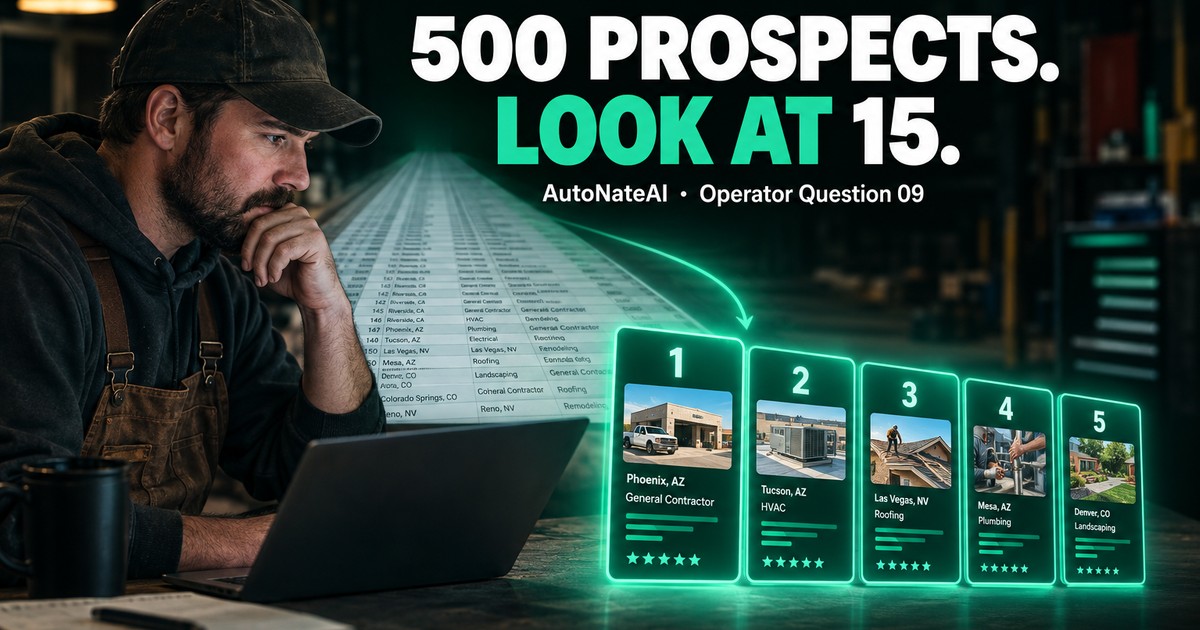
A licensing scrape hands you 500 names. De-duplicate, enrich, and score them transparently, and the owner reviews 15 with the reasons attached. That's a 16x cut in review time.
Short Answer
You don't hand the owner a list. You hand them a short, ranked queue with the reasons attached, and you keep the owner's judgment for the top of it. A good ranker does five jobs before a human ever looks:
- resolves duplicates so each business appears once
- enriches each record with public data
- scores fit, timing, reachability, relationship proximity, and value with weights you can read, not a black box
- surfaces the top 15 to 25 with a one-line "why"
- learns from what you do with them
The raw material is often free. Florida's licensing agency publishes licensee files as weekly CSV downloads, and Texas posts contractor license data too. The value isn't the scrape. It's the ranking, and it's the difference between "I have 500 names" and "I know which 15 to call Tuesday."
The Spreadsheet That Ate Saturday
You finally did it. You pulled every licensed HVAC and electrical contractor in three counties out of the state licensing database. 512 rows. Name, license number, type, status, issue date, city.
Now what?
You scroll. Row 14 is a business that closed. Rows 40 through 43 are the same company under four license numbers. Row 88 is a guy you already know. Row 131 looks perfect, but there's no phone number. By row 60 you're skimming. By row 120 you're guessing. You end up picking prospects by whether the name sounds good. And the list goes into a folder where, statistically, it will stay forever.
The data wasn't the problem. You asked a human to do a machine's job, and then asked the machine to do nothing.

Why Long Lists Stall
You've probably heard of the famous "jam study." In 2000, Sheena Iyengar and Mark Lepper set up a tasting table at an upscale grocery store. Shoppers who saw 24 jams were more likely to stop, but only about 3% bought. Among shoppers who saw 6, about 30% bought.
I'll be honest about what came next, because it matters. A 2010 meta-analysis by Scheibehenne, Greifeneder, and Todd pooled 50 experiments and found the average "choice overload" effect was close to zero, with big differences between studies. More options don't always paralyze people. But the follow-up research points to when they do: when options are hard to compare, when there's no clear way to rank them, and when the decider is short on time.
That's a precise description of a raw prospect list in the hands of a busy owner. Five hundred rows, no scores, no way to compare them, and forty minutes on a Saturday. The fix isn't fewer prospects. It's making them comparable.
From 500 Rows to 15 Calls
Here's the pipeline, and what each step removes:
open_with Drag nodes to rearrange, tap one for the evidence behind it — pinch or scroll to zoom.
And here's roughly what each stage does to the count. The exact numbers depend on your market, so read this as the shape:

What "Transparent Scoring" Actually Means
A black-box score ("this lead is an 87, trust us") breaks the moment you disagree with it. The Operator OS uses a score with readable parts, so you can see why something ranked high and change the weights when your instincts know better.
For a company selling to contractors (say, an Operator OS install, a supply relationship, or a subcontracting partnership), the five factors might look like this:
| Factor | What it measures | Example signals (from public or your own data) | Example weight |
|---|---|---|---|
| Fit | Do they look like your best customers? | Trade, license class, size, service area | 30% |
| Timing | Is something changing for them right now? | Newly licensed, license expiring, hiring, new permits | 25% |
| Reachability | Can you actually contact them? | Phone, email, website, active listings | 15% |
| Proximity | How close are they in your network? | Mutual partners, referrals, chamber membership | 20% |
| Value | What's the likely size of the opportunity? | Crew size, commercial vs. residential, permit volume | 10% |
Proximity is the one most rankers ignore, and it may matter most. In Q07 we covered research finding referred customers worth 16–25% more. A prospect who shares a partner with you isn't a cold lead. They're one warm introduction away.
Every card in the queue shows the score and the reasons: "Score 84. Licensed 8 months ago (timing). 3-truck residential HVAC (fit). No website (reachable by phone only). Marcus at the supply house knows them (proximity)." You can agree, disagree, or re-weight. That's what makes it a tool and not an oracle.

Where This Lives
In an Operator OS, a scraper isn't a CSV generator. It's a graph-ingestion adapter. Every prospect it finds becomes an organization and a person in the same relationship graph as your clients and partners. That's why entity resolution works (it can see who you already know) and why proximity is computable (it can see your partners' connections).
Then the ranked queue is simply the Prospects view in your cockpit, sorted by score. Click one and you get a profile with a research thread (notes from you, your AI, and the scraper), touchpoints, and a button to create a goal once the research says it's real. That's the same flow as every other relationship. The top 15 become tasks in your Tuesday pipeline block. The other 485 wait, ranked, with no guilt attached.
Run Your Own Numbers
The time math is simple:
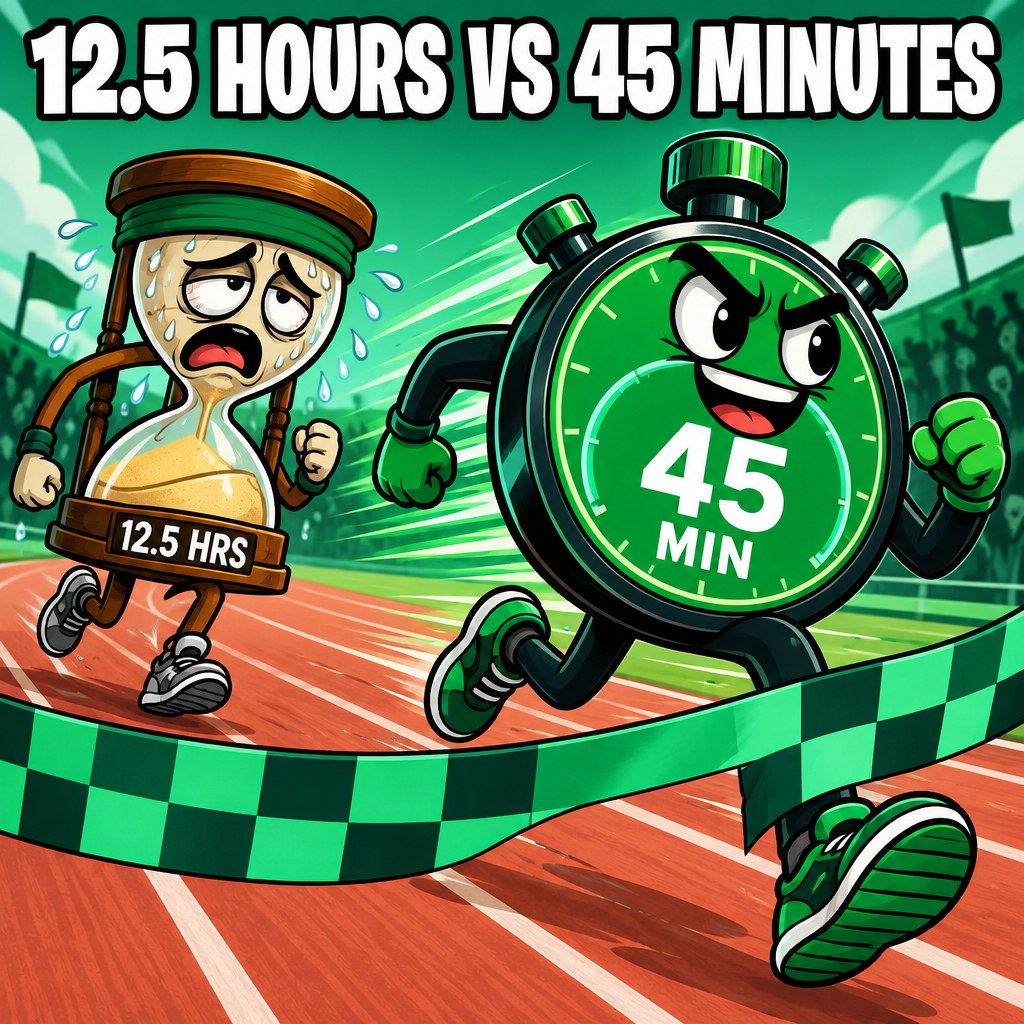
- Reviewing raw rows: 500 rows × about 90 seconds each (look it up, decide) ≈ 12.5 hours. Realistically, nobody does it. The list just dies.
- Reviewing a ranked queue: 15 profiles × about 3 minutes each (read the reasons, decide) ≈ 45 minutes.
That's a 16x reduction in owner time, and the 45 minutes are spent on the prospects most likely to matter. The ranking itself runs on software and costs very little each week. The expensive part is the owner's attention, and that's now pointed at the right 3%.
What does it cost to build? On our pricing page, a prospect scraper and enrichment pipeline runs $1,500–$4,000 and a ranker or scoring model $1,000–$3,000. The range depends on how many sources, how messy the data is, and how much ongoing maintenance the sources need.
A Word on Doing It Right
Public records are public, but "public" doesn't mean "no rules":
- Follow each source's terms. Use official bulk downloads where they exist (like Florida's weekly files) instead of hammering a search page.
- Record provenance. Every field should know where it came from and when.
- Contact compliantly. A scraped phone number doesn't mean consent to automated texts (see Q04 on TCPA and 10DLC). Ranked prospects get human outreach first.
What the Research Doesn't Tell Us
The choice-overload evidence is mixed. The jam study is famous, but the average effect across studies is near zero, and it matters most under specific conditions. We're leaning on those conditions, not the headline. The funnel numbers and the scoring weights are illustrative. The real ones depend on your trade, your market, and your definition of a great customer. We don't have published data on lift from transparent versus black-box scoring in small businesses, and that's something we'd rather measure with real installs than claim.
Moral of the Story
- Never review a raw list again. Before you look at a single row, decide your top three fit criteria and filter on them. Even a spreadsheet filter beats scrolling.
- Sort by timing. "Licensed in the last 12 months" or "license expiring soon" is often the strongest single signal in licensing data. People who are changing are people who are buying.
- Mark every prospect you already know someone in common with. That's your warmest 5%, and they should go first.
- Cap your weekly queue. Fifteen researched prospects contacted well beats 500 imported and ignored.
- Want a ranker that learns what a great prospect looks like for your business? Book a discovery call. We'll show you our own prospect queue running live, then sketch yours.
Sources
- Florida DBPR — Public Records Read Me / Disclaimer (weekly CSV licensee files)
- Florida DBPR — Instant Public Records
- Texas Department of Licensing and Regulation
- Iyengar & Lepper — "When Choice Is Demotivating," Journal of Personality and Social Psychology (2000)
- Scheibehenne, Greifeneder & Todd — "Can There Ever Be Too Many Options? A Meta-Analytic Review of Choice Overload," Journal of Consumer Research (2010)
- Schmitt, Skiera & Van den Bulte — "Referral Programs and Customer Value," Journal of Marketing (2011)
Book a 20–30 minute discovery call.
We'll show you a live Operator OS cockpit and tell you straight whether it fits.
Related questions
 Published
How Many Leads Can a Contractor Realistically Manage Before Follow-Up Starts Breaking?
For an owner-operator, follow-up starts breaking around 20–25 new leads a month. Not from lack of hustle, but because the clock and your working memory both hit their ceilings.
 Published
What Does One Missed Estimate Actually Cost an HVAC or Electrical Contractor?
A silent HVAC estimate costs about $2,900 in expected revenue: the install, the repairs, the plan, and the referral. It never shows up as a loss anywhere.
 Published
What Should a Contractor Automate First: Lead Generation, Quoting, Dispatch, or Follow-Up?
Follow-up first, then quoting, then dispatch, with lead gen last. At $128 a paid HVAC lead, fixing follow-up adds as many jobs as 25% more ads, and makes every lead cheaper.