Why Does Adding Another CRM Often Increase the Owner's Cognitive Load?
A CRM stores information. It doesn't carry it. Add one more tool that doesn't share memory and you've added pairs to reconcile, and the owner is still the integration layer.
Short Answer
Because a CRM stores information. It doesn't carry it. You still have to remember to open it, type into it, check whether it's right, and decide what to do with what's in it. Your texts, your inbox, and your head don't stop being sources of truth just because you bought a new one. So instead of one place that knows your business, you now have one more place that partly knows it, plus a new job: keeping it in sync. The research on app switching and "work about work" says this tax is real and measurable. For a small business, the fix isn't a better database. It's taking the owner out of the integration job.
The Sunday Night Reconciliation
You know this one.
It's Sunday, 9 PM. You open the CRM you're paying $89 a month for, because this week you're going to "get it caught up." Three of the leads in there are dead. Two jobs you closed on Thursday aren't in there at all, because you closed them over text. The follow-up tasks it's nagging you about already happened, on the phone, in your truck. And there's a customer note that says "call back re: estimate" with no date, no amount, and no memory of who wrote it.
So you spend forty-five minutes making the software match reality. Which, for the record, you already knew. Reality was in your head the whole time.
Then Monday happens and the gap opens right back up.
That's the part nobody puts on the sales page. The CRM didn't take anything off your plate. It added a plate.
You Didn't Replace Anything. You Added a Node.
Here's what your information actually looks like after the new CRM goes in:
open_with Drag nodes to rearrange, tap one for the evidence behind it — pinch or scroll to zoom.
Notice the dotted line. The CRM is the one source that only knows what someone remembered to type into it. Everything else captures information automatically, because that's where the conversation happened. So the CRM is almost always the least accurate place in the system. It's also the one it'll make you feel guilty about.
And the owner's head is still at the bottom, still the only place all four sources come together.
The Math of Adding One More Tool
This part is just arithmetic, and it explains a lot of frustration.
When you have tools that don't talk to each other, somebody has to be the connection between every pair. Two tools make one pair to keep in sync. Three tools make three pairs. Five make ten. Eight make twenty-eight. The formula is n × (n − 1) ÷ 2, and it grows faster than your tool count.
Most small shops I talk to are running five or six: phone and texts, email, calendar, a spreadsheet or two, an invoicing app, maybe a scheduling tool, and now a CRM. Adding the CRM to five others didn't make one more thing to check. It made five new pairs that can disagree.
And the pressure is only going one way. The U.S. Chamber of Commerce's 2025 small-business report found 84% of small businesses plan to increase their use of technology platforms. More tools are coming. Unless something changes in the architecture, more reconciliation is coming with them.
What the Research Says the Tax Costs
The switching isn't free, even when each switch is quick.
- Toggling. In a 2022 Harvard Business Review study of 137 workers at three Fortune 500 companies, people toggled between applications about 1,200 times a day. Each switch cost only about two seconds to reorient, but that added up to just under four hours a week, roughly 9% of work time. Those are corporate knowledge workers, not owner-operators. But nobody toggles harder than the person who is sales, dispatch, and billing at once.
- Work about work. Asana's Anatomy of Work research (its own survey of knowledge workers) found people spent about 58% of their day on "work about work": chasing status, searching for information, switching between apps. That's instead of the skilled work they were hired for. In 2021 it found workers juggling about 10 apps, switching up to 25 times a day.
- Selling vs. not selling. Salesforce's own State of Sales research reports sales reps spend about 60% of their time on non-selling tasks, with manual data entry among the biggest. 42% say they feel overwhelmed by too many tools. That's the company that sells the most popular CRM telling you the CRM work is eating the selling.
None of those studies measured small-business owners. I want to be straight about that. But the mechanism isn't specific to big companies: every tool that doesn't share memory with the others adds reorienting, re-entering, and reconciling. And in a small business there's no ops department to absorb it. There's you.
Why it feels heavier than it looks
Cognitive scientists have a name for this: extraneous cognitive load. It's mental effort spent on how information is arranged instead of on the actual problem. John Sweller's cognitive load research described a specific version called the split-attention effect. When you have to mentally stitch together two separate sources to understand one thing, the stitching itself eats capacity you needed for the thinking.
That's a CRM next to a text thread. To answer "where are we with the Hendersons?" you have to pull the record from one place, the conversation from another, the date from a third, and hold all of it in working memory while you decide. Cowan's research puts that working memory at about four chunks. You're spending two of them on logistics.
The Real Problem Is Where the Typing Happens
Here's the part I wish someone had told me years ago.
Most CRMs fail in small businesses for a simple reason: they require the owner to do data entry at the exact moment the owner is busiest. The information shows up on a job site, in a truck, in a parking lot after a meeting. The CRM wants it in a form, on a screen, in fields. So it waits for "later." Later is Sunday night.
And even when the data does get in, the CRM mostly just holds it. It doesn't read your texts, decide what's urgent, draft the follow-up, or rearrange tomorrow. You still do all of that. A CRM is a filing cabinet with reminders. You're still the office manager.
What Changes When Conversation Is the Input
The Operator OS flips both problems.
- You talk instead of typing into fields. "Just met the Hendersons. They want the heat pump, but not till after their kid's graduation in June. Call them May 20th." Your AI writes the person, the job, the context, and the date into your business's structured memory. Capture happens at the moment of truth, in the truck, in the voice you already use.
- One memory, not five partial copies. Prospects, clients, partners, jobs, goals, touchpoints, and tasks all live in one connected graph. Email, calendar, and files are wired into the same memory, so the conversation and the record stop being two different things.
- The cockpit is for looking, not maintaining. Your custom interface shows the state of the business live, updating as the memory changes. You open it to see, not to fix.
- The AI does the reconciling. Ask "what's slipping this week?" and the answer comes from all of it at once. No more stitching together four sources in your head.
The measure of success is simple: Sunday night reconciliation should disappear. If the system needs you to babysit it, it isn't an operating system yet. It's another tool.

Run Your Own Numbers
A rough weekly "tool tax" estimate. My assumptions are in parentheses. Replace them.
| Line item | How to estimate it | Example |
|---|---|---|
| Re-entering info into the CRM | new leads/jobs per week × minutes per entry (4) | 10 × 4 = 40 min |
| Weekly reconciliation session | your actual Sunday-night number (45) | 45 min |
| Hunting for "where did we leave it?" | lookups per day (6) × minutes each (2) × 5 days | 60 min |
| Toggling / reorienting | HBR's ~9% of work time, scaled to your admin hours (10 hrs) | 54 min |
| Weekly tool tax | ~3.3 hours |
Three hours a week is roughly 170 hours a year. That's more than four full work weeks spent keeping software in sync with things you already knew. And that's before counting what slipped because the systems disagreed.
What the Research Doesn't Tell Us
The app-switching, "work about work," and non-selling-time figures all come from corporate knowledge workers and sales teams, and two of the three are vendor surveys. There's no good public study of CRM overhead for owner-operated trades or service businesses specifically. The n(n−1)/2 chart is math, not measurement: plenty of tools do integrate. The "tool tax" table is a model. The mechanism is well supported. The exact size for your shop is something you'd have to measure.
Moral of the Story
- Count your sources of truth. Write down every place customer information lives: phone, texts, inbox, calendar, CRM, spreadsheets, invoicing. If it's more than three and they don't sync, you're the integration layer.
- Find the least-accurate one. It's usually the one that depends on manual typing. Stop treating it as the source of truth, or fix how data gets into it. Don't just feel bad about it.
- Time your Sunday. Next reconciliation session, set a timer. That's your weekly tool tax, and it's a real number you can price.
- Before buying another tool, ask one question: "Where does the information get captured, and who types it?" If the answer is "you, later," it'll join the pile.
- Want the reconciliation to go away instead of getting organized? That's the discovery call. We'll map your sources of truth and show you what one memory looks like.
Sources
- Harvard Business Review — Murty, Dadlani & Das, "How Much Time and Energy Do We Waste Toggling Between Applications?" (2022)
- Asana — Anatomy of Work Global Index 2023 (press release)
- Asana — Anatomy of Work Index 2021
- Salesforce — Sales Statistics from the State of Sales report
- U.S. Chamber of Commerce — Empowering Small Business: The Impact of Technology on U.S. Small Business (2025)
- Sweller et al. — "Cognitive Architecture and Instructional Design: 20 Years Later," Educational Psychology Review (2019)
- Cowan — "The Magical Number 4 in Short-Term Memory," Behavioral and Brain Sciences (2001)
Book a 20–30 minute discovery call.
We'll show you a live Operator OS cockpit and tell you straight whether it fits.
Related questions
 Published
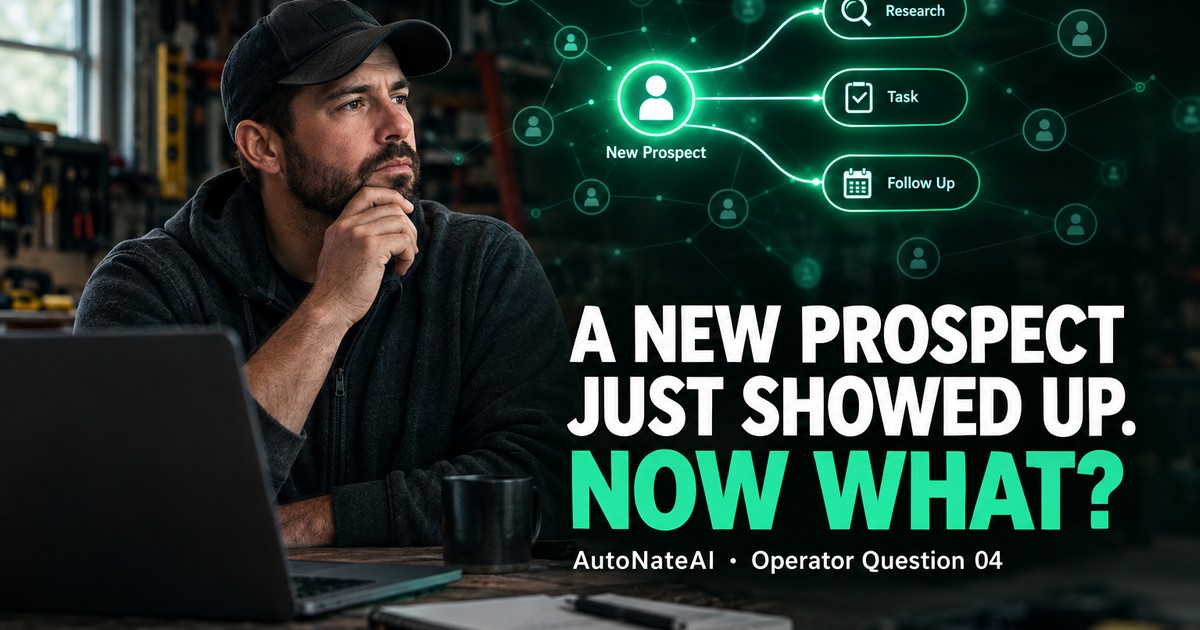
What Should Happen Automatically After a New Prospect Enters Your Business?
Six things should happen automatically in the first 48 hours: capture, recognize, acknowledge, research, route, follow up. In most shops the owner does all six by hand, hours late.
 Published
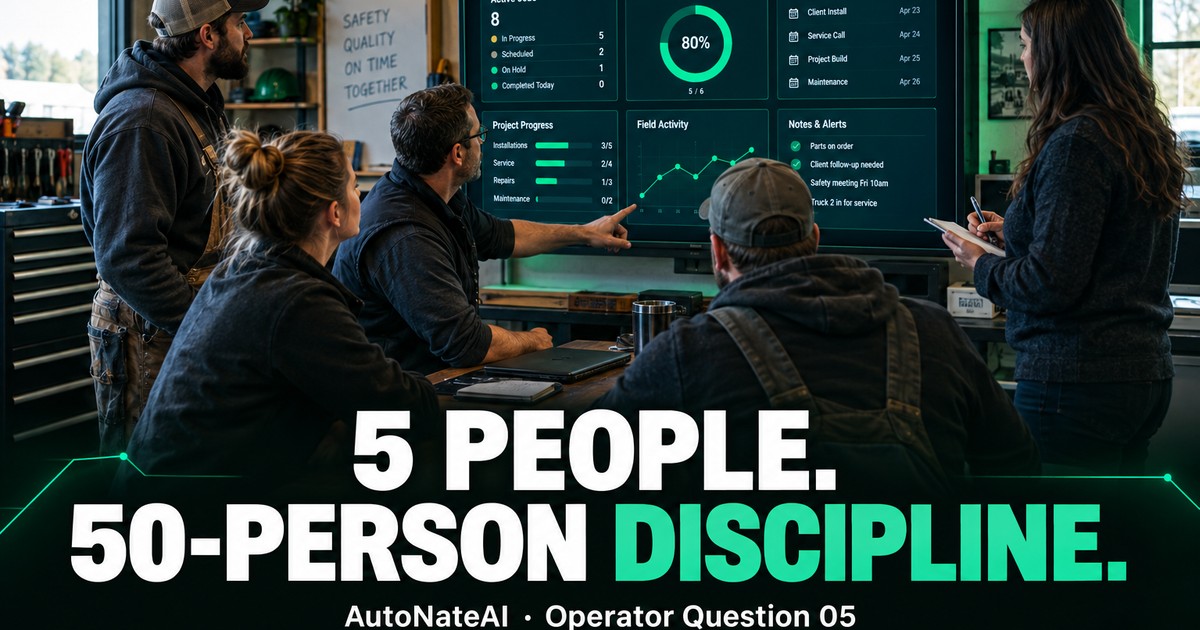
Can a 5-Person Company Operate With the Information Discipline of a 50-Person Company?
Big companies pay whole teams to keep information straight. Small ones pay with the owner's evenings. AI finally makes the clerical half of that discipline affordable.
 Published
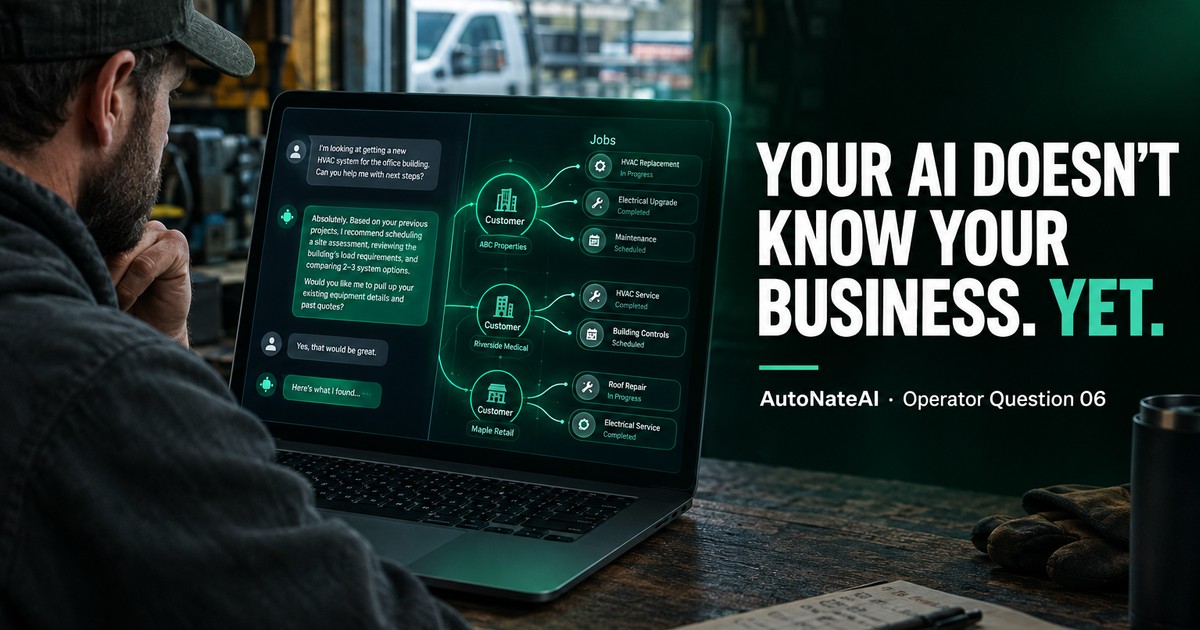
What Information Should Your AI Know Before It Recommends Your Next Sales Action?
ChatGPT gives confident advice about a business it has never seen. Seven layers of context turn a generic answer into a real sales recommendation.