Can a 5-Person Company Operate With the Information Discipline of a 50-Person Company?
Big companies pay whole teams to keep information straight. Small ones pay with the owner's evenings. AI finally makes the clerical half of that discipline affordable.
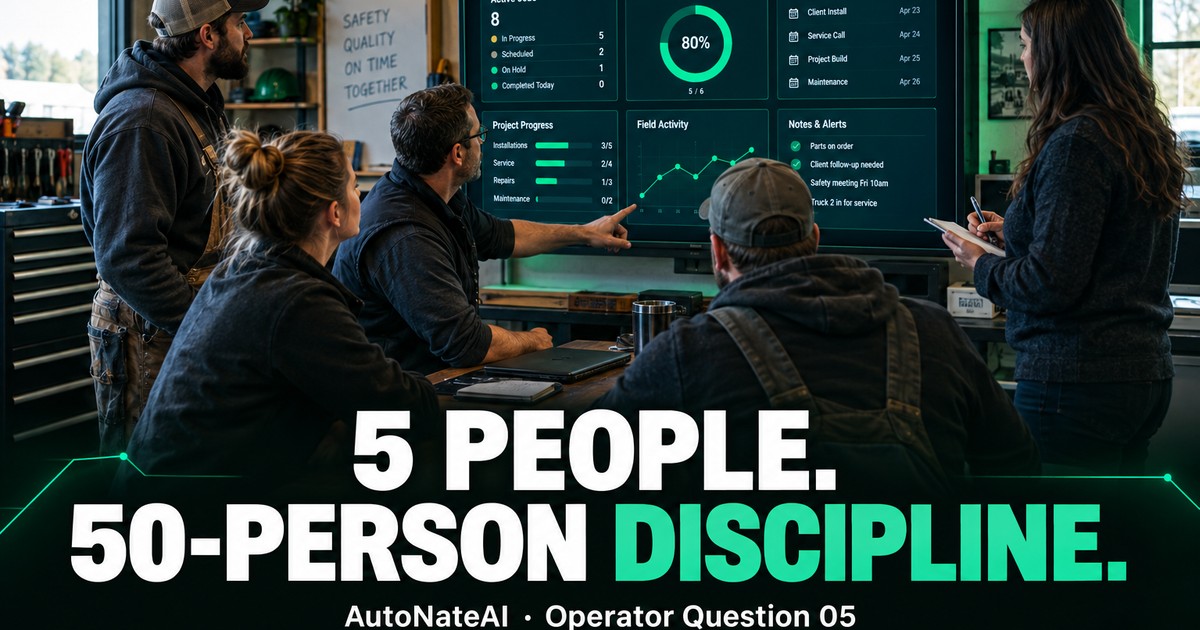
Short Answer
Yes, for the first time it's realistic. A 50-person company keeps its information straight by paying people to do it: office managers, coordinators, dispatchers, account managers, someone who runs the weekly numbers. Nationally, office and administrative support is about one in eight U.S. jobs. A 5-person shop has none of those roles. It has the owner, working evenings. Census research on thousands of U.S. establishments ties more structured management (monitoring, targets, reviews) to higher productivity and faster growth, and it finds smaller establishments adopt less of it. The gap was never about knowing better. It was about affording the people. AI changes that math, because most of what those roles do is remembering, organizing, reminding, and reporting, and a well-built system can now do that work when you talk to it.
Two Companies, Same Tuesday
The 50-person company. A customer calls about a warranty claim. The coordinator pulls up the account and sees the install date, the tech who did it, and the last three touches. She opens a ticket, assigns it, and the service manager sees it in the Wednesday dispatch meeting. Thursday the account manager gets a note that this customer's commercial property is up for a rooftop replacement next spring. Friday's ops report shows warranty claims are up 12% on one equipment line. Nobody had to remember any of it. The information moved because the company is built to move it.
The 5-person company. Same call. It goes to the owner's cell. He's on a roof. He calls back at 5:40, remembers the job but not the date, and texts his tech to "swing by when you can." The spring replacement opportunity gets mentioned and forgotten. There's no Friday report. The pattern in warranty claims isn't visible to anyone, because nobody's counting.
Both companies have a smart, capable person answering the phone. Only one of them has discipline built into the structure. In the other, discipline depends on the owner's memory on a Tuesday afternoon.

What "Information Discipline" Actually Is
When people say a big company is "organized," they usually mean six functions are covered by somebody:
open_with Drag nodes to rearrange, tap one for the evidence behind it — pinch or scroll to zoom.
None of this is exotic. It's just expensive, because in most companies each function is somebody's job.
Why This Matters: The Research on Structure
This isn't a productivity-blog opinion. It's one of the most studied questions in economics.
- Structure predicts performance. The Census Bureau's Management and Organizational Practices Survey (MOPS) covers about 50,000 U.S. manufacturing establishments. It was designed with economists Nick Bloom (Stanford), Erik Brynjolfsson (MIT), and John Van Reenen (LSE). Establishments with more structured practices for monitoring, targets, and incentives show higher productivity and profitability, more innovation, and faster employment growth.
- Small establishments adopt less of it. The Census Bureau's 2023 MOPS release says it plainly: establishments with more employees typically had higher structured-management adoption than smaller ones, and scores rose with each size class.
- Informal management has a long, costly tail. Bloom and Van Reenen's World Management Survey found management quality strongly associated with productivity, profitability, and survival. It also found a "long tail" of badly managed firms, often family-run firms passed down without formal systems.
I want to be careful here. MOPS surveys manufacturing plants, not HVAC shops or brokerages. And "structured management" isn't the same thing as "a system that remembers." But the mechanism carries over cleanly: businesses that write things down, track a few numbers, set dated goals, and review them regularly perform better. Small businesses do less of it, mostly because nobody is assigned to do it.
That chart explains why big companies must build discipline: 1,225 channels can't run on memory. It also explains the small-business trap. With only 10 channels, you can run on memory, and nearly all of them run through you. That works until you're on a roof.

The Headcount Math Small Businesses Can't Do
Here's the uncomfortable number. The Bureau of Labor Statistics counts office and administrative support at about 12.2% of U.S. employment (May 2023). That's the people who keep records, schedule, coordinate, and report. Apply that share to company size and the gap gets obvious:
At 50 people, that's about six people whose whole job is information discipline. At 5 people it's 0.6 of a person. In practice that means the owner, after hours. And hiring your way out is steep: the BLS median wage for secretaries and administrative assistants was $48,310 in May 2025, before taxes, benefits, and the time it takes to train someone.
So the old answer to this article's question was: "Not really. Discipline is a line item you can't afford yet."
What Changed
Look back at those six functions: memory, monitoring, targets, routing, review, handoffs. Most of the labor in them isn't judgment. It's clerical:
- writing down what happened
- filing it where the right person will find it
- noticing when something's overdue
- counting things every week
- turning a conversation into an assignment
- summarizing where things stand
That's precisely the work AI got good at, as long as it's connected to a structured memory of the business and not just floating in a chat window.
In an Operator OS, the six functions map like this:
| Function | 50-person company | 5-person company with an Operator OS |
|---|---|---|
| Memory | Coordinators + CRM admin | You talk; the AI writes to one relationship graph |
| Monitoring | Ops analyst, weekly report | The cockpit shows live counts: open leads, aging estimates, jobs, cash |
| Targets | Managers set quarterly goals | Goals attached to relationships and projects, with dates and dollar targets |
| Routing | Dispatcher / project manager | Tasks created from goals and conversations land in time blocks |
| Review | Weekly ops meeting | A nightly or weekly reflection conversation that updates tomorrow's plan |
| Handoffs | Notes in shared systems | Every touchpoint and research note attached to the person or job, so a tech or partner sees context without a phone call |
You still make every decision that matters. What you stop doing is being the filing cabinet, the reminder system, and the weekly report.

This Is How AutoNateAI Runs
I'll use myself as the example, because it's the one I can show you honestly.
AutoNateAI is a small practice. It runs on the same system we install. Every week starts with an attention graph: the week's objective, the relationships in play, the goals attached to them, and time-boxed tasks across five daily blocks. Every night there's a reflection, a conversation, not a form, that closes what got done, drops what stopped mattering, and rewrites tomorrow. Prospects from networking, referrals, and data scrapers land in one relationship graph next to clients and partners. ChatGPT and Claude read and write it. Coding agents extend it. The cockpit shows all of it live.
That's monitoring, targets, routing, review, and handoffs, the structured-management checklist from the research. There's no staff behind it, just an architecture.

Run Your Own Numbers
A quick "discipline audit." Give yourself one point for each one that's true today without depending on your memory:
- Every open lead and job is written down in one shared place.
- You can see, right now, how many estimates are open and how old they are.
- You have written goals with dates and dollar amounts for this quarter.
- Every task has a day it's supposed to happen, not just a list it lives on.
- There's a weekly moment where you look at the numbers and change the plan.
- A tech or partner can pick up a job's context without calling you.
0–2: your business's discipline is you. 3–4: partially structured, still owner-dependent. 5–6: you're running like a much bigger company already.
Now the cost side. If covering the missing functions takes even half an admin role, that's about $24,000 a year in wages alone, at the BLS median. Or you can keep paying for it in evenings. Most owners pay in evenings without ever putting a number on it.
What the Research Doesn't Tell Us
MOPS measures manufacturing establishments, and the World Management Survey measured medium-sized firms. Neither studies 5-person service businesses directly. Applying the national admin-employment share to company size is illustrative, not a staffing benchmark. And there's no rigorous published evidence yet on how much AI-based operating systems close the small-firm management gap. That's a question we expect to answer with real client data, not assume.
Moral of the Story
- Take the six-question audit above tonight. Be honest about the ones that only work because you remember.
- Pick three numbers to watch weekly. For most service businesses: new leads, open estimates by age, and cash collected. Structure starts with counting.
- Write one dated, dollar-specific goal for this quarter. "Grow" isn't a target. "$60K in replacement installs by Dec 31" is.
- Schedule a 20-minute weekly review and protect it like a job. It's the cheapest structured-management practice there is.
- If you want the 50-person discipline without the 50-person payroll, book a discovery call. We'll show you our own cockpit running live, then sketch yours.
Sources
- U.S. Census Bureau — Management and Organizational Practices Survey (MOPS) overview, CES working paper 18-51
- U.S. Census Bureau — 2023 MOPS release on manufacturing establishments
- Bloom & Van Reenen — "Measuring and Explaining Management Practices Across Firms and Countries," Quarterly Journal of Economics (2007)
- U.S. Bureau of Labor Statistics — Occupational Employment and Wages, May 2023 (office and administrative support share)
- U.S. Bureau of Labor Statistics — Secretaries and Administrative Assistants, Occupational Outlook Handbook
- Brooks, Frederick P. — The Mythical Man-Month (1975)
Book a 20–30 minute discovery call.
We'll show you a live Operator OS cockpit and tell you straight whether it fits.
Related questions
 Published
Why Does Adding Another CRM Often Increase the Owner's Cognitive Load?
A CRM stores information. It doesn't carry it. Add one more tool that doesn't share memory and you've added pairs to reconcile, and the owner is still the integration layer.
 Published
What Should Happen Automatically After a New Prospect Enters Your Business?
Six things should happen automatically in the first 48 hours: capture, recognize, acknowledge, research, route, follow up. In most shops the owner does all six by hand, hours late.
 Published
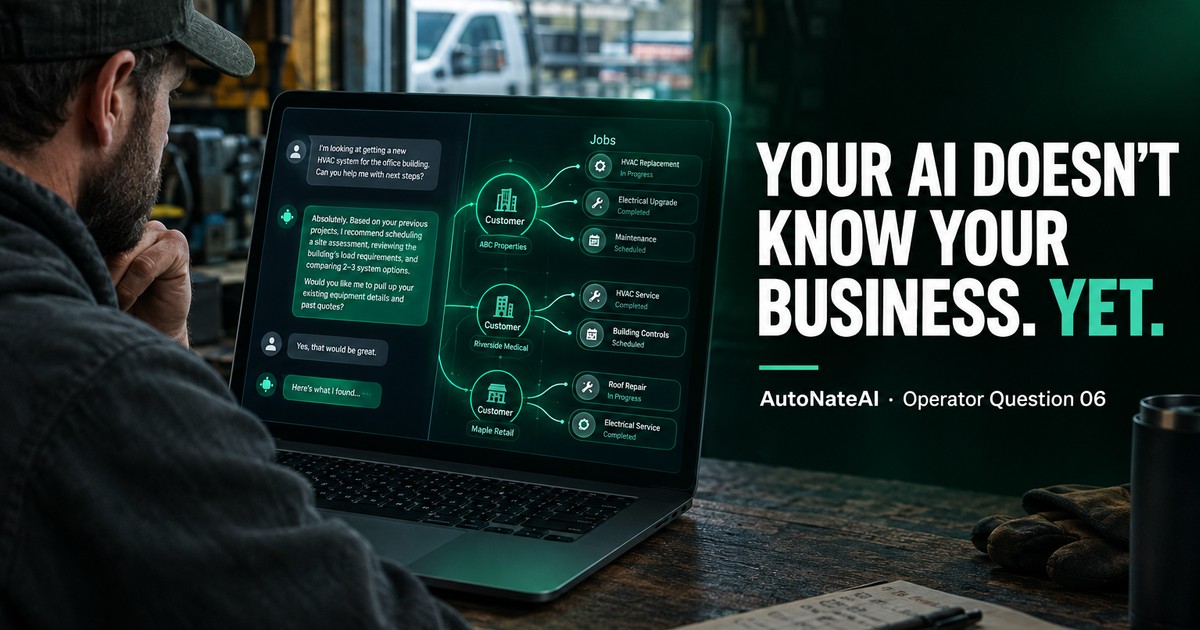
What Information Should Your AI Know Before It Recommends Your Next Sales Action?
ChatGPT gives confident advice about a business it has never seen. Seven layers of context turn a generic answer into a real sales recommendation.