Can Your Business Become Easier to Operate as It Becomes More Complex?
Growth usually hands the owner more to hold, the crisis Greiner described in 1972. Add capability to one memory and cockpit instead of new tools, and complexity stops landing on you.

Short Answer
It can, but not by accident. Normally every step of growth hands the owner more to hold: more customers, more crew, more services, more tools, and more pairs of things that can fall out of sync. Management research has described this for over fifty years. Larry Greiner's classic Harvard Business Review model shows companies growing smoothly until they hit a crisis, first of leadership, then autonomy, then control, and fixing each one traditionally meant adding people and procedures. Cybernetics offers the underlying rule: only variety can absorb variety. A more complex business needs a more capable control system. The new option is making that control system software you talk to, one memory and one cockpit that grow in capability without growing the number of places you check. Done right, complexity goes up and the owner's load goes flat, or even down.
The Growth Trap You Can Feel
Think back to your first year. You knew every customer by name, every job by heart, every dollar by memory. It was exhausting, but it was simple. Everything lived in one head.
Then it worked. You added a truck, a tech, a second service line, a part-time office person, a scheduling app, a CRM, an invoicing tool, a review tool. Revenue went up. So did:
- the number of people who need to know things
- the number of tools that need to agree with each other
- the number of decisions that route back to you
- the number of evenings spent catching up
Most owners describe the same moment: "The business got bigger and I got busier, not freer." That's not a personal failing. It's one of the most predictable patterns in management research.
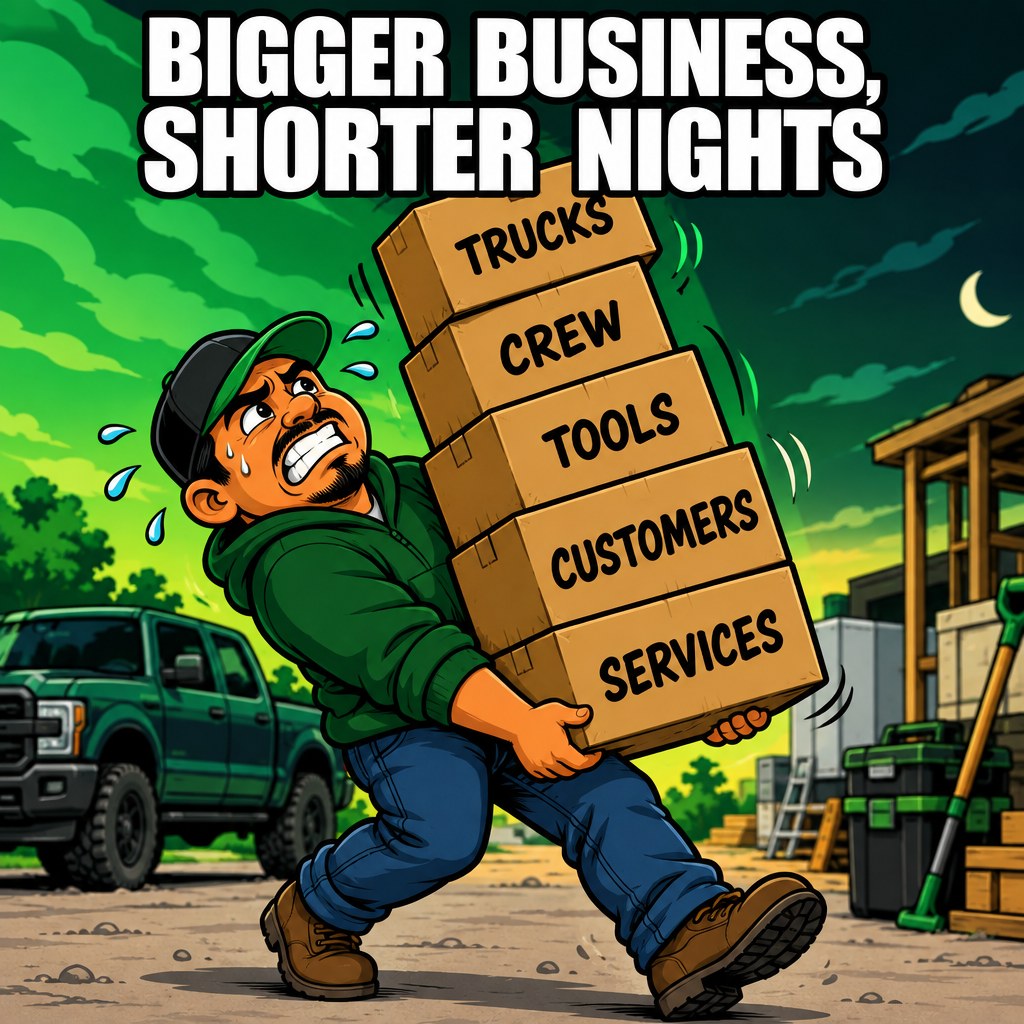
Fifty Years of Growing Pains
In 1972, Larry Greiner published "Evolution and Revolution as Organizations Grow" in Harvard Business Review, and it's still one of the most cited frameworks on the subject. His argument: companies grow through phases, each with a calm stretch of evolution that ends in a revolution, a management crisis the old way of working can't survive.
The first phases map uncomfortably well onto a growing service business:
- Creativity → crisis of leadership. The founder does everything through informal communication. It works until the business outgrows one person's head.
- Direction → crisis of autonomy. Someone takes firm control with more structure. It works until capable people are stuck waiting for decisions.
- Delegation → crisis of control. Managers get authority. It works until the owner loses sight of what's happening.
- Coordination → crisis of red tape. Formal systems and procedures pull it back together, until the procedures become the problem.
Here's the key line from Greiner: the critical task in each crisis is finding a new set of organizational practices for the next phase. Historically, that meant hiring managers, writing procedures, and adding layers. That's expensive, slow, and often the reason small businesses stall rather than grow.
open_with Drag nodes to rearrange, tap one for the evidence behind it — pinch or scroll to zoom.
The Rule Underneath: Only Variety Absorbs Variety
In 1956, cybernetics pioneer W. Ross Ashby stated what's now called the law of requisite variety: to control a system, your control mechanism has to be at least as varied and responsive as the system itself. His own slogan: "only variety can absorb variety."
Translate that to your business. Every new customer type, service line, crew member, and channel adds variety. Something has to absorb it: notice it, route it, remember it, respond to it. There are only three candidates:
- The owner. Absorbs variety until they burn out. This is Greiner's crisis of leadership.
- More people and procedures. Absorbs variety at the cost of payroll, layers, and eventually red tape.
- A system. Absorbs variety in software, if it's actually designed to, rather than adding more tools that each absorb a sliver and create new sync problems.
Most small businesses try option 3 and accidentally get the worst of both worlds. Every new tool absorbs a little variety and adds a new place to check. That's how you end up with the eight tools and 28 sync pairs from Q03.

The Metric That Matters: Places You Have to Check
Here's the simplest way to tell whether complexity is making your business harder or easier: count the places the owner has to look to know what's going on.
With the usual approach, every new capability (scheduling, CRM, reviews, invoicing, lead tracking, follow-up, reporting, a scraper) arrives as its own tool with its own login and its own partial truth. The count climbs by one each time.
With an operating system, each new capability plugs into the same memory and shows up in the same cockpit, and you reach all of it through the same conversation. The count stays at two: chat to change it, cockpit to see it.
And the pressure is real. The U.S. Chamber of Commerce's 2025 report found 84% of small businesses plan to increase their technology platform use. Salesforce's research found 42% of sales reps already feel overwhelmed by too many tools. More capability is coming either way. The question is whether it arrives as more places to check or as more power in the places you already use.
Why It Can Actually Get Easier
Here's the counterintuitive part, and it's the one I care most about. A well-built operating system doesn't just hold the owner's load flat as the business grows. In some ways it makes things easier:
- More history means better answers. A year of win/loss reasons, partner referrals, and follow-up outcomes makes your AI's recommendations sharper (see Q06). A new business can't have that. A growing one earns it.
- More relationships mean better ranking. The more of your network is in the graph, the better the system can spot warm paths to new prospects (see Q07 and Q09).
- Every module is reusable. The follow-up engine built for estimates also handles maintenance renewals. The scraper built for one county extends to the next. Your second capability costs less than your first.
- Handoffs get cheaper as you hire. A new tech or office person doesn't need a brain-dump from you. The context is already attached to every customer and job.
That's the real test of an operating system: does the next customer, hire, or service line make the business harder to run, or better informed?

Run Your Own Numbers
Three quick checks on whether your growth is getting heavier or lighter:
| Check | Count it | Heavier if… |
|---|---|---|
| Places you check daily to know the state of the business | It went up in the last year | |
| Decisions per day that route to you (not decided without you) | It went up as you hired | |
| Hours per week you spend on "catch-up" (reconciling, re-explaining, re-entering) | It grew faster than revenue |
If all three rose while revenue rose, you're in Greiner's crisis of leadership, whatever size you are. The traditional fix is headcount and procedures. The other fix is architecture.

What the Research Doesn't Tell Us
Greiner's model is a conceptual framework drawn from observing companies, not a controlled study, and it describes larger organizations than most readers of this piece run. Ashby's law comes from cybernetics and control theory, and applying it to a small business is an analogy, though a useful one. The "places to check" chart is a design model, not measurement. There's no long-run evidence yet that AI-based operating systems let small businesses skip Greiner's crises. That's the bet this whole approach is built on, and we'd rather show it with client data over time than claim it now.
Moral of the Story
- Count your places-to-check number today. Write it down. Every new tool you're considering should come with a promise that it won't raise that number.
- Before your next hire, list what you'll have to explain to them. Everything on that list that lives only in your head is complexity the business hasn't absorbed yet.
- Pick the one decision you make most often that someone else could make with the right context. That's your first candidate to hand off, to a person or a system.
- Judge every new capability by one question: does it make the business better informed, or just bigger?
- Want growth to get lighter instead of heavier? Book a discovery call. We'll look at where your complexity is landing today and whether one operating system could absorb it.
Sources
Book a 20–30 minute discovery call.
We'll show you a live Operator OS cockpit and tell you straight whether it fits.
Related questions
 Published
Why Does Adding Another CRM Often Increase the Owner's Cognitive Load?
A CRM stores information. It doesn't carry it. Add one more tool that doesn't share memory and you've added pairs to reconcile, and the owner is still the integration layer.
 Published
What Should Happen Automatically After a New Prospect Enters Your Business?
Six things should happen automatically in the first 48 hours: capture, recognize, acknowledge, research, route, follow up. In most shops the owner does all six by hand, hours late.
 Published
Can a 5-Person Company Operate With the Information Discipline of a 50-Person Company?
Big companies pay whole teams to keep information straight. Small ones pay with the owner's evenings. AI finally makes the clerical half of that discipline affordable.