What Is the Difference Between Using AI and Building an AI Operating System?
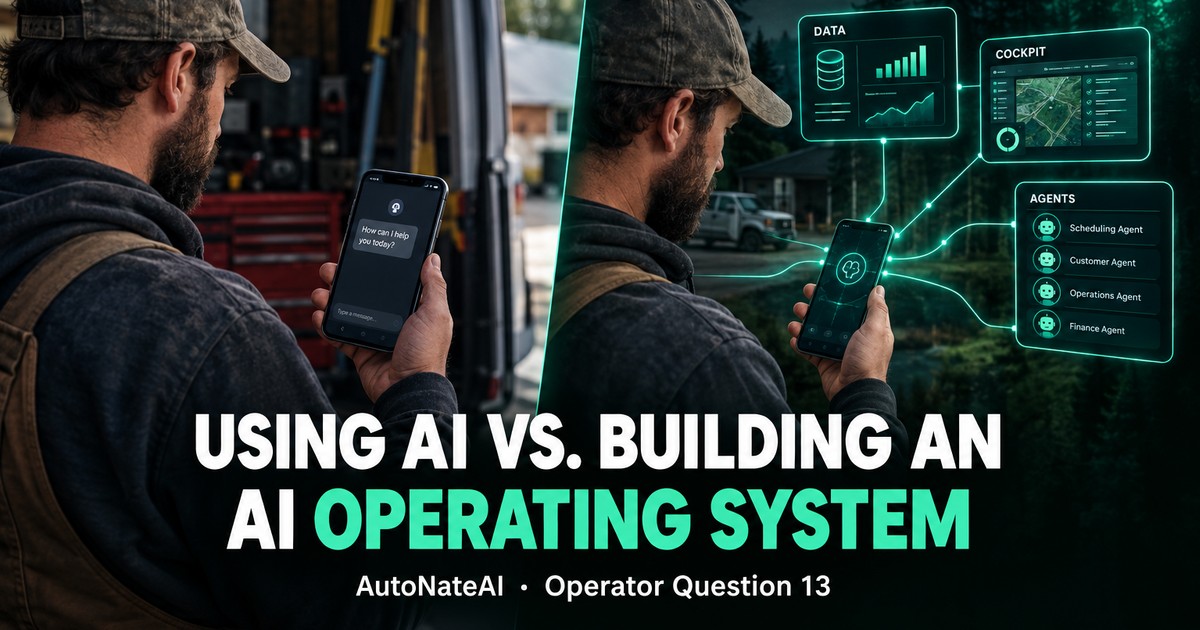
58% of small businesses use AI, but the research says results follow workflow redesign, not adoption. The test: is your business more organized after you close the tab?
Short Answer
Using AI means consulting a smart tool. You open ChatGPT, ask something, copy the answer somewhere, and close the tab. Building an AI operating system means the AI lives inside the business. It has a memory of your customers and commitments, it's wired into your workflows, it acts through agents, and it shows its work in a cockpit you can check. Most small businesses have already done the first: the U.S. Chamber of Commerce found 58% used generative AI in 2025, up from 23% two years earlier. The research on who actually gets results points somewhere else. McKinsey's 2025 global survey found that redesigning workflows has the biggest effect on whether AI shows up in the bottom line, yet only about 1 in 5 organizations using it had redesigned any. Using AI makes tasks faster. An operating system changes how the business runs.
Two Owners Who Both "Use AI"
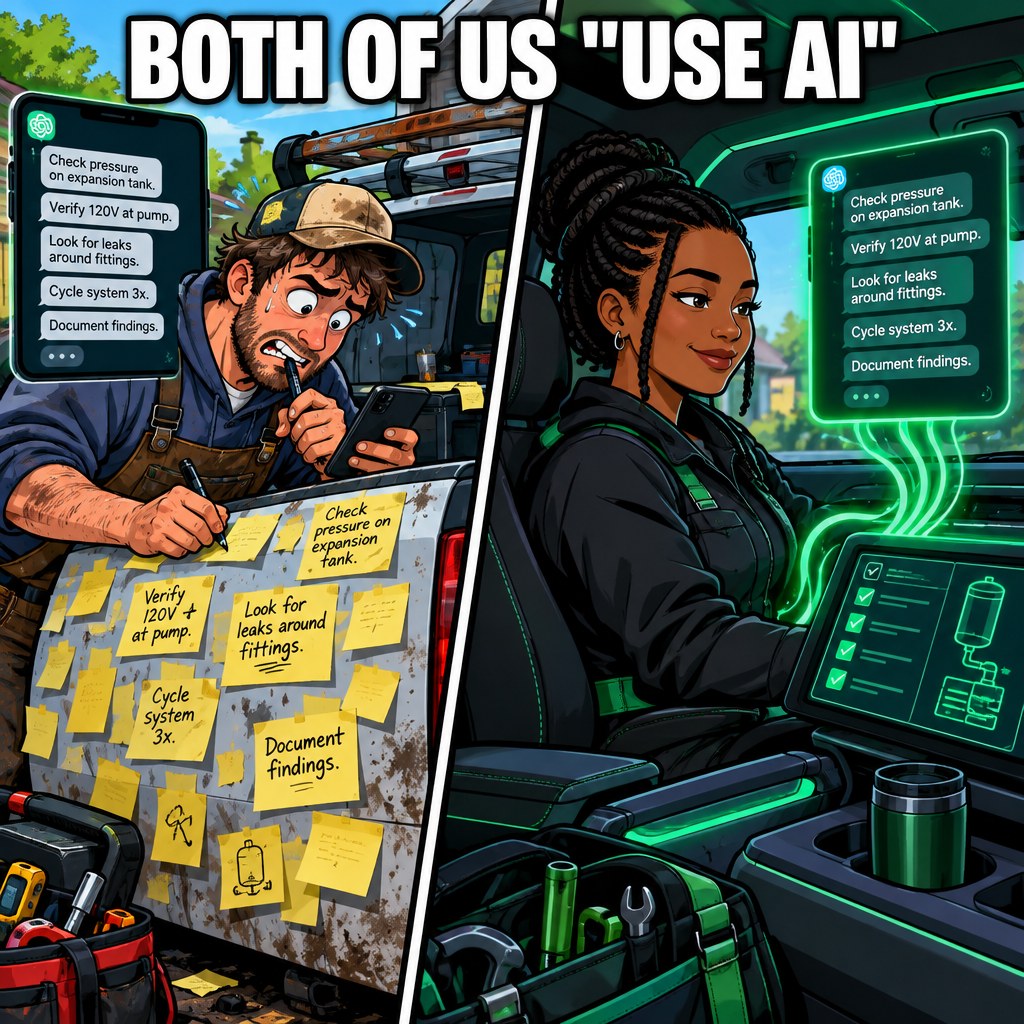
Owner A runs a four-truck plumbing company. He uses ChatGPT almost every day. It writes his Facebook posts, cleans up his estimate descriptions, drafted his employee handbook, and once talked him through a tough conversation with a customer. It's genuinely useful. He'd tell you he "uses AI a lot."
But every conversation starts from zero. It doesn't know his customers, his open estimates, his goals, or what happened yesterday. Whatever it produces, he copies and pastes somewhere else. When he closes the tab, the business is exactly as organized, or disorganized, as it was before.
Owner B runs a similar company. She also talks to ChatGPT every day, but her conversations write to her business. "Log the Martinez callback, water heater, wants a quote Friday" creates the person, the job, and the task. Her follow-up agent drafts messages she approves. Her cockpit shows every open estimate by age. Her nightly reflection rewrites tomorrow's plan. When she closes the tab, the business is more organized than before.
Both are "using AI." Only one has an operating system.
Adoption Isn't the Problem Anymore
Small businesses adopted generative AI faster than almost any business technology in memory:
Where small businesses apply technology is telling, too. In the Chamber's data the leading areas are marketing and promotion (46%), payroll (44%), and customer relationship management (42%). Most of the AI usage owners describe to me is Owner A territory: faster content, better writing, quicker answers. Real value, but it's task-level value.
Where the Results Actually Come From
The bigger companies have been at this longer, and their results are a warning.
McKinsey's State of AI (2025) surveyed organizations worldwide and found that redesigning workflows had the single biggest effect on whether generative AI produced measurable EBIT impact. Yet only about 21% of organizations using gen AI had redesigned even some of their workflows. Only about 6% qualified as "AI high performers," attributing 5% or more of EBIT to AI. Among those high performers, 55% fundamentally reworked workflows when deploying AI.
MIT's NANDA initiative published "The GenAI Divide" (July 2025), which became famous for one number: roughly 95% of enterprise generative-AI pilots it examined showed no measurable P&L impact. It deserves a big caveat. It's an industry report, not peer-reviewed research, built on about 300 public initiatives, 52 interviews, and 153 survey responses, and critics have questioned its methods. But its core finding matches McKinsey's: widespread experimentation without transformation.
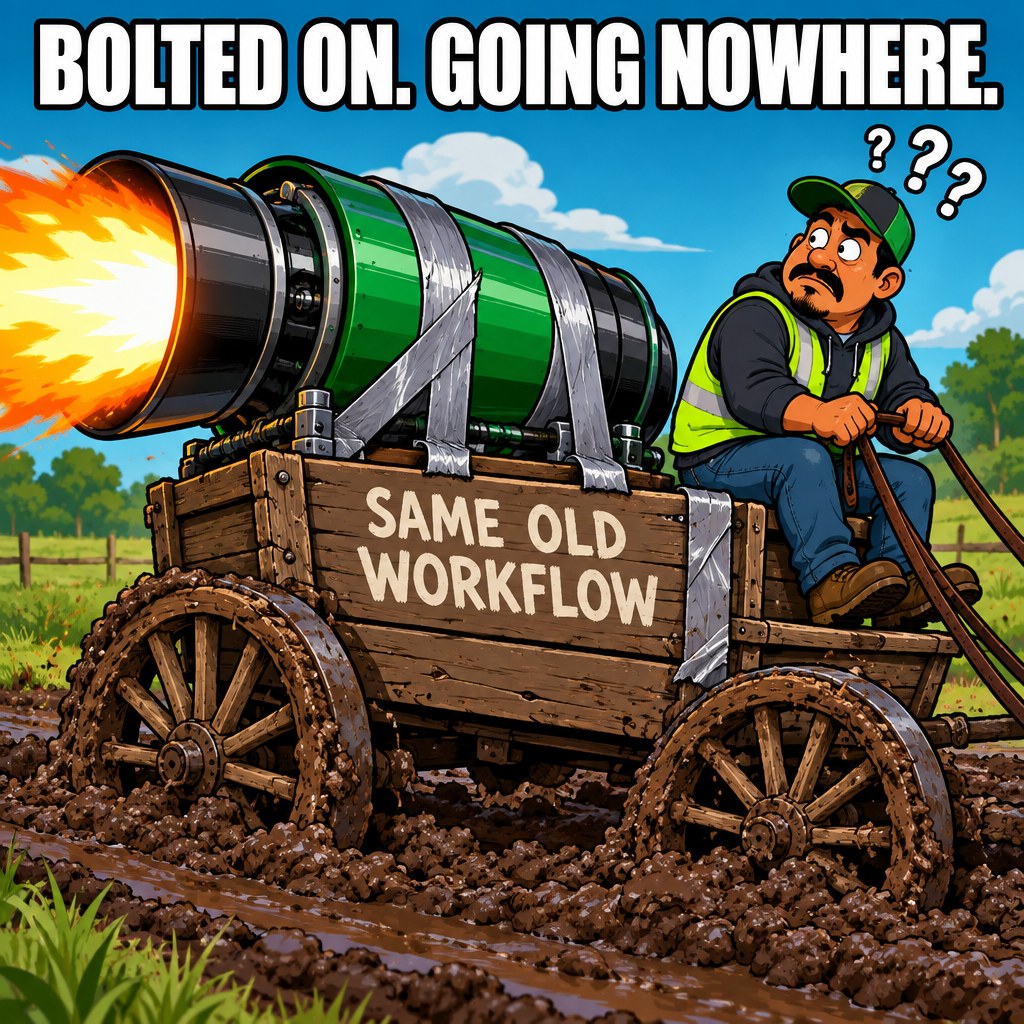
The lesson isn't "AI doesn't work." It's that bolting AI onto an unchanged workflow produces faster versions of the same work. The results show up when the work itself is redesigned around what AI can now do.
Side by Side
Here's the difference in concrete terms:
| Using AI | An AI operating system | |
|---|---|---|
| Memory | Starts from zero each conversation | Remembers every person, job, promise, and outcome |
| Input | You paste context in | Conversations write directly to structured business memory |
| Output | Text you copy somewhere else | Records created, tasks scheduled, messages drafted in place |
| Who integrates | You, by hand | The system; your tools share one memory |
| Workflow | Unchanged, just faster in spots | Redesigned: follow-up, prospecting, and planning run through it |
| Visibility | Scrollback | A live cockpit showing state and everything agents did |
| Compounding | None; every day is day one | Gets smarter with history (win/loss reasons, partner yield) |
| Your role | Operator and integrator | Operator: judgment, relationships, approvals |
The Layers of an Operating System
This is what "building" actually involves. It's what AutoNateAI runs on and what we install:
open_with Drag nodes to rearrange, tap one for the evidence behind it — pinch or scroll to zoom.
Notice where the owner sits: at the top, talking, and at the cockpit, looking. The layers in between are where most "AI adoption" never reaches, and where the research says the value is.
Where Are You on the Ladder?
A quick self-assessment. Most owners reading this are at Level 1 or 2:
| Level | What it looks like |
|---|---|
| 0: Not using AI | Everything is manual |
| 1: Assistant | You use ChatGPT for writing, answers, and ideas. Nothing connects to the business. |
| 2: Assistant with context | You paste in customer notes and spreadsheets to get better answers, by hand, every time |
| 3: Connected tools | Some apps have AI features, each with its own partial memory |
| 4: Operating system | Conversation writes to one memory; workflows, agents, and a cockpit run on it |
| 5: Learning system | Outcomes feed back in; recommendations improve with every closed or lost job |
Going from Level 1 to Level 4 isn't about a better prompt or a smarter model. It's architecture: the memory, the workflows, and the interface. That's also why it's hard to do yourself. It takes an engineer's and an architect's mindset, which is exactly what most operators don't have time to develop, and shouldn't have to.

Run Your Own Numbers
Two questions reveal which side of the divide you're on:
- Close ChatGPT right now. Is your business any more organized than when you opened it? If the honest answer is "no, but I got some good writing," you're using AI.
- If you stopped using AI tomorrow, what breaks? If the answer is "nothing, I'd just be a bit slower," AI isn't part of how your business operates yet. It's a productivity tool sitting beside it.
Neither answer is bad. Level 1 is real value. But it's worth knowing that the ceiling on Level 1 is "somewhat faster," while the research points to Level 4 as the place where AI starts showing up in the P&L.

What the Research Doesn't Tell Us
McKinsey's and MIT NANDA's findings come from large organizations, and MIT NANDA's report isn't peer-reviewed. The Chamber's adoption numbers are self-reported by small businesses. There's no public study yet measuring the return of AI operating systems specifically for small service businesses. The ladder is our framework, not an industry standard. The consistent thread across the research is that value follows workflow redesign, not tool adoption. That's the premise this whole series is built on.
Moral of the Story
- Keep using AI the way you do. Level 1 is valuable, so don't stop.
- Pick one workflow to redesign, not one tool to add. For most service businesses the best first candidate is estimate follow-up (see Q10). Ask: what would this look like if the AI remembered everything and I only approved?
- Give your AI a memory before you give it more tasks. A structured record of customers, jobs, and goals is the foundation everything else stands on.
- Judge AI by what's still organized after you close the tab. That's the difference between a tool and a system.
- Ready to go from using AI to operating with it? Book a discovery call. We'll show you a live Level 4 system, ours, then map what yours would take.
Sources
- U.S. Chamber of Commerce — Empowering Small Business: The Impact of Technology on U.S. Small Business (2025)
- U.S. Chamber of Commerce — Empowering Small Business report PDF (2025)
- McKinsey — The State of AI (2025)
- MIT NANDA — The GenAI Divide: State of AI in Business 2025, via Virtualization Review coverage
Book a 20–30 minute discovery call.
We'll show you a live Operator OS cockpit and tell you straight whether it fits.
Related questions
 Published
Why Does Adding Another CRM Often Increase the Owner's Cognitive Load?
A CRM stores information. It doesn't carry it. Add one more tool that doesn't share memory and you've added pairs to reconcile, and the owner is still the integration layer.
 Published
What Should Happen Automatically After a New Prospect Enters Your Business?
Six things should happen automatically in the first 48 hours: capture, recognize, acknowledge, research, route, follow up. In most shops the owner does all six by hand, hours late.
 Published
Can a 5-Person Company Operate With the Information Discipline of a 50-Person Company?
Big companies pay whole teams to keep information straight. Small ones pay with the owner's evenings. AI finally makes the clerical half of that discipline affordable.