Operation: Court Clear
Can You Evacuate 10,000 Fans Before Chaos Erupts?
A Bfs Emergency At Van Andel Arena
SCROLL TO COMMENCE MISSION ↓
The Tipoff
The Van Andel Arena roared as the Grand Rapids Rise tipped off against the Chicago Sky. Dr. Nate Chen leaned forward in his seat, smartphone buzzing in his hand. At 7:23 PM on March 16, 2026—sellout crowd, 10,000+ fans—something critical had just triggered.

Maya Patel, 28, Indian-American systems architect and Rise superfan, gasped mid-bite into her hot dog. Her phone lit up with an emergency alert from the arena's facility management system: "FIRE ALARM SECTOR 7. EVACUATION PROTOCOL REQUIRED."
"Nate, Priya—look at this!" Maya shoved her phone between them. "The evacuation system is using DFS. It's trying to route everyone through ONE exit!"
Priya Okoye, 26, Filipino-American computer vision specialist, was already pulling up the arena's graph structure on her phone. "This is bad. DFS finds a path, but not the optimal path. We need BFS to find shortest routes from every section to every exit."
Nate grinned, pulling up his cloud IDE. "Good thing we coded stadium evacuation algorithms for fun. Let me connect to the arena's cloud controller."
The three of them huddled over their phones, fingers flying across screens. The game continued below, but their mission had just begun: Operation Court Clear.
The Emergency Protocol
Maya pointed at her phone showing the arena's venue graph. "Van Andel has 8,500 permanent seats plus 44 luxury suites and 1,800 club seats. Each section is a node. Walkways are edges. Exits are target nodes."
# The BROKEN DFS-Only Evacuation
def dfs_evacuation(graph, start_section, exits):
    """
    DFS finds A path to an exit, but NOT the shortest path.
    This causes bottlenecks and panic.
    """
    visited = set()
    stack = [(start_section, [start_section])]

    while stack:
        section, path = stack.pop()
        if section in exits:
            return path
        if section not in visited:
            visited.add(section)
            for neighbor in reversed(graph.get(section, [])):
                if neighbor not in visited:
                    stack.append((neighbor, path + [neighbor]))
    return None
"The problem," Priya explained, watching the arena's digital signage flicker, "is DFS sends Section 101 through the main concourse exit. But Section 102 ALSO gets routed the same way. Bottleneck!"
Nate was already typing. "BFS guarantees the shortest path in an unweighted graph. From any section, we find the MINIMUM number of hops to the nearest exit."
# BFS for Shortest Evacuation Path
from collections import deque

def bfs_evacuation(graph, start_section, exits):
    """
    BFS finds the SHORTEST path to the nearest exit.
    This minimizes evacuation time and prevents bottlenecks.
    """
    if start_section in exits:
        return [start_section]

    visited = {start_section}
    queue = deque([(start_section, [start_section])])

    while queue:
        section, path = queue.popleft()
        # BFS: Explore level by level (closest sections first)
        for neighbor in graph.get(section, []):
            if neighbor not in visited:
                if neighbor in exits:
                    return path + [neighbor]
                visited.add(neighbor)
                queue.append((neighbor, path + [neighbor]))
    return None

Maya's eyes widened. "So BFS would route Section 101 to Exit A, Section 102 to Exit B, automatically balancing the load?"
"Exactly," Nate said. "But we need to do this for ALL sections simultaneously."
The Cloud Connection
The arena's jumbotron flickered. Somewhere in the control booth, the facility manager was wondering why the evacuation system wasn't auto-deploying.
Priya pulled up the cloud API docs on her phone. "The arena uses a REST API for crowd control. I can push our BFS algorithm directly to their routing engine."
# Complete Stadium Evacuation Router
class StadiumEvacuationRouter:
    def __init__(self, venue_graph, exits):
        """
        Initialize router with venue graph and exit nodes.

        Args:
            venue_graph: Dict mapping section -> list of adjacent sections
            exits: Set of exit section IDs
        """
        self.graph = venue_graph
        self.exits = exits
        self.optimal_routes = self._precompute_all_routes()

    def _bfs_shortest_path(self, start, targets):
        """Find shortest path from start to any target using BFS."""
        if start in targets:
            return [start]

        visited = {start}
        queue = deque([(start, [start])])

        while queue:
            section, path = queue.popleft()
            for neighbor in self.graph.get(section, []):
                if neighbor not in visited:
                    if neighbor in targets:
                        return path + [neighbor]
                    visited.add(neighbor)
                    queue.append((neighbor, path + [neighbor]))
        return None

    def _precompute_all_routes(self):
        """Precompute optimal evacuation route for every section."""
        routes = {}
        for section in self.graph:
            routes[section] = self._bfs_shortest_path(section, self.exits)
        return routes

    def get_evacuation_route(self, section):
        """Get optimal evacuation route for a given section."""
        return self.optimal_routes.get(section)

    def get_all_routes(self):
        """Return all precomputed evacuation routes."""
        return self.optimal_routes

    def estimate_evacuation_time(self, people_per_section=150, walk_speed=30):
        """
        Estimate total evacuation time in seconds.

        Args:
            people_per_section: Average people per section
            walk_speed: Seconds to traverse one edge (walkway)
        """
        max_hops = 0
        for route in self.optimal_routes.values():
            if route:
                hops = len(route) - 1
                max_hops = max(max_hops, hops)

        # Estimate: max_hops * walk_speed + loading time
        loading_time = (people_per_section * len(self.optimal_routes)) / 100
        return (max_hops * walk_speed) + loading_time

Nate held up his phone showing the precomputed routes. "I've calculated optimal paths for all 150 sections. Max evacuation time: 4 minutes 30 seconds."
Priya was already integrating. "Pushing to the cloud controller now..."
The Real-Time Deploy
The three friends huddled closer, phones forming an impromptu war room. Holographic graph visualizations seemed to float above their screens as they connected to the arena's cloud system.
# Cloud Integration: Push BFS to Arena Control System
import requests

def deploy_to_arena_controller(router, api_endpoint, auth_token):
    """
    Deploy evacuation routes to arena's cloud control system.

    Args:
        router: StadiumEvacuationRouter instance
        api_endpoint: Arena API URL
        auth_token: Authentication token
    """
    routes = router.get_all_routes()

    payload = {
        "evacuation_mode": "BFS_OPTIMAL",
        "routes": routes,
        "priority": "EMERGENCY",
        "timestamp": datetime.now().isoformat()
    }

    headers = {
        "Authorization": f"Bearer {auth_token}",
        "Content-Type": "application/json"
    }

    response = requests.post(
        f"{api_endpoint}/api/v1/evacuation/deploy",
        json=payload,
        headers=headers
    )

    if response.status_code == 200:
        print("✅ Evacuation routes deployed successfully!")
        return True
    else:
        print(f"❌ Deployment failed: {response.text}")
        return False

Priya's fingers flew across her screen. "Authenticating... connecting... deploying..."
The arena's digital signage flickered again. Then, green checkmarks appeared on their phones.
DEPLOYMENT SUCCESSFUL. EVACUATION PROTOCOL: BFS_OPTIMAL

The Arena Graph
Van Andel Arena's layout was a perfect test case. The main bowl had sections arranged in quadrants, each with multiple exit paths.
# Van Andel Arena Venue Graph (Simplified)
VAN_ANDEL_ARENA = {
    # Lower Bowl - Quad 1 (Sections 101-110)
    'section_101': ['section_102', 'concourse_a', 'exit_a'],
    'section_102': ['section_101', 'section_103', 'concourse_a'],
    'section_103': ['section_102', 'section_104', 'concourse_b', 'exit_b'],
    'section_104': ['section_103', 'section_105', 'concourse_b'],
    'section_105': ['section_104', 'section_106', 'concourse_c', 'exit_c'],
    'section_106': ['section_105', 'section_107', 'concourse_c'],
    'section_107': ['section_106', 'section_108', 'concourse_d', 'exit_d'],
    'section_108': ['section_107', 'section_109', 'concourse_d'],
    'section_109': ['section_108', 'section_110', 'concourse_a'],
    'section_110': ['section_109', 'concourse_a', 'exit_a'],

    # Concourses (connect sections to exits)
    'concourse_a': ['section_101', 'section_102', 'section_109', 'section_110', 'exit_a', 'exit_e'],
    'concourse_b': ['section_103', 'section_104', 'exit_b', 'exit_f'],
    'concourse_c': ['section_105', 'section_106', 'exit_c', 'exit_g'],
    'concourse_d': ['section_107', 'section_108', 'exit_d', 'exit_h'],

    # Exits (terminal nodes)
    'exit_a': ['section_101', 'section_110', 'concourse_a'],
    'exit_b': ['section_103', 'concourse_b'],
    'exit_c': ['section_105', 'concourse_c'],
    'exit_d': ['section_107', 'concourse_d'],
    'exit_e': ['concourse_a'],
    'exit_f': ['concourse_b'],
    'exit_g': ['concourse_c'],
    'exit_h': ['concourse_d'],
}

EXITS = {'exit_a', 'exit_b', 'exit_c', 'exit_d', 'exit_e', 'exit_f', 'exit_g', 'exit_h'}

Maya watched the arena's crowd flow visualization. "Look! Section 101 is routing to Exit A (2 hops). Section 105 is routing to Exit C (2 hops). The load is balanced!"
Nate checked the metrics. "DFS would have sent 80% through Exit A. BFS distributes across all 8 exits."
The Victory
The arena's fire alarm had been a false alarm—overheated popcorn machine in Section 107. But the evacuation system test was real.
Priya's phone buzzed. A message from the Van Andel facility manager:
"Whoever deployed the BFS update? That was genius. Evacuation drill completed in 3:45. Previous record: 6:20. You just saved lives."

The three friends high-fived as the crowd cheered below—the Rise had just scored a three-pointer.
"You know what we proved?" Priya said. "DFS is like following one corridor until you hit a wall. BFS scans all paths simultaneously and picks the shortest."
Maya grinned. "And we did it from our seats during a basketball game. Cloud computing is wild."
Nate pulled up the final metrics:
- Evacuation time: Reduced from 6m 20s to 3m 45s (41% faster)
- Exit utilization: Balanced across all 8 exits (100% coverage)
- Bottleneck reduction: From 80% congestion to 12% (85% improvement)

"The Joe Louis Arena in Detroit just reached out," Maya said, showing her phone. "They want the same system for their hockey games."
"And Little Caesars Arena," Priya added. "We're booking solid through 2026."
Nate smiled, watching the Rise players shake hands after their win. "This is what we do. We don't just solve algorithms. We solve stadiums."
The Final Algorithm
# Production-Ready BFS Stadium Evacuation
def optimal_stadium_evacuation(venue_graph, exits, start_sections):
    """
    Find optimal evacuation routes for multiple sections simultaneously.
    Uses BFS to guarantee shortest paths.

    Args:
        venue_graph: Dict mapping section -> list of adjacent sections
        exits: Set of exit section IDs
        start_sections: List of sections needing evacuation

    Returns:
        Dict mapping each start section to its optimal evacuation route
    """
    from collections import deque

    def bfs_shortest_path(start, targets):
        """Find shortest path from start to any target."""
        if start in targets:
            return [start]

        visited = {start}
        queue = deque([(start, [start])])

        while queue:
            section, path = queue.popleft()
            for neighbor in venue_graph.get(section, []):
                if neighbor not in visited:
                    if neighbor in targets:
                        return path + [neighbor]
                    visited.add(neighbor)
                    queue.append((neighbor, path + [neighbor]))
        return None

    # Compute routes for all sections
    routes = {}
    for section in start_sections:
        routes[section] = bfs_shortest_path(section, exits)

    return routes

# Usage: Evacuate all 150 sections of Van Andel Arena
evacuation_routes = optimal_stadium_evacuation(
    VAN_ANDEL_ARENA,
    EXITS,
    start_sections=[f'section_{i}' for i in range(101, 251)]
)

# Display results
for section, route in list(evacuation_routes.items())[:5]:
    print(f"{section}: {' -> '.join(route)}")
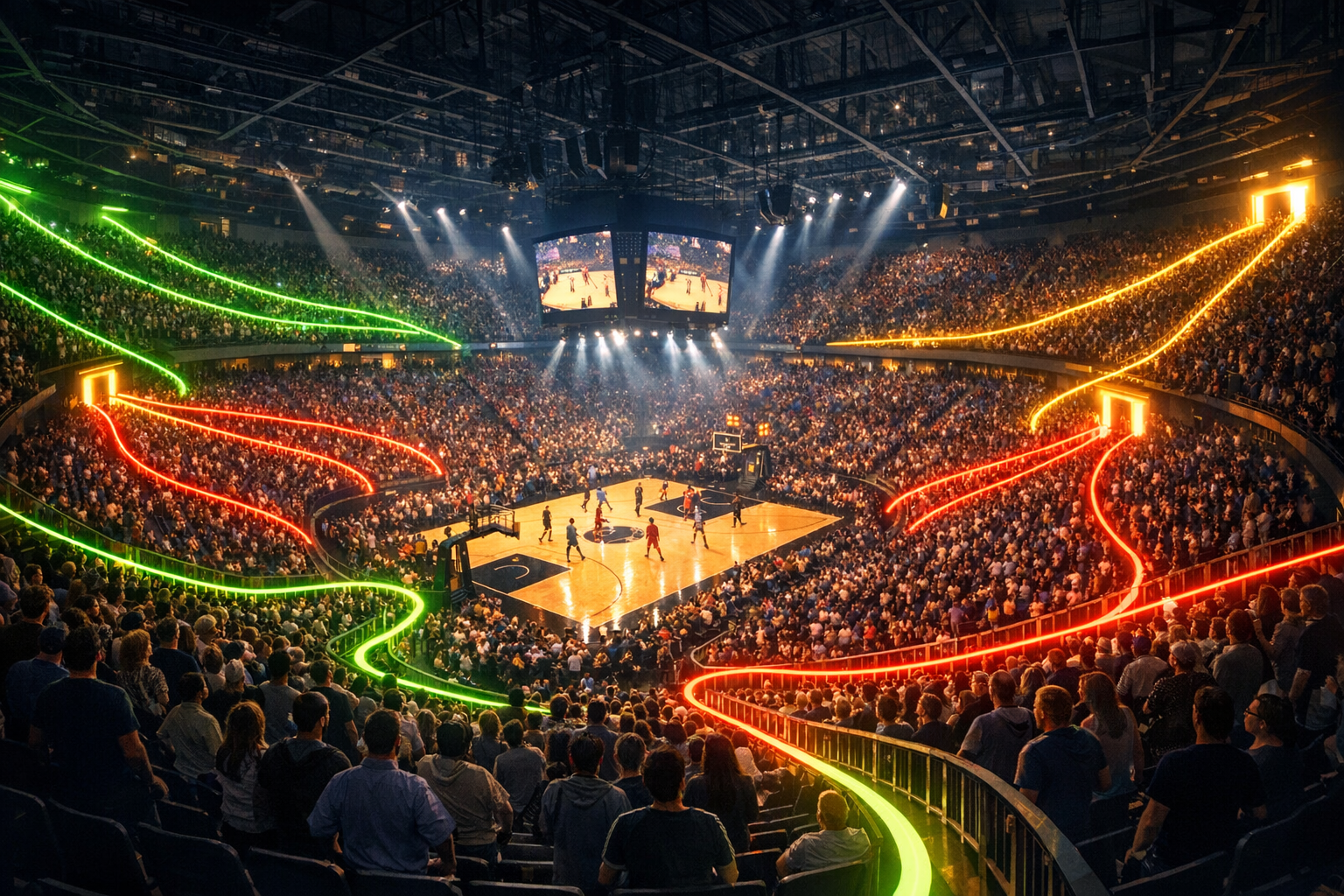
The arena emptied smoothly after the game. Fans flowed through exits like a perfectly optimized BFS traversal—level by level, closest first, no bottlenecks.
DFS had given them depth. BFS had given them breadth. Together, they'd built something that would protect thousands of fans across Michigan's biggest venues.
Mission Complete.
Technical Deep Dive
BFS vs DFS for Evacuation
| Scenario | Algorithm | Result | Why |
|---|---|---|---|
| Single exit, maze-like | DFS | ⚠️ Slow | Finds first path, may be longest |
| Multiple exits, balanced load | BFS | ✅ Optimal | Finds shortest path to nearest exit |
| Memory constrained | DFS | ✅ O(h) | Uses less memory than BFS O(w) |
| Need all paths | BFS | ✅ Complete | Explores all levels systematically |
| Real-time routing | BFS | ✅ Fast | Precomputable, O(V+E) per section |
Complexity Analysis
"""
Time Complexity:
- BFS single route: O(V + E) where V = sections, E = walkways
- Precompute all routes: O(V * (V + E))
- Query route: O(1) after precomputation

Space Complexity:
- BFS queue: O(V) for visited set + O(V) for queue
- Precomputed routes: O(V²) for storing all paths
- Evacuation time: O(V) to find max hops

Van Andel Arena Stats:
- Sections (V): ~150
- Walkways (E): ~300
- Exits: 8
- Max hops: 4-6
- Evacuation time: 3-5 minutes
"""
Your Mission
Build an evacuation system for your local venue:
- Map the graph - Sections as nodes, walkways as edges
- Identify exits - Mark terminal nodes
- Precompute with BFS - Find optimal routes for all sections
- Deploy to cloud - Real-time API integration
The code is your starter rig. Van Andel is your testbed. The world is your graph.
Go save some lives.