Missouri Rice Is Harvested. Should Bootheel Farmers Sell Now or Finance Time?
With Missouri's 2026 rough-rice Marketing Assistance Loan rate set at $7.70/cwt and Dunklin County cash bids reported in the low-$6/bushel range, how much basis improvement — and by when — is actually required for storage or MAL-supported financing to beat a harvest-time sale once financing interest, storage, shrink and quality risk are counted?

Short Answer
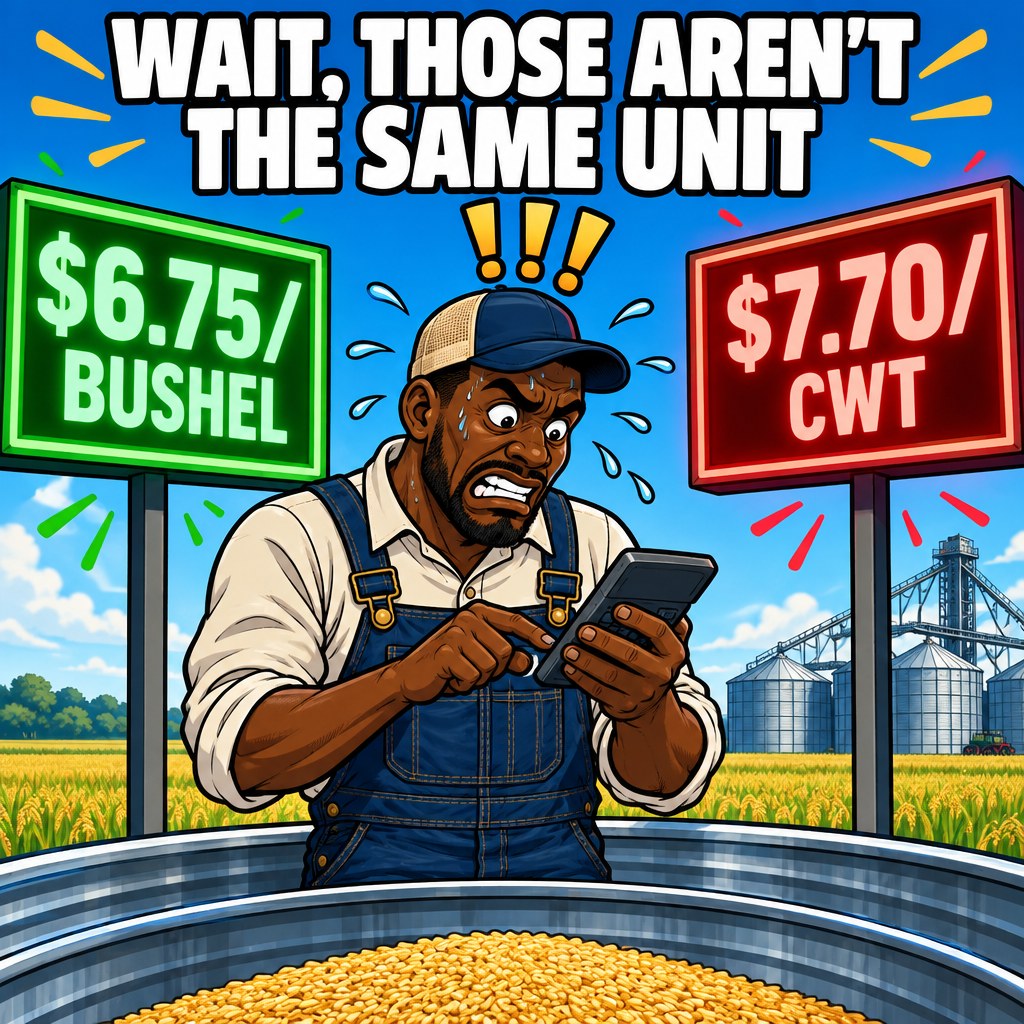
I went into this expecting a basis story and came out with a units story. Dunklin County rice farmer and Missouri Rice Council chair Rance Daniels told Brownfield Ag News he's only moved about 20% of his crop, at cash prices in the "low sixes," and that he'd feel comfortable selling more around $6.75. Quoted that way, next to USDA's $7.70-per-hundredweight loan rate, it reads like his cash price is below the government's floor. It isn't — he's quoting dollars per bushel, the loan rate is dollars per hundredweight, and once you convert those onto the same footing, his price is already running *above* the loan rate, not below it. That changes what this decision actually is. It's still investigating, not answered, because the number that would actually settle it — a real Bootheel mill bid and a real local storage cost — isn't published anywhere I can find. But I can tell you exactly what waiting costs in financing terms, and it's a lot cheaper than the basis gap Daniels is holding out for.
Why This Decision Even Has This Shape
The reason a Bootheel farmer in 2026 can choose to *not* sell at harvest — can put rice in a bin and wait for a better number instead of dumping the whole crop into whatever the market offers in September — traces back to a very specific piece of Depression-era plumbing. President Franklin Roosevelt created the Commodity Credit Corporation by executive order in October 1933, with a mandate to make low-interest loans against stored crops so farmers weren't forced to sell everything at once into a collapsed harvest-time market. The loans were structured as nonrecourse: a farmer could put up the stored grain as collateral, take the cash, and if the market price never recovered above the loan rate, simply forfeit the grain to the government instead of repaying — no penalty, no debt follows them. That mechanism, reauthorized farm bill after farm bill, is the direct ancestor of the Marketing Assistance Loan Rance Daniels could take out on his 2026 crop right now. Ninety-plus years later, the problem it solves hasn't changed: harvest floods the market with grain at exactly the moment prices are weakest, and someone has to be able to afford to wait. (EBSCO Research Starters — Roosevelt Creates the Commodity Credit Corporation; farmdoc daily — Historical Background on Marketing Assistance Loans)
How This Connects
open_with Drag nodes to rearrange, tap one for the evidence behind it — pinch or scroll to zoom.
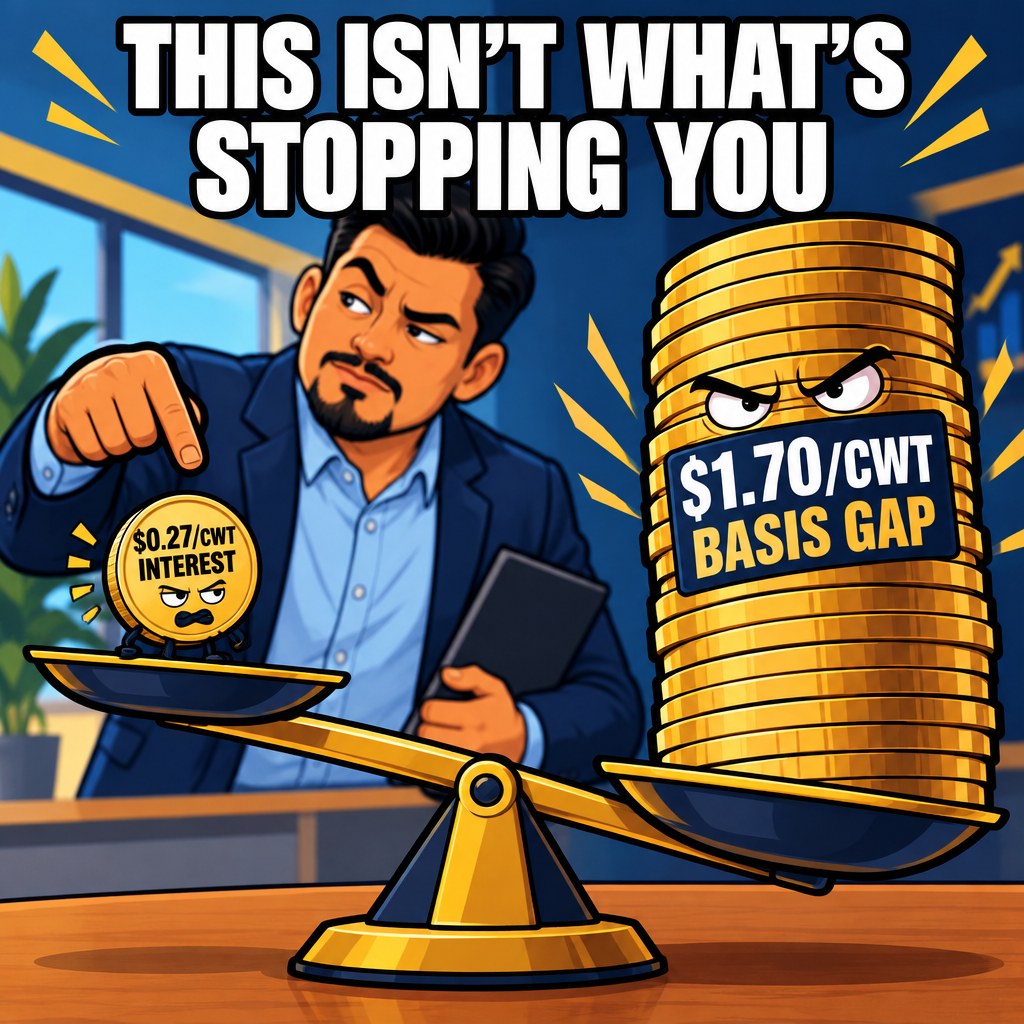
Six months of financing interest on the loan alone is real money, but it's not the thing standing between Daniels and a sale. The gap between his current price and his comfort price is roughly six times larger than the interest cost of waiting for it. That's the actual finding here: the Marketing Assistance Loan isn't functioning as a price floor this year — cash is trading well above it — it's functioning as cheap time. The real bet a Bootheel rice grower is making right now isn't "can I afford to wait," it's "will the basis actually narrow before I run out of reasons to keep waiting."
Two Government Rice Numbers That Are Not the Same Number
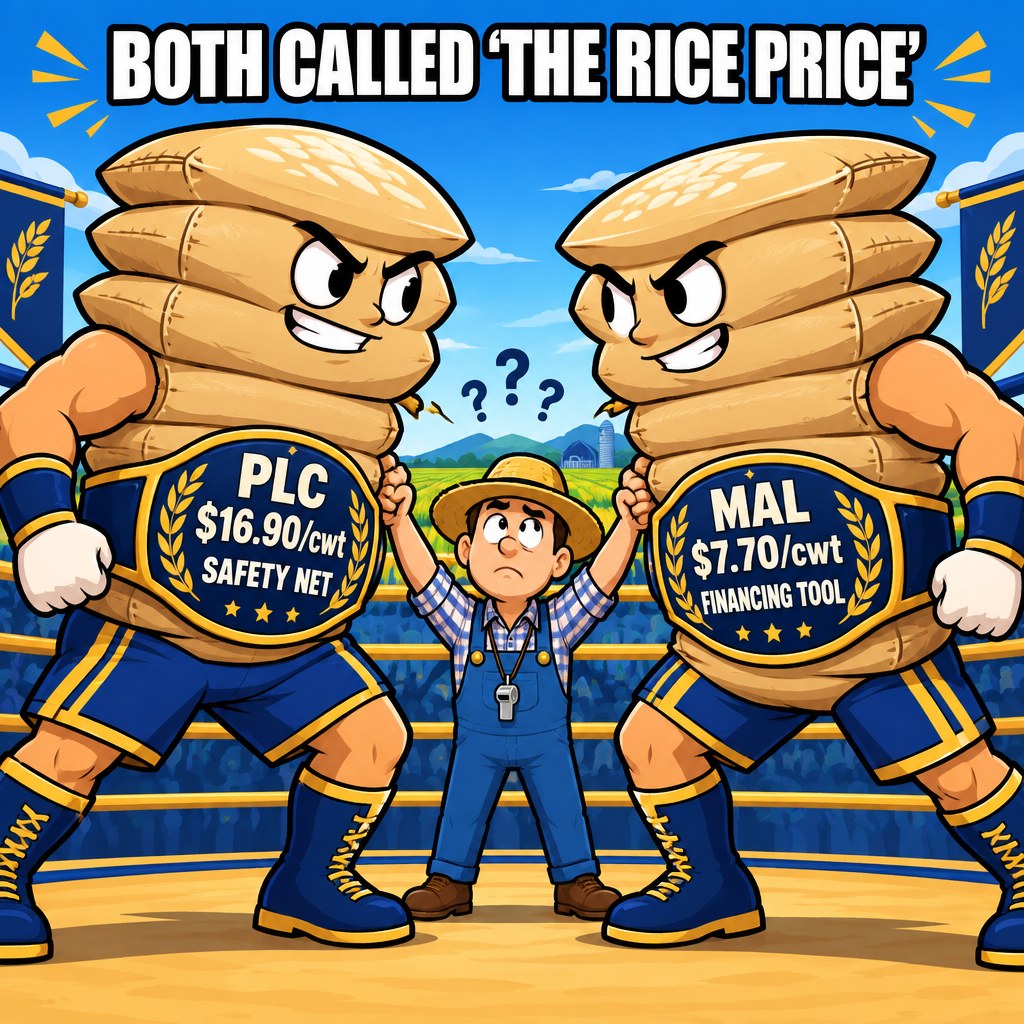
This is the part worth being explicit about, because it's an easy thing to blur if you're not looking closely. In the same 2026 season, USDA has published two very different "rice numbers" that both get called "the government's rice price" in casual conversation, and they do completely different jobs:
- The Price Loss Coverage (PLC) reference price, raised 20.7% to $16.90/cwt by the One Big Beautiful Bill Act (enacted July 2025), is a *safety-net trigger* — it determines whether growers get a payment at the end of the marketing year if the season-average price falls short, and it has nothing to do with what a mill will pay a farmer in September. (See our companion piece on the Bootheel rice-to-soybean pivot for the full policy picture there.)
- The Marketing Assistance Loan rate, set at $7.70/cwt for Missouri's 2026 rough rice, is a *financing tool* — a nonrecourse loan a grower can take against stored grain, repay with interest if the price comes back, or forfeit the grain against if it doesn't. It's not a forecast, a target, or a recommendation. (USDA FSA — 2026 Marketing Assistance Loan Rates for Wheat, Feed Grains, Oilseeds and Rice)
Neither of those two numbers is "what rice is worth" — and neither one is what's actually driving Daniels' decision. What's driving it is a third, much more local number nobody publishes: the mill bid in front of him today, and whether it's closer to $6.00 or $6.75.
The Numbers So Far
That third bar landing almost exactly on USDA's own $14.90/cwt national forecast isn't something I engineered — it fell out of the unit conversion. It's also consistent with a separate, independent data point from the same week: the Arkansas Farm Bureau's September 18, 2026 market brief put Mid-South rice basis at "near $1/cwt under the board" against November futures pushing toward $16/cwt — which nets out to almost exactly the same $15/cwt Daniels is holding out for. Two unrelated sources, one Missouri farmer quote and one regional futures-and-basis report, converge on the same number from different directions. That's about as close to triangulated as public data gets you on a figure nobody publishes directly for the Bootheel. (Arkansas Farm Bureau — Market Briefs, September 18, 2026)
National marketing, storage, and transportation expense is up 12% year over year — a real signal that the general cost of holding grain is climbing, even without a Bootheel-specific number to attach it to. Production expenses overall are forecast at $492.8 billion for 2026, up 4.5%, against a farm sector debt load USDA now puts at $605.1 billion, up 4.6%. Net farm income is projected down 5.5% after inflation. None of that tells Rance Daniels what to do with this year's rice. All of it says the room for error on a bad carry decision is smaller than it was a couple of years ago. (USDA ERS — Farm Sector Income Forecast)
Where This Is Happening
On the Record, Right Now
The most useful sentence in this whole investigation isn't a USDA figure — it's Daniels describing the mechanism in his own words: "the futures had outrun the mill market price," which is exactly why basis went wide, and why it's since narrowed "some." That's a working rice farmer, in real time, diagnosing a basis move the way a trader would — futures ran ahead of what mills were actually willing to pay for physical grain, and the gap between those two things is the entire decision. It's also, notably, not a story about the water table, drought, or anything happening in the field. This year's rice-marketing decision in the Bootheel is a pure financial-markets story wearing a harvest costume. (Brownfield Ag News — Missouri rice farmer holds off on sales as basis remains wide)

Methodology
This round pulled from USDA FSA's official 2026 Marketing Assistance Loan rate announcement and September 2026 lending-rate announcement, USDA ERS's farm sector income and production-expense forecast, USDA's rice season-average price forecast as reported by agricultural trade press, Brownfield Ag News' direct interview with Rance Daniels, the Arkansas Farm Bureau's weekly market brief, the Missouri Rice Council's own organizational page, and University of Arkansas Extension's rice moisture/weight standards (used only for the bushel-to-hundredweight conversion, not as a Missouri-specific figure). It does not include an actual current Bootheel mill bid sheet, a documented local storage/drying rate, a forward basis curve by month, or a direct interview beyond the one Brownfield already published — those four gaps are exactly what the dossier flagged as missing going in, and they're still missing coming out. The bushel-to-cwt price conversion is this piece's own calculation from a published weight standard, not an officially reported figure for Daniels' operation specifically, and is labeled that way everywhere it appears above.

Moral of the Story
If you're waiting on rice because the price feels wrong, check whether you're actually comparing it to the right number in the right units first — Daniels' own math shows that mistake alone can make a fair price look like a bad one.

A few concrete moves that fall out of that:
- If you grow rice and you're holding for basis, the financing cost of waiting through the MAL's full window — call your local FSA office and confirm your county's exact rate, since it moves monthly — is a real but genuinely small number next to a basis gap this wide. Don't let "I can't afford to wait" talk you out of a position when the actual math says you can afford it for cheap; the harder, honest question is whether the basis gap is actually going to close before next year's crop forces the decision again.
- If you're a lender, the useful renewal-season question isn't "did you sell yet" — it's "what mill bid, in what units, are you actually comparing your MAL rate against," because this piece found that confusion sitting right out in a farmer's own public quote. A borrower doing that math wrong in either direction is a borrower making the wrong call on when to release collateral.
- If you're USA Rice, the Missouri Rice Council, or a county Extension office, the single highest-leverage thing you could publish this fall is a plain-language, weekly, Bootheel-specific mill bid and basis number in both $/bu and $/cwt side by side. Nothing else in this piece required original data collection — that one number did, and its absence is the entire reason this stays "investigating."
- If you're a mill or elevator operator, Daniels' own account — that basis widened because futures outran the mill market, then narrowed "some" — is a real-time signal worth tracking against your own book. If growers across the region are reading basis the same way he is, storage utilization this fall is a leading indicator worth watching before county acreage data ever catches up to it.
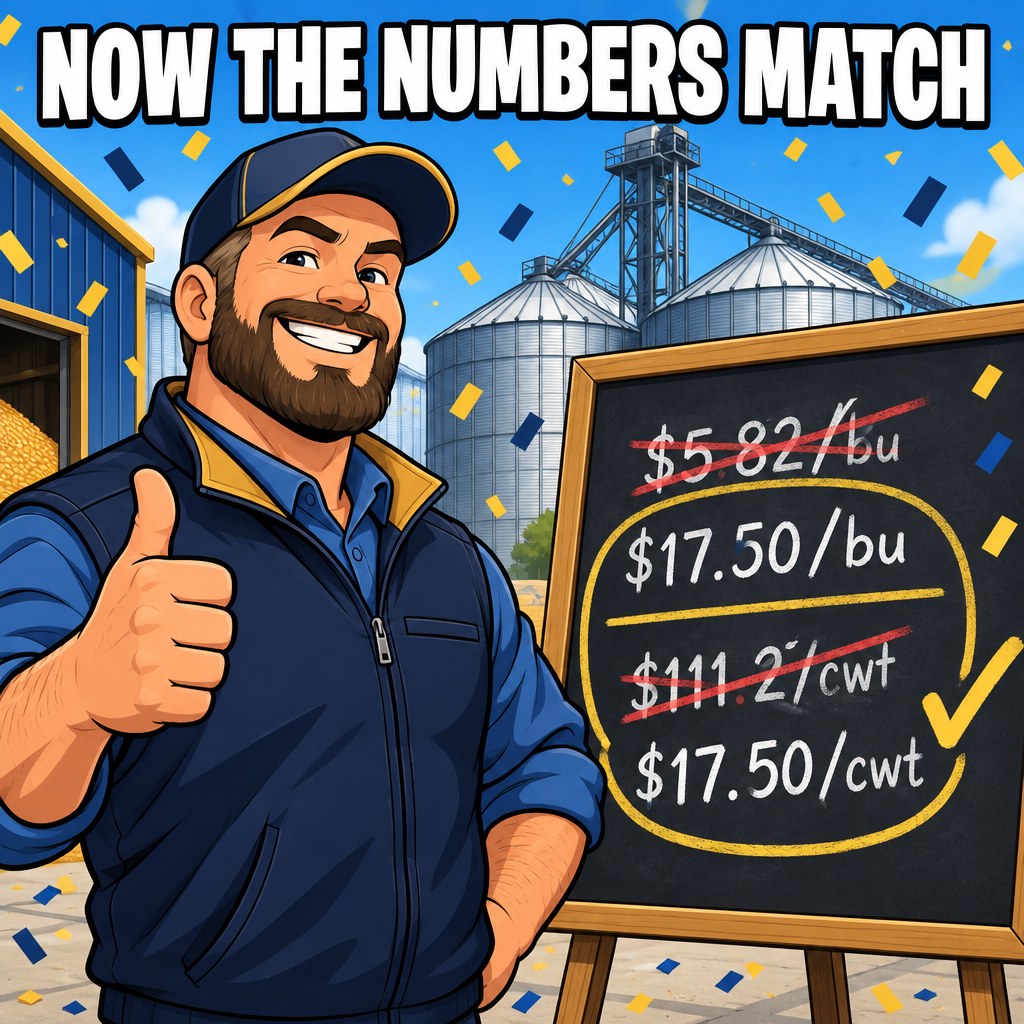
None of this is instructions. It's the actual math behind a decision a real Bootheel farmer is making this week, laid out in one place, in units that match.
Related Research
The structured fields below this narrative — what got us asking this, who we'd like to talk to, what we still need, and our sources — carry the parts of this investigation that update independently of the write-up above. See also our companion pieces on the Bootheel rice-to-soybean pivot and Farm Credit SEMO's crop-credit stress for the wider Bootheel financial picture this decision sits inside.
Where This Stands
Investigating
Our Best Guess So Far
If a grower's real cost of waiting is dominated by MAL/operating-credit interest rather than storage, shrink or quality risk, the Marketing Assistance Loan's actual value this year is cheap time to let basis narrow — not price support, since cash already appears to trade above the loan rate once converted to matching units. This is a hypothesis built from the FSA's actual September 2026 lending rate and the published MAL rate, not a locally verified Bootheel carry-cost figure — the real storage/shrink numbers that would fully settle it aren't public.
What Got Us Asking This
- linkBrownfield Ag News — Missouri rice farmer interview, Sep 2026 — Dunklin County producer and Missouri Rice Council chair Rance Daniels: average yields, only ~20% of his crop marketed, cash prices in the low $6/bu range, ~$6.75/bu as a more comfortable selling level; basis widened because 'the futures had outrun the mill market price.'
- linkUSDA FSA — 2026 Marketing Assistance Loan Rates, Apr 2026 — Missouri's 2026 rough-rice MAL rate set at $7.70/cwt (long grain and medium/short grain), available through May 31, 2027.
- linkUSDA FSA — September 2026 Lending Rates — Direct operating loan rate 5.25%, direct ownership loan rate 6.00%, commodity loan rate 5.00%, effective Sep. 1, 2026.
- linkUSDA ERS — Farm Sector Income Forecast, Sep 2026 — 2026 farm sector debt forecast at $605.1B (+4.6%); production expenses at $492.8B (+4.5%); marketing/storage/transportation expenses up 12% YoY nationally.
- linkArkansas Farm Bureau — Market Briefs, Sep 18 2026 — Mid-South rice basis 'near $1/cwt under the board' against November futures pushing toward $16/cwt — an independent cross-check that lands within cents of Daniels' own converted comfort price.
How This Connects
The Physical Side
Harvested rough rice moves from field to on-farm bin or elevator storage, then to a local mill for milling into the rice that actually sells — the same physical path the Commodity Credit Corporation's nonrecourse loan program was built around in 1933 to make viable at all.
The Money Side
A grower chooses between a harvest-time cash bid (~$6.00-$6.75/bu per Daniels, ≈$13.3-$15.0/cwt converted), self-financed storage, an operating line at FSA's 5.25% September rate, or a $7.70/cwt Marketing Assistance Loan available through May 31, 2027 — each a different cost of waiting.
The Day-to-Day Work
Growers, Farm Credit Southeast Missouri and other ag lenders, county FSA offices administering the MAL, the Missouri Rice Council, and the mills whose bids actually set the local basis that determines whether waiting pays.
The Data/Systems Side
Daily local mill bids, the widening/narrowing basis gap against futures, storage/drying/shrink costs, and MAL mechanics — several of which (a Bootheel-specific mill bid sheet, a local storage rate) simply aren't published anywhere public yet.
Who We'd Like to Talk To
- Rance Daniels / Missouri Rice Council
- Farm Credit Southeast Missouri loan officers
- County FSA offices administering the MAL
- USA Rice Federation (Mollie Buckler, Missouri liaison)
- Local rice mills and elevators setting Bootheel basis
What We Still Need
- A real, current Bootheel mill bid sheet by grade, in both $/bu and $/cwt
- A documented local storage/drying/shrink cost figure — not a national or Iowa/Mississippi State benchmark
- A forward basis curve by month for Missouri long-grain rice
- Farm Credit Southeast Missouri's own rice-specific loan/collateral practices for the 2026 crop
- A direct conversation with a Bootheel grower or lender beyond the one interview Brownfield already published
What We'll Build From This
- A weekly, plain-language Bootheel mill-bid and basis tracker published in both $/bu and $/cwt
- A break-even carry calculator by days-in-storage once a real local storage-cost figure exists
What We Found
Converting Rance Daniels' publicly quoted cash price and comfort level from dollars-per-bushel into dollars-per-hundredweight — the units USDA's MAL rate and season-average price forecast are quoted in — shows his price is already running above, not below, both the $7.70/cwt MAL rate and close to USDA's own $14.90/cwt 2026/27 season-average forecast. The financing-interest cost of waiting out the MAL's full availability window, at FSA's actual 5.25% September rate, comes to roughly $0.27/cwt — a small fraction of the ~$1.7/cwt gap between his current price and his stated comfort level. That means the loan isn't functioning as price support this year; it's functioning as cheap time while basis narrows. What's still missing — a real Bootheel mill bid sheet and a documented local storage cost — is exactly what would tell a grower whether that basis gap is actually likely to close, which is why this stays "investigating."
Sources
- linkBrownfield Ag News — Missouri rice farmer holds off on sales as basis remains wide
- linkUSDA FSA — 2026 Marketing Assistance Loan Rates for Wheat, Feed Grains, Oilseeds and Rice
- linkUSDA FSA — USDA Announces September 2026 Lending Rates for Agricultural Producers
- linkUSDA ERS — Farm Sector Income Forecast
- linkArkansas Farm Bureau — Market Briefs, September 18, 2026
- linkMissouri Rice Research and Merchandising Council — About
- linkUniversity of Arkansas Extension — On-Farm Rice Drying and Storage
- linkEBSCO Research Starters — Roosevelt Creates the Commodity Credit Corporation
- linkfarmdoc daily — Farm Bill Review: Historical Background on Marketing Assistance Loans