The Bootheel Is Built on Groundwater. What Is One More Irrigation Pass Actually Worth in 2026?
With persistent Southeast Missouri dryness, late-season soybean/cotton decisions, and elevated energy costs, when does another irrigation pass protect enough yield and quality to justify pumping cost and aquifer draw?
Short Answer
Status: investigating. Here's the honest version: I did not find a single Bootheel-wide number that tells a grower whether to run the pump one more time this month, and I'm not going to invent one. What I did find is a real cost structure — irrigation fuel runs somewhere around $2/acre-inch, not the $80+/acre "irrigation cost" line a budget sheet shows you, because most of that line is a fixed cost you already paid this season whether you irrigate again or not. And I found real agronomic timing data showing that a single well-timed late-season pass on soybeans can be worth anywhere from under a bushel to nearly seven bushels an acre, depending on maturity group — while a poorly-timed one is close to worthless. The marginal decision is cheap. The information to make it well is what's actually missing.

Why Nobody Up Here Dry-Farms by Choice
Southeast Missouri doesn't look like it should need irrigation. It floods. The Bootheel was a cypress swamp until the Little River Drainage District spent from 1914 to 1928 digging over 900 miles of ditches and building the levee system that turned Mississippi River overflow basin into some of the flattest, most fertile row-crop ground in the country.
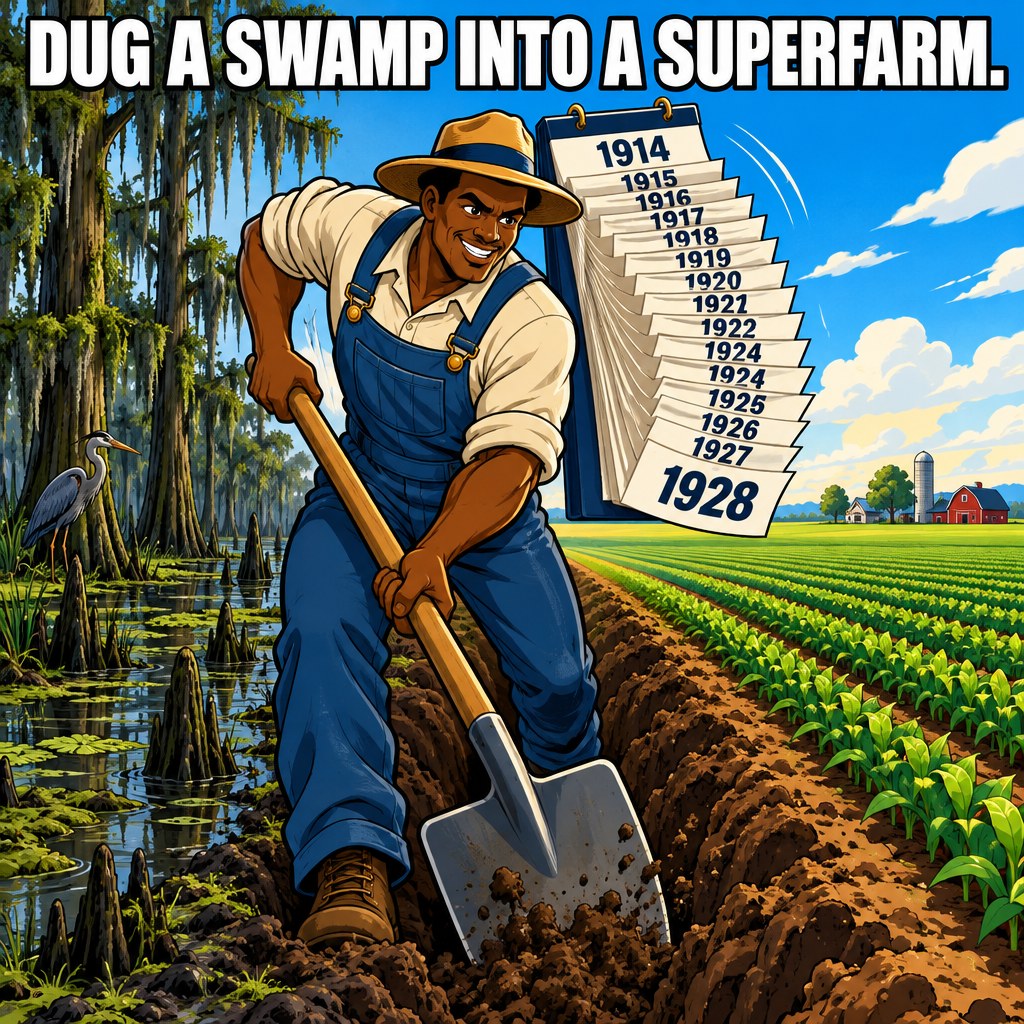
That drainage project is also the reason this ground is so irrigation-dependent today: the same alluvial geology that made it easy to drain also left a shallow, productive aquifer sitting right underneath it. The Missouri Department of Natural Resources doesn't call the Southeastern Lowlands the state's most irrigation-heavy province by accident — the surface-level Southeast Lowlands Alluvial Aquifer, built from sand and gravel the Mississippi and Ohio rivers deposited over thousands of years, is the region's most heavily used water source, with individual irrigation wells here capable of pumping up to 3,000 gallons per minute. Underneath that, the deeper McNairy and Wilcox formations hold roughly 44 trillion gallons combined, and many of those wells are naturally artesian — they need little or no pumping at all. (Missouri DNR — Southeastern Lowlands Groundwater Province)
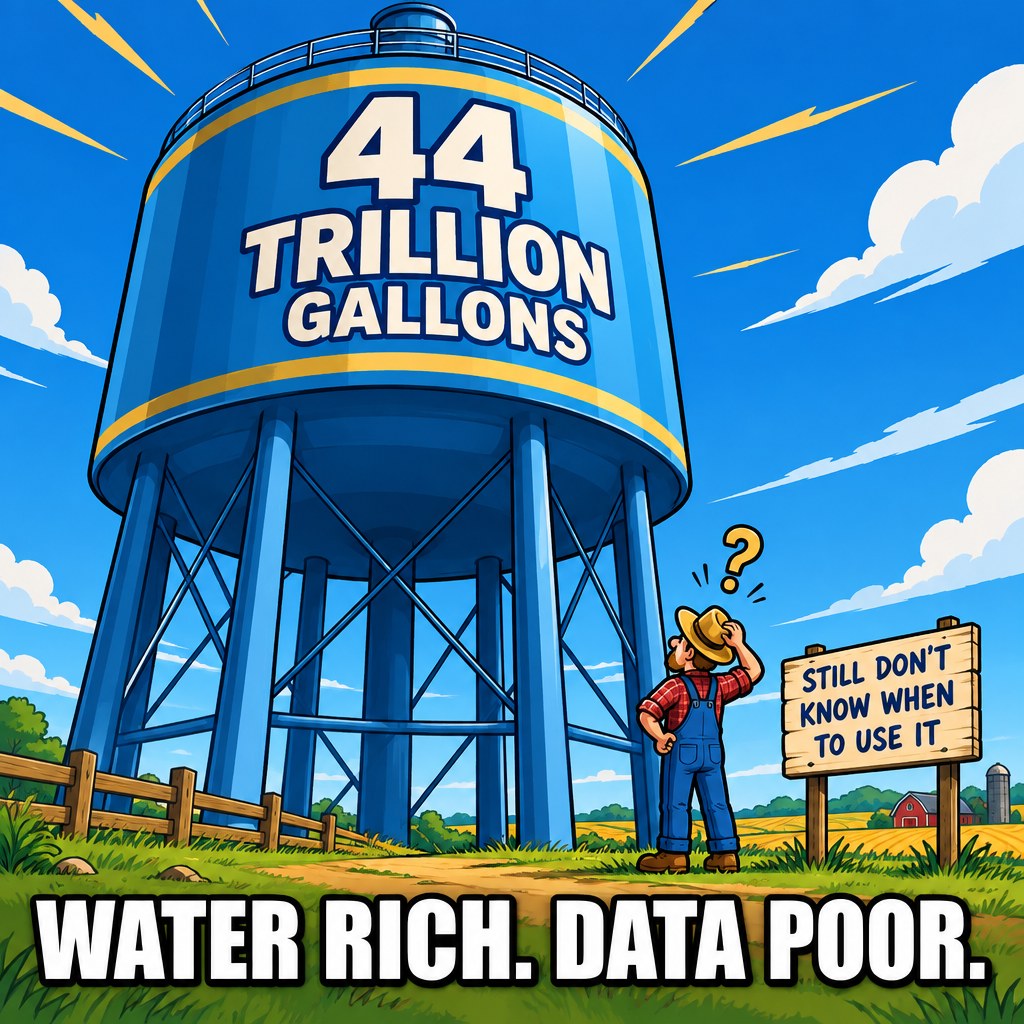
So the Bootheel isn't short on water. It's short on cheap certainty about exactly when to use it.
How This Connects
open_with Drag nodes to rearrange, tap one for the evidence behind it — pinch or scroll to zoom.
The Two Policy Levers Pulling in Different Directions This Year
There's a real tension sitting under this decision, and it's worth naming instead of glossing over. On one side, USDA's own September 2026 farm income forecast shows the input-cost environment getting worse for exactly the kind of decision an irrigation pass represents: fuel and oil expense is projected to jump 28.8% versus the February 2026 forecast, total production expenses are up 4.5% to $492.8 billion, and net farm income nationally is forecast at $158.4 billion — down 5.5% in real terms from 2025. That's the "don't spend on anything marginal" signal. On the other side, USDA's Farm Service Agency actually kept its direct lending rates historically approachable for September 2026: 5.25% on operating loans, 6.00% on ownership loans, and a 3.75% emergency rate for actual losses — rates that exist specifically so a cash-tight producer isn't forced into a worse decision than the agronomics call for. (USDA ERS — Farm Sector Income Forecast; USDA FSA — September 2026 Lending Rates)

Put those next to each other and the actual message isn't "don't irrigate" or "irrigate freely" — it's that the cost of getting this specific decision wrong (over-applying water on a field that didn't need it, or skipping a pass that would have paid for itself many times over) matters more in a year when the cushion on both sides — margin and credit — is thinner than usual.
The Numbers So Far
The reason this matters: if you ask "how much does irrigation cost me," MU's own budget says something like $115/acre. If you ask the actual decision question — "what does one more pass cost me, given I already own and am running the system" — the honest number is closer to $2/acre-inch in fuel, not $115/acre. Those are two different questions with two very different answers, and conflating them is exactly how a defensible marginal-cost decision turns into an indefensible average-cost one.
Timing is the whole ballgame in that second chart. MU Extension's own guidance is specific: if a grower can only afford to irrigate once, do it during late pod development to early seed fill — not at flowering, because soybeans facing water stress simply abort flowers and the water spent getting there doesn't show up in yield. A pass at the wrong stage isn't a smaller version of the right decision. It's close to a wasted one. (MU Extension — Irrigating Soybeans, G4420)
Where This Is Happening
What's Actually Happening in the Field Right Now
This isn't a drought-headline story, and the on-the-ground reporting backs that up. A Stoddard County farmer told Brownfield Ag News on September 14, 2026 that despite some variety-specific disease pressure, "I think the beans are going to be really good," and that his cotton "looks really good" with "probably the least amount of disease pressure that I've seen in 25 years" — after 25 years farming the same ground. Rain the week before had settled dust from a preceding dry stretch. That's a real, current, sourced ground-truth data point, and it cuts against treating "persistent dryness" as a crisis: this year's Bootheel crop looks fine so far. The open question isn't whether the crop survived. It's whether the last irrigation decisions along the way protected value that would otherwise have been left on the table — and that's a field-by-field answer, not a regional one. (Brownfield Ag News — Early soybean yields look good as harvest advances in Missouri Bootheel)

Methodology
This pass combined the Missouri DNR's own groundwater-province documentation, MU Extension's irrigation program pages, its Scott County crop budgets, and its soybean irrigation-timing guide (G4420), a Mid-South regional pumping-cost analysis (Southern Ag Today, 2024 baseline), USDA's September 2026 farm income and FSA lending-rate releases, and current Brownfield Ag News harvest reporting. It explicitly did not do: pull an actual current-season Bootheel pump-lift, well-depth, or soil-moisture reading from a real field; obtain a current-year (rather than representative) local diesel or electricity price; or interview a Bootheel grower, Farm Credit Southeast Missouri loan officer, or MU Extension agronomist directly. Those are exactly the inputs the "Bootheel Water-Energy Decision Engine" described in this investigation's artifacts would need to turn this from a general cost-and-timing framework into a real field-level tool.

Moral of the Story
If you're a grower: the actual marginal cost of one more pass is probably closer to $2/acre-inch in fuel than the $80-100+/acre your crop budget's "irrigation" line implies — but that only pays off if you're irrigating at the right crop stage. Before your next pass, ask yourself (or your agronomist) one specific question: is this field currently in late pod development/early seed fill, or is it still flowering? That single answer moves the expected return by an order of magnitude.

If you're a lender (Farm Credit Southeast Missouri or otherwise): a 5.25% direct operating rate is a national floor, not a local guarantee — but it does mean the financing side of a marginal irrigation decision is currently cheaper than the agronomic uncertainty around it. Worth asking a borrower directly whether their last irrigation pass was timed off soil-moisture data or off habit.
If you're MU Extension, Missouri Soybeans, or NRCS: the single most useful public dataset that doesn't yet exist is a current-season, field-level pairing of pump lift/energy source with crop-stage-tagged yield response, specific to the Bootheel's alluvial aquifer conditions rather than a regional average. That's the dataset this investigation's proposed Decision Engine is built to consume the moment it exists.
Related Research
This connects directly to our investigations into the September 2026 Bootheel diesel shock — the same pump running on the same expensive fuel — and Farm Credit Southeast Missouri's crop-loan stress, the lender's-eye view of every one of these marginal decisions stacking up across a season.
Where This Stands
Investigating
Our Best Guess So Far
Southeast Missouri is unusually irrigation-dependent and groundwater-rich, but the correct late-season irrigation decision is field-specific — a water-energy decision model joining crop stage, soil moisture, pump lift/efficiency, energy price, and expected yield response is the defensible product, not a single Bootheel-wide answer. This is a hypothesis to test against real field-level pump, moisture, and yield-response data, not a conclusion.
What Got Us Asking This
- linkMissouri DNR — Southeastern Lowlands Groundwater Province — The Bootheel's shallow Southeast Lowlands Alluvial Aquifer holds up to 21 trillion gallons and supports irrigation wells pumping up to 3,000 gallons per minute; deeper McNairy/Wilcox formations hold ~44 trillion gallons combined, many artesian.
- linkMU Extension — Irrigating Soybeans (G4420) — A single well-timed late pod-development/early seed-fill irrigation pass added 6.7 bu/ac (short-season), 3.7 bu/ac (medium-season), and 0.8 bu/ac (full-season) in SE Missouri trials; irrigating at flowering alone is largely wasted water.
- linkMU Extension — Scott County irrigated soybean crop budget — Representative SE Missouri cost structure: irrigation fuel ~$16.80/acre for 8 acre-inches (~$2.10/acre-inch), fixed irrigation cost ~$82/acre, repairs ~$12/acre, labor ~$5/acre.
- linkUSDA ERS — Farm Sector Income Forecast, September 2026 — 2026 net farm income forecast at $158.4B, down 5.5% real vs. 2025; production expenses $492.8B (+4.5%); fuel & oil expense forecast up 28.8% vs. the February 2026 estimate.
- linkUSDA FSA — September 2026 Lending Rates for Agricultural Producers — Direct operating loan rate 5.250%, farm ownership 6.000%, emergency loan (actual loss) 3.750%, effective Sept. 1, 2026.
How This Connects
The Physical Side
Wells, pumps, and the Southeast Lowlands Alluvial Aquifer sit under a 12-county river-bottom soybean/cotton/corn/rice economy; fields, crop stage, and soil moisture determine what one more pass is actually worth.
The Money Side
FSA's September 2026 lending rates (5.25% operating) and USDA's national fuel-cost/farm-income squeeze (fuel +28.8%, net farm income -5.5% real) set the financing and cost backdrop against which any marginal irrigation dollar gets judged this season.
The Day-to-Day Work
Farm Credit Southeast Missouri, Missouri Soybeans, MU Extension/Fisher Delta, NRCS/Missouri DNR, and regional grain/cotton buyers all touch this decision from a different angle — credit exposure, agronomy, water policy, and market access respectively.
The Data/Systems Side
MU Extension and Missouri DNR supply strong regional/program-level evidence; no public source yet joins field-level pump lift, soil moisture, crop stage, and yield response into one current-season Bootheel dataset.
Who We'd Like to Talk To
- Bootheel soybean and cotton growers
- Farm Credit Southeast Missouri
- Missouri Soybeans
- MU Extension / Fisher Delta Research Center
- NRCS / Missouri DNR
- regional grain and cotton buyers
What We Still Need
- Field-level pump lift, flow rate, and efficiency for representative Bootheel wells
- Current-season (not representative/vintage) local diesel and electricity pricing
- Real-time soil-moisture and crop-stage data tied to specific fields
- Local yield/quality response to the last irrigation pass, by field and variety
- A direct conversation with a Bootheel grower, Farm Credit SEMO loan officer, or MU Extension/Fisher Delta agronomist — zero interviews conducted so far
What We'll Build From This
- Bootheel Water-Energy Decision Engine — inputs field/crop/stage, soil moisture, forecast ET/rain, pump lift/flow/efficiency, energy price, and expected yield/quality response; outputs $/acre irrigation cost, break-even bushels/lint, sensitivity bands, and a stop/go 'measure more' state
What We Found
The Bootheel's groundwater dependence and the general shape of the irrigation cost structure are both well-documented: the marginal cost of one more pass (roughly $2/acre-inch in fuel) is far smaller than the average per-acre irrigation budget line suggests, and MU Extension's own agronomic guidance shows timing — not water volume — is what drives most of the yield-response variance. What remains unverified is the field-specific answer for any given 2026 Bootheel field, which requires current pump, moisture, and yield data this pass did not have access to, which is why status stays "investigating."
Sources
- linkMissouri DNR — Southeastern Lowlands Groundwater Province
- linkMU Extension — Irrigation Programs
- linkMU Extension — Irrigating Soybeans (G4420)
- linkMU Extension — Scott County irrigated soybean crop budget
- linkSouthern Ag Today — Irrigation Water Pumping Costs in the Mid-South
- linkUSDA ERS — Farm Sector Income Forecast, September 2026
- linkUSDA FSA — September 2026 Lending Rates for Agricultural Producers
- linkBrownfield Ag News — Early soybean yields look good as harvest advances in Missouri Bootheel