Wallula Is Pulling the Export Ramp Inland. Which PNW Crops Actually Gain From Containerizing Closer to the Farm?
Tri-Cities Intermodal and MAC Container Line's Sep 10, 2026 partnership adds 75,000 lifts/year of agricultural transload capacity at Wallula, WA, built specifically for McKay Seed's food-grade barley exports to Japan. Does moving the container transload step inland to Wallula actually beat a direct truck haul over the Cascades on landed cost, or does the real value case rest on capacity and reliability instead — and for which commodities and origin points does that distinction actually matter?
Short Answer
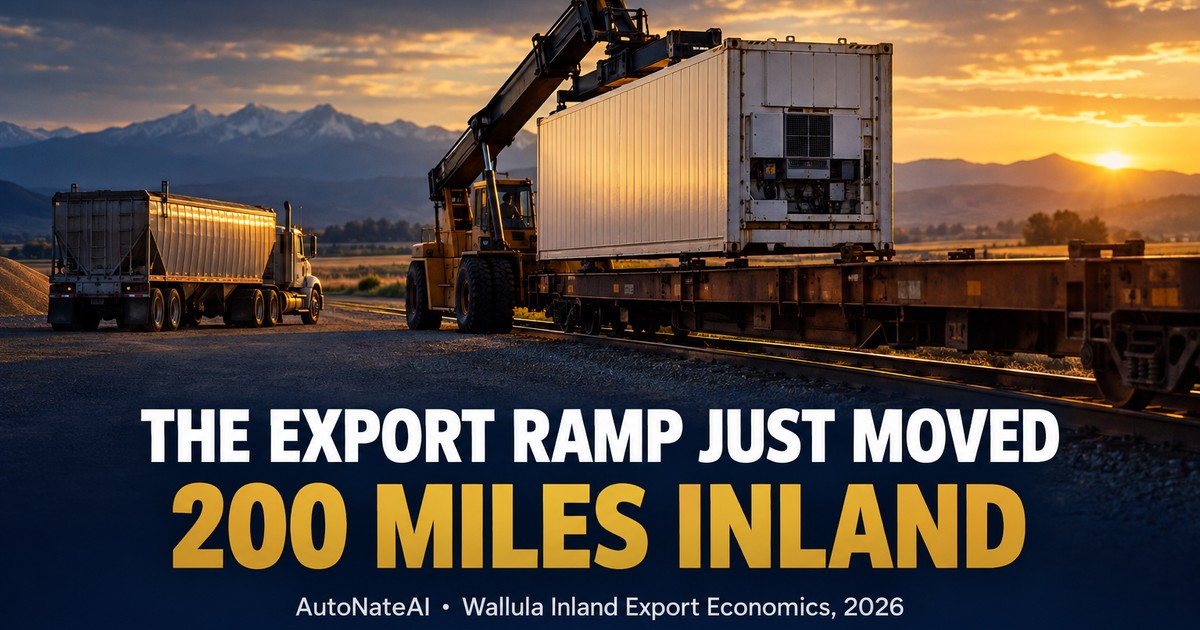
The pitch behind Wallula is simple enough to fit on a slide: instead of trucking grain over the Cascades to a coastal port, you containerize it 200-plus miles closer to the farm and let rail carry it the rest of the way. What the pitch doesn't settle is whether that actually beats a direct truck haul on landed cost — and when I ran the only real distance number publicly available against the freight industry's own generic break-even rule of thumb, the lane looked short enough that cost alone probably isn't the whole story. What is real: a named specialty exporter, a named rail-drayage partnership, an actual government interlocal agreement, and one honest, if small and dated, before-and-after mileage data point from the facility's own 2024 launch. Status: investigating.
Grain Has Always Had to Cross a Mountain Range to Leave Washington
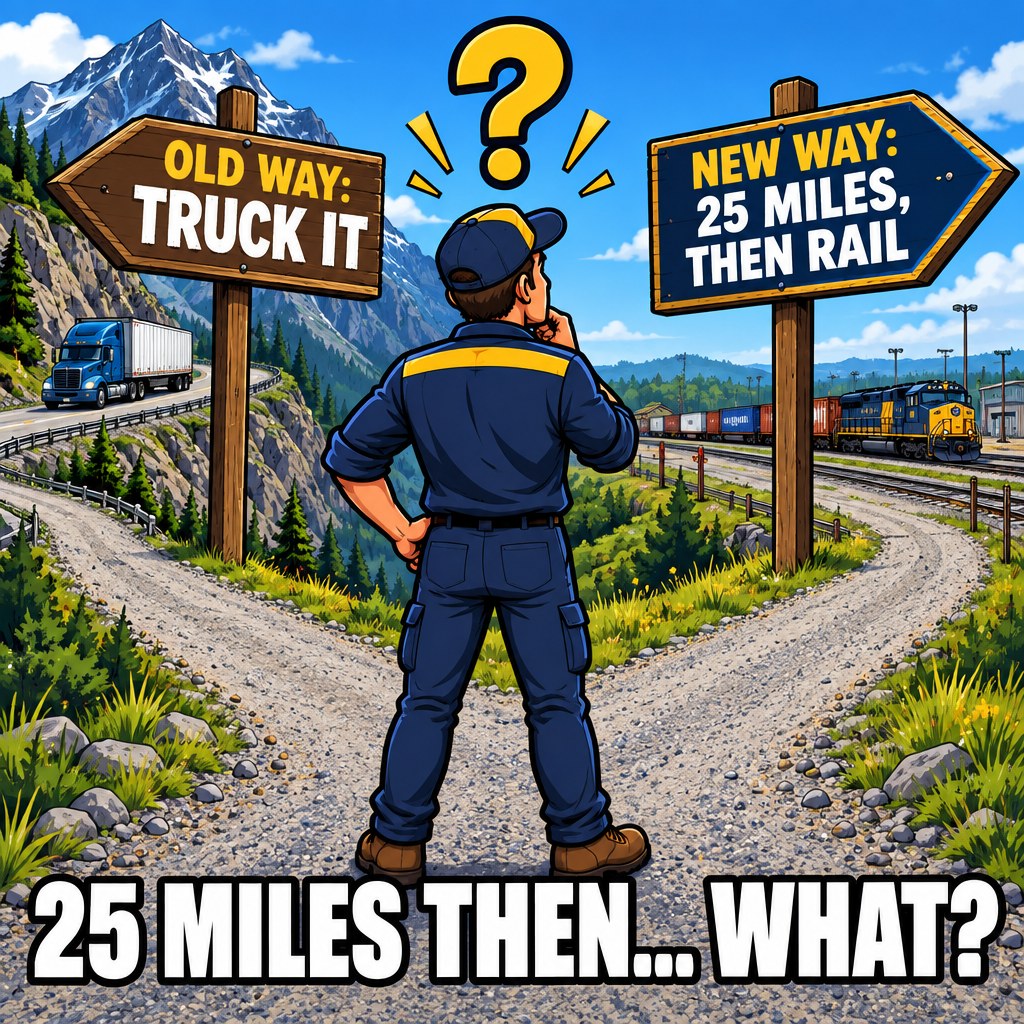
Eastern Washington's wheat and barley country sits on the wrong side of the Cascades from every major container port the state has. That's not a new problem — it's the reason the Columbia-Snake River barge system exists at all, moving bulk grain by water past the mountains rather than by truck over them. Containerized agricultural exports, though, have mostly stayed a truck-and-highway story: a hopper truck hauls to a coastal transload yard, gets loaded into a container, and only then does the cargo touch rail or ocean freight. Wallula's bet is that the transload step itself — not just the bulk-barge alternative — can move inland, closer to where the grain is actually grown.

How This Connects
open_with Drag nodes to rearrange, tap one for the evidence behind it — pinch or scroll to zoom.
The honest read of this diagram: everything above the decision node is real and dated. Everything below it — which mode Wallula-area exporters are actually choosing at scale, and what it costs them — is the open question the rest of this article tries to size up, without inventing a shipper-specific number nobody's published.
The Distance Math Nobody's Published, Run Against the Industry's Own Rule of Thumb
Here's the part of this investigation that turned up something more useful than a press-release recap. General 2026 freight-industry cost reporting puts the distance where intermodal rail typically starts beating direct truck on total landed cost at roughly 750 miles one-way — below that, drayage fees on both ends tend to eat most of rail's per-mile savings. The actual distance from Pasco to the Port of Tacoma, the pre-Wallula default route, works out to roughly 225 miles one-way, based on the 450-mile round trip the facility's own 2024 launch reporting cited. That's less than a third of the generic break-even distance.
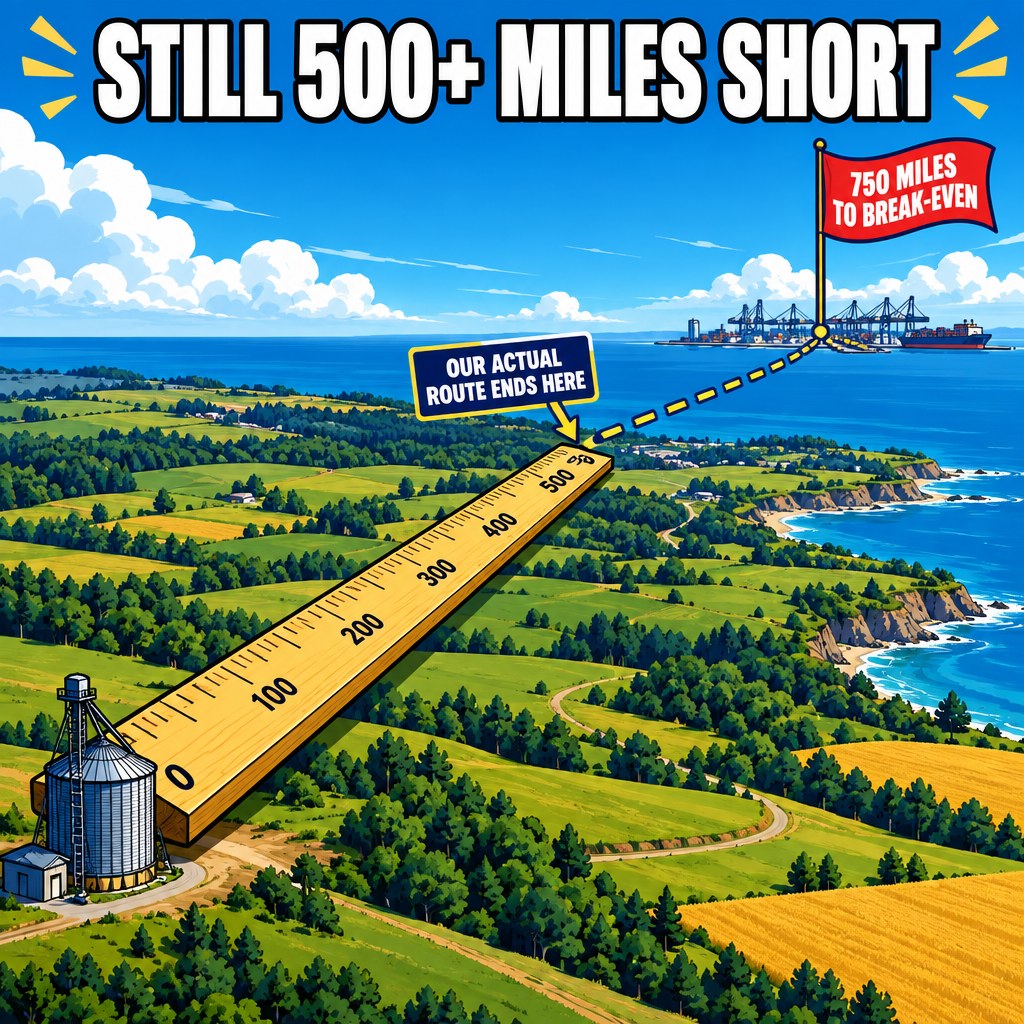
That doesn't mean Wallula is a bad bet — it means the value case probably isn't primarily a landed-cost story, and the people who built this partnership seem to know that. MAC Container Line's own president, Brad Heier, framed the deal this way at announcement: "Wallula offers a unique opportunity to bring the agricultural supply chain closer to the producer." (Truck News, Sep 10, 2026) Coverage of the facility has also emphasized shorter driver turns, less exposure to Cascade mountain-pass conditions, and drivers being able to get home the same night — a capacity-and-reliability pitch, not a per-container savings figure. That's the same shape of argument this site found behind Georgia's Gainesville inland port: when the distance math is short of the generic break-even line, the real sell tends to be driver capacity and service reliability, not a landed-cost number nobody's willing to publish yet.
The Numbers So Far
Three honest jobs, three different scales: the first is the one real before/after mileage number this facility has ever published, for a shipment that isn't even the commodity this article is about. The second is the actual math that should make anyone selling this purely as a cost play pause. The third is scale context for why food-grade barley to Japan is worth building dedicated rail capacity for in the first place — without pretending to know McKay Seed's own volume through Wallula, which nobody's disclosed.
Where This Is Happening
What the Public Record Actually Confirms, and What It Still Doesn't
Every piece of this story that's genuinely public checks out: the Sep 10, 2026 TCI-MAC partnership is real and named, with an initial 75,000-lift annual capacity and dedicated McKay Seed infrastructure; the Tri-Cities Inland Logistics Hub interlocal agreement between four public port/seaport entities is real, filed, and dated; McKay Seed's status as the top U.S. exporter of commercial food-grade barley to Japan is corroborated by its own trade-council membership listing. (Truck News, Sep 10, 2026; Port of Pasco — Interlocal Agreement, Jan 6, 2026; U.S. Grains & BioProducts Council — McKay Seed Company)
What's still missing, and what genuinely would settle this article's core question, is a real shipper's own before-and-after landed-cost or dwell-time figure for freight actually moving through the new McKay Seed capacity specifically — not the 2024 hay data point, not a generic freight-industry rule of thumb, an actual number from this partnership. Nobody's published one yet, four months into the partnership being announced isn't long to expect it, and that's a genuinely different, more honest place to leave this than pretending the mileage math above settles the cost question.

Methodology
This pass drew on Truck News' Sep 10, 2026 reporting on the TCI-MAC Container Line partnership, PNW Ag Network's Feb 6, 2024 reporting on the facility's soft launch (the source of the only real before/after mileage figure found), the Port of Pasco's own filed interlocal agreement document (Jan 6, 2026), the U.S. Grains & BioProducts Council's McKay Seed membership page, and multiple 2026 freight-industry sources for the generic intermodal break-even distance benchmark. It does not include: a single McKay Seed- or barley-specific rate quote, dwell-time figure, or landed-cost comparison; a direct statement from Theodore Prince, Dan McKay, or a Washington Grain Commission representative; or confirmation of what share of the 75,000-lift annual capacity is actually being used as of this research pass. The 89% mileage-reduction figure is real but describes a 2024 hay shipment, not the 2026 barley partnership this article is centered on — using it as more than an illustration of the mechanism would overstate what it actually proves.
Moral of the Story
If you're a Wallula-area grain or specialty-crop shipper, the concrete thing worth doing is asking Tri-Cities Intermodal or MAC Container Line for an actual quoted rate on your specific lane and commodity, rather than assuming a new rail option is automatically cheaper — the generic distance math above suggests it might not be, on cost alone.
If you're McKay Seed or another exporter actually using the new capacity, publishing even one real before/after landed-cost or transit-time figure would do more to validate this partnership than another capacity announcement — and it's the single piece of information every other stakeholder in this diagram is missing.
If you're AgWest Farm Credit or another lender financing agricultural exporters in this corridor, mode flexibility (can a borrower ship either way, or are they locked into one) is a logistics-risk variable worth a specific underwriting question this season — the same variable our companion investigation into Georgia's inland port flagged for poultry lenders.
If you're the Port of Walla Walla, Port of Benton, Port of Pasco, or the Northwest Seaport Alliance, the honest sell to the next prospective shipper isn't "rail beats truck on cost" until someone actually publishes that number for this specific lane — it's shorter driver turns, reduced mountain-pass exposure, and driver retention, which is exactly what the facility's own public language already leads with.

Related Research
This is the first flagship investigation into the Pacific Northwest / Columbia Basin on this site, and it shares an analytical shape — a new inland logistics investment measured against the freight industry's own generic cost break-even distance — with our investigation into Georgia's $134M Gainesville Inland Port. The structured fields below (who we'd like to talk to, what we still need, our sources) carry the parts of this investigation that update independently of the write-up above.
Where This Stands
Investigating
Our Best Guess So Far
The generic 2026 freight-industry intermodal break-even distance is roughly 750 miles one-way; the actual Pasco-to-Port of Tacoma distance (the pre-Wallula default route) is roughly 225 miles one-way. If that generic pattern holds on this specific lane, the primary value case for routing agricultural exports through Wallula likely isn't landed-cost savings — it's more probably driver capacity, reduced Cascade mountain-pass exposure, and service reliability, which matches the language the partnership's own principals have used publicly. This is a hypothesis built from one dated, non-commodity-specific mileage data point (a 2024 hay shipment) plus a generic national freight benchmark, not a McKay Seed-specific cost or dwell-time figure — nobody has published one of those yet.
What Got Us Asking This
- linkTruck News — Tri-Cities Intermodal expands agricultural transload capacity (Sep 10, 2026) — TCI and MAC Container Line partnership: MAC as preferred ag-export logistics provider, initial 75,000 lifts/year, dedicated McKay Seed storage/transload bins, Union Pacific + Columbia Rail service. Brad Heier (MAC President): 'Wallula offers a unique opportunity to bring the agricultural supply chain closer to the producer.'
- linkPNW Ag Network — Tri-Cities Intermodal Offers Wallula Facility Update (Feb 6, 2024) — Facility's first shipment: 300 tons of hay moved via ten 50-mile round trips (Pasco-Wallula) instead of a 450-mile round trip (Pasco-Port of Tacoma) — an 89% cut in highway miles for that load.
- linkPort of Pasco — Interlocal Agreement, Inland Logistics Hub (filed Jan 6, 2026) — Northwest Seaport Alliance, Port of Benton, Port of Pasco, and Port of Walla Walla signed an interlocal agreement to jointly develop the Tri-Cities inland logistics hub; signing ceremony Feb 5, 2026.
- linkU.S. Grains & BioProducts Council — USGC Welcomes New Member McKay Seed Company — McKay Seed is the #1 U.S. exporter of commercial food-grade barley to Japan, specializing in waxy, high-Beta-Glucan varieties.
How This Connects
The Physical Side
Eastern Washington grain/barley origin → short local drayage to Wallula (Port of Walla Walla's Dodd Road Industrial Park) → Union Pacific/Columbia Rail → coastal container port → ocean export to Japan. The competing physical path is a direct ~225-mile truck haul over the Cascades to a coastal transload yard.
The Money Side
TCI and MAC Container Line built the Wallula transload/storage capacity as a private partnership; four public port/seaport entities co-fund the broader inland logistics hub under a Jan 2026 interlocal agreement; McKay Seed's own export financing and AgWest Farm Credit sit downstream of whichever mode ends up cheaper or more reliable.
The Day-to-Day Work
McKay Seed and other PNW grain exporters choose the mode; TCI and MAC Container Line operate the Wallula rail-drayage alternative; the four-port interlocal agreement provides the public infrastructure layer around it.
The Data/Systems Side
The Sep 2026 partnership terms, the Jan 2026 interlocal agreement, and one 2024 non-commodity-specific mileage data point are public. Actual McKay Seed-specific landed-cost, dwell-time, or adoption-share data is not.
Who We'd Like to Talk To
- Theodore Prince, CEO/Founder, Tri-Cities Intermodal
- Brad Heier, President, MAC Container Line
- Dan W. McKay, McKay Seed Company
- AgWest Farm Credit
- Port of Walla Walla / Port of Benton / Port of Pasco / Northwest Seaport Alliance
- Washington Grain Commission and other PNW grain exporters
What We Still Need
- A real before/after landed-cost or transit-time figure for McKay Seed (or another exporter) freight actually moving through the new Wallula capacity
- What share of the 75,000-lift annual capacity is being used as of this research pass
- A statement from Theodore Prince, Dan McKay, or the Washington Grain Commission on adoption drivers (cost vs. reliability vs. driver capacity)
- AgWest Farm Credit's or another PNW ag lender's view on whether logistics-mode flexibility factors into export-financing underwriting
- County/origin-level GIS data on which crop-origin pairs are geographically closest to Wallula vs. a traditional coastal transload point
What We'll Build From This
- A commodity-by-origin landed-cost comparison (Wallula-rail vs. direct truck) once real shipper rate/dwell data exists
- A tracker for the Wallula facility's disclosed lift-capacity utilization over time, as a proxy signal while direct adoption data is unavailable
What We Found
The infrastructure and partnership facts are fully verified: a real Sep 10, 2026 TCI-MAC Container Line partnership, a real Jan 2026 four-port interlocal agreement, and a real, named exporter (McKay Seed, the #1 U.S. food-grade barley exporter to Japan) whose specialty barley the new capacity was built to support. What isn't yet verified is the actual cost or reliability case: the only real before/after mileage data point this facility has published (an 89% highway-mile cut) is from a 2024 hay shipment, not McKay Seed's barley, and the actual Pasco-to-coast distance (~225 miles one-way) sits well short of the freight industry's own ~750-mile generic intermodal break-even distance — suggesting the real value case is more likely driver capacity and reliability than landed-cost savings, which matches the language the partnership's own principals have used publicly. No McKay Seed-specific landed-cost or dwell-time figure is public yet. Status stays investigating.
Sources
- linkTruck News — Tri-Cities Intermodal expands agricultural transload capacity
- linkPNW Ag Network — Tri-Cities Intermodal Offers Wallula Facility Update
- linkPort of Pasco — Interlocal Agreement, Inland Logistics Hub
- linkNorthwest Seaport Alliance — Interlocal Agreement press release
- linkU.S. Grains & BioProducts Council — USGC Welcomes New Member McKay Seed Company