Georgia Built a $134M Inland Port. Will Poultry Actually Move From Truck to Rail?
Five months after the Gainesville Inland Port opened, has North Georgia's frozen-poultry export freight actually shifted from direct truck to Norfolk Southern rail, and does the distance/cost math even favor that shift at this lane length?
Short Answer
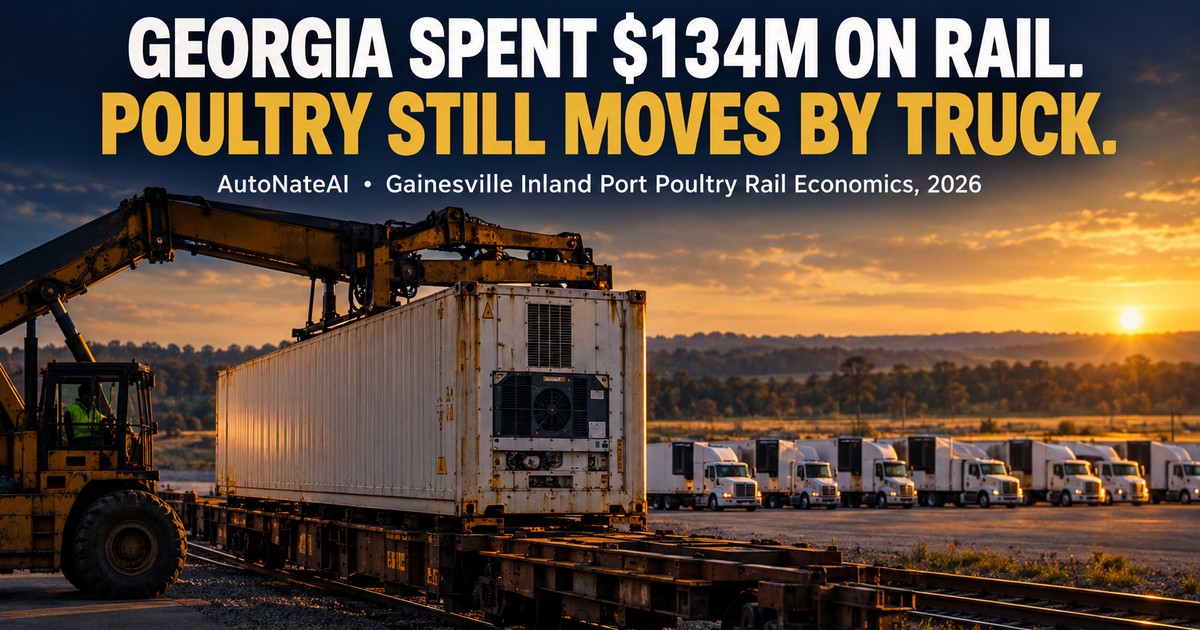
I went looking for the number that would settle this — how much frozen poultry has actually shifted from truck to rail since Gainesville's inland port opened — and it doesn't exist publicly yet. Georgia Ports Authority's own most recent release still describes frozen poultry moving to Savannah by truck. That's not a research failure; that's the honest state of the evidence four and a half months after opening day. But chasing that missing number turned up something more interesting than the number itself: run the math on the actual distance involved, and Gainesville-to-Savannah sits right at — maybe just under — the range where general freight-industry rules of thumb say intermodal rail stops obviously beating a direct truck on cost alone. If that generic pattern holds locally, the $134 million bet isn't really a bet on landed-cost savings. It's a bet on truck-driver capacity, service reliability, and Atlanta congestion relief being worth paying for in their own right — which is a very different pitch to a poultry shipper's CFO than "this will be cheaper." Status stays investigating.
The Poultry Capital of the World Wasn't an Accident
Before there was a $134 million rail terminal to argue about, there was a feed salesman surviving the Great Depression by giving away chickens. Jesse Jewell took over his family's feed, seed, and fertilizer business in Gainesville in 1930, right as the Depression was gutting demand for all three. His fix: he'd supply cash-poor North Georgia farmers with baby chicks and feed on credit, then buy the grown birds back at a price that covered his costs and guaranteed the farmer a profit. Between 1940 and 1954 he built out his own hatchery, processing plant, feed mill, and rendering plant — the first fully vertically integrated poultry operation of its kind, and the direct template every major poultry integrator has run since. He's the reason Gainesville calls itself the Poultry Capital of the World, and he's the reason "poultry" and "Hall County" have been the same sentence for almost a century now. (New Georgia Encyclopedia — Jesse Jewell)

That history matters for a reason that isn't sentimental: it's *why* $134 million in public port-authority capital landed specifically in Gainesville and not somewhere closer to Savannah. The freight isn't following the port. The port is chasing freight that's been concentrated in this one corner of North Georgia since the 1930s.
How This Connects
open_with Drag nodes to rearrange, tap one for the evidence behind it — pinch or scroll to zoom.
A grower or plant manager in Hall County doesn't experience any of this as a diagram — they experience it as a phone call: does this week's frozen-poultry container go on a truck, like it always has, or does it go five miles down the road to the new rail yard instead? Everything downstream of that one call — cost, transit time, reliability, what a lender thinks about the plant's logistics risk — depends on an answer nobody outside Georgia Ports Authority and the shippers themselves can currently see.

A $134 Million Bet on Traffic, Not Just Freight
Read Georgia Ports Authority's own language about why it built this thing, and the pitch is broader than poultry economics. GPA President and CEO Griff Lynch told the authority's board the Gainesville terminal would "significantly offset truck traffic congestion in Atlanta and improve air quality by replacing an estimated 26,000 truck roundtrips in the first year alone." The facility is built to serve roughly 330 manufacturers in the region — poultry, heavy equipment, and forest-products companies — not poultry alone. (Georgia Ports Authority — Gainesville Inland Port Set for May Opening)
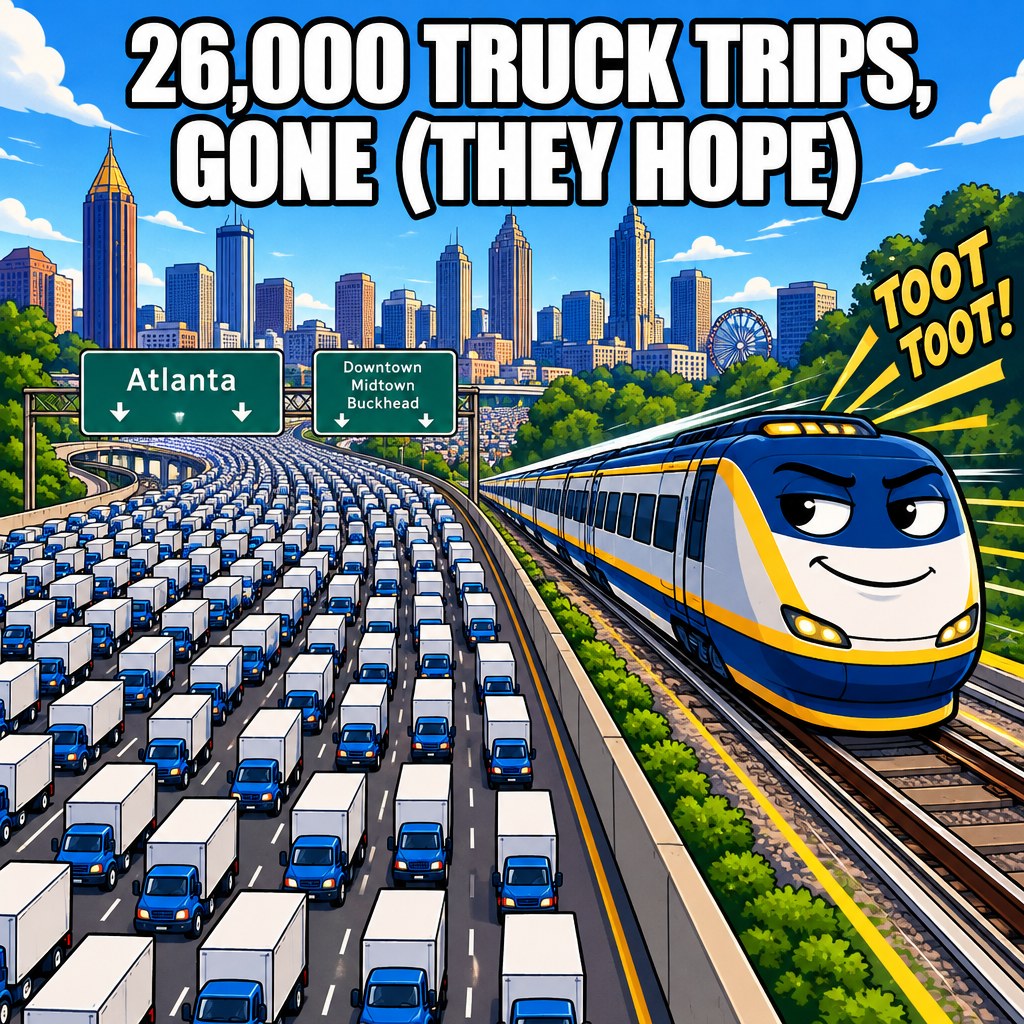
That's an important tell. A port authority selling a project on congestion relief and regional manufacturing capacity, rather than on a specific commodity's freight-cost savings, is a port authority that either doesn't have — or isn't leading with — a clean landed-cost case for poultry specifically. Hall County's own economic-development arm frames it the same way: the Greater Hall Chamber counts more than 330 manufacturing and processing concerns and 66 international-company locations in the county, and its 2025 year-end report credits ten new or expanding developments with 691 new jobs and $186.5 million in fresh capital investment — a general industrial-growth story the inland port is one piece of, not a poultry-logistics case study on its own. (Greater Hall Chamber of Commerce — Economic Development)
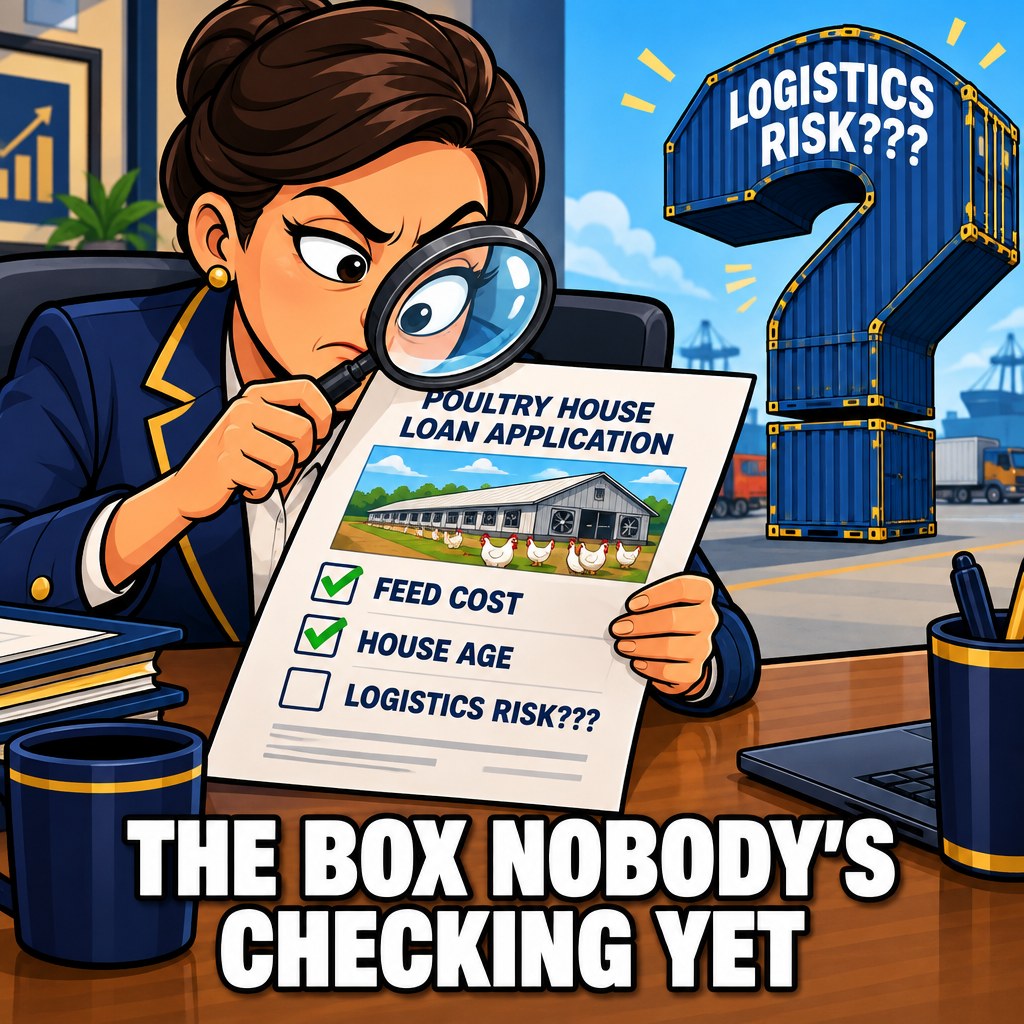
AgGeorgia Farm Credit, the lender that finances new poultry-house construction, upgrades, and equipment across the state, doesn't publicly disclose anything about factoring logistics reliability into poultry-facility underwriting — which is itself notable. If a $134 million rail option started meaningfully changing a grower or integrator's shipping cost or reliability, you'd expect that to eventually show up somewhere in how a poultry-house loan gets sized or priced. As of this research pass, it hasn't shown up publicly at all. (AgGeorgia — Poultry Financing)
The Numbers So Far
Three honest numbers, three different jobs: the first says the underlying freight is genuinely growing. The second says intermodal has real, if unevenly reported, cost advantages nationally. The third is the one that should make a shipper actually pause — Gainesville-to-Savannah is short enough that the generic version of this math doesn't hand rail an obvious win the way a longer haul would.
Where This Is Happening
What Georgia Ports Is Actually Saying Right Now
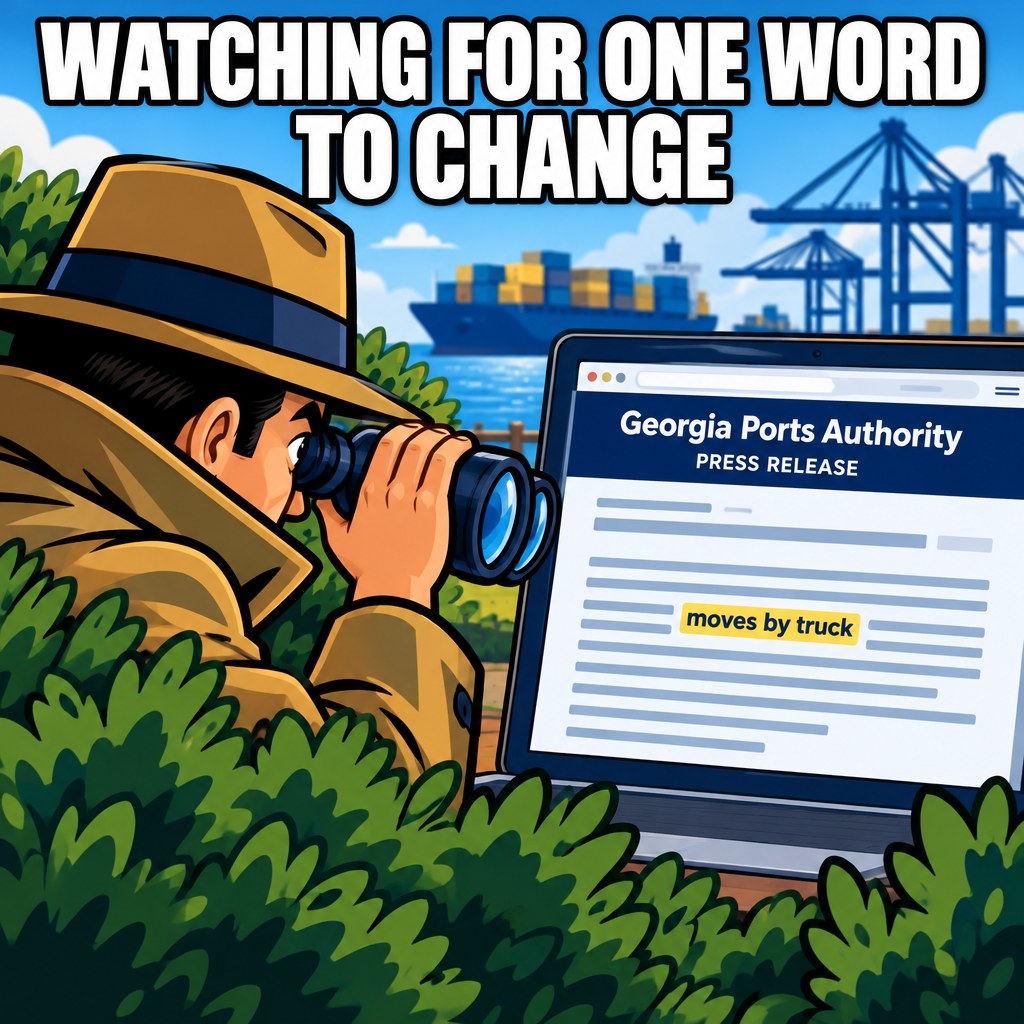
This is the ground-truth check that kept this article honest. Georgia Ports Authority's own press release on the 8.5% frozen-poultry export growth — published well after the Gainesville terminal's May 4 opening — describes the current mode plainly: "frozen poultry exports move to the port by truck." Not "increasingly move by rail." Not "a growing share now moves by rail." Just: by truck, present tense, from the agency that operates the rail alternative and has every incentive to announce a mode-shift the moment it's real. (Georgia Ports Authority — Frozen Poultry Exports Up 8.5 Percent)
That's not a knock on the port. Five months is genuinely fast to expect a freight-mode change to show up in an authority's own boilerplate language, and shippers with existing trucking contracts don't tear them up the week a new option opens. But it does mean anyone telling you poultry has "moved to rail" at Gainesville is ahead of what Georgia Ports itself is willing to say in writing.
Methodology
This pass drew on Georgia Ports Authority's own press releases (frozen-poultry export volumes, the Gainesville facility's opening announcement and specs), Norfolk Southern's public intermodal service pages, the Greater Hall Chamber of Commerce's economic-development reporting, AgGeorgia's public poultry-financing pages, the New Georgia Encyclopedia's history of Jesse Jewell and Georgia's poultry industry, and multiple 2026 freight-logistics industry sources for generic intermodal-vs-truckload cost benchmarks. It does not include a single Gainesville- or poultry-specific rate quote, dwell-time figure, or adoption percentage — none of that is public. It also does not include a conversation with Georgia Ports Authority, Norfolk Southern, AgGeorgia, a North Georgia poultry integrator, or the Greater Hall Chamber — everything here is drawn from what each of those parties has already published, not from asking them directly. The industry-wide intermodal cost benchmarks used above are national generics, not verified against this specific lane; they're included because they're the best publicly available proxy for a genuine, sourced comparison, and every place they're used says so explicitly.
Moral of the Story
If you're a North Georgia poultry integrator or exporter, the open question worth actually asking Georgia Ports Authority or Norfolk Southern isn't "what's the rate" in the abstract — it's whether your specific volume and lane clear the roughly 500-mile rule of thumb that generally makes intermodal pencil out, and if it doesn't on cost alone, whether reliability or driver-capacity relief closes the gap for you specifically. That's a very different conversation than assuming a new rail option is automatically cheaper.
If you're AgGeorgia or another poultry-facility lender, this is a logistics-risk variable that isn't in your underwriting yet, as far as public information shows — worth a real internal conversation about whether a borrower's mode flexibility (can they use either truck or rail, or are they locked into one) should factor into how you price expansion risk.

If you're the Greater Hall Chamber or another regional economic-development office, the honest sell to a prospective poultry-adjacent manufacturer isn't "rail will cut your freight bill" until someone actually publishes that number — it's congestion relief, capacity, and optionality, which is exactly what Georgia Ports Authority itself is leading with.
If you're just trying to figure out whether $134 million in public infrastructure money was well spent, don't wait for a poultry-specific savings number that may never get published — watch instead for GPA's own language to change from "frozen poultry exports move to the port by truck" to anything else. That's the tell, and it's free to watch for.
Related Research
The structured fields below this narrative — what got us asking this, who we'd like to talk to, what we still need, and our sources — carry the parts of this investigation that update independently of the write-up above.
Where This Stands
Investigating
Our Best Guess So Far
Generic 2026 freight-industry cost benchmarks put the intermodal-vs-truck break-even around 500 miles one-way (below that, two drayage legs erode most of rail's per-mile savings); the Gainesville-to-Savannah lane is roughly 299 miles one-way. If that generic pattern holds on this specific lane, direct-cost savings alone may not be the main driver of any real mode shift — the more likely value driver is truck-driver capacity, service reliability, and Atlanta-area congestion relief, which is also exactly the rationale Georgia Ports Authority itself leads with publicly. This is a hypothesis built from generic national freight data applied to a specific real distance, not a Gainesville-specific study — it needs actual shipper rate quotes and dwell data to confirm or falsify.
What Got Us Asking This
- linkGeorgia Ports Authority — Frozen Poultry Exports Up 8.5 Percent — Savannah handled 55,957 TEUs of frozen poultry in the 12 months ending February 2026 (+8.5%); Georgia handled 37% of all U.S. frozen poultry exports in 2025. States plainly that frozen poultry currently 'moves to the port by truck.'
- linkGeorgia Ports Authority — Gainesville Inland Port facility page — $134M facility, 200,000-container annual capacity at full build-out, five-day/week Norfolk Southern rail service, opened May 4, 2026.
- linkGeorgia Ports Authority — Gainesville Inland Port Set for May Opening — CEO Griff Lynch: projected to replace 26,000 truck roundtrips in year one; serves ~330 regional manufacturers (poultry, heavy equipment, forest products), not poultry alone.
- linkGreater Hall Chamber of Commerce — Economic Development — 330+ manufacturing/processing concerns in Hall County; 2025 year-end report: 10 new/expanding developments, 691 new jobs, $186.5M new capital investment.
- linkAgGeorgia — Poultry Financing — Finances poultry-house construction, upgrades, and equipment; no public mention of logistics/mode risk in underwriting.
- linkNew Georgia Encyclopedia — Jesse Jewell — Jewell built the first fully vertically-integrated poultry operation in Gainesville, 1930-1954 (hatchery, processing plant, feed mill, rendering plant) — the reason poultry freight is concentrated here at all.
How This Connects
The Physical Side
Poultry plants/cold stores (concentrated in Hall County since Jesse Jewell's 1930s-50s vertical-integration build-out) → drayage → Gainesville inland port → Norfolk Southern rail → Savannah reefer/cold storage (~3,600 powered slots) → vessel. The competing physical path is a direct ~299-mile truck haul.
The Money Side
$134M in public Georgia Ports Authority capital built the rail option; AgGeorgia finances the poultry-house assets on the origin end; truck vs. rail carries different fuel, drayage, dwell, and working-capital-in-transit costs that aren't yet publicly measured for this specific lane.
The Day-to-Day Work
Integrators/exporters choose the mode; Georgia Ports Authority and Norfolk Southern operate the rail alternative; the Greater Hall Chamber and regional economic-development offices use the port as a broader manufacturing-attraction asset, not a poultry-specific pitch.
The Data/Systems Side
Bookings, dwell time, container utilization, and reliability data exist inside GPA/Norfolk Southern systems but aren't public; the only public signal so far is GPA's own boilerplate language, which as of this research pass still describes poultry moving by truck.
Who We'd Like to Talk To
- North Georgia poultry integrators and exporters (e.g. Fieldale Farms)
- Georgia Ports Authority operations/planning staff
- Norfolk Southern intermodal service team
- AgGeorgia Farm Credit poultry-lending staff
- Greater Hall Chamber of Commerce economic-development staff
- Georgia Poultry Federation / USPOULTRY
What We Still Need
- Actual poultry-specific container counts or share moving through Gainesville vs. direct-to-Savannah truck
- Real Norfolk Southern intermodal rate quotes and drayage costs for this specific lane, not national generic benchmarks
- Dwell-time and service-reliability data for the Gainesville-Savannah rail leg
- A statement from a North Georgia poultry integrator (e.g. Fieldale Farms) or the Georgia Poultry Federation on whether/why they are or aren't using the rail option
- AgGeorgia or another poultry lender's view on whether logistics-mode flexibility factors into underwriting
What We'll Build From This
- A lane-specific truck-vs-rail landed-cost comparison once real drayage/rail rate quotes exist
- A tracker for Georgia Ports Authority's own public language about poultry mode share over time, as a proxy signal while direct data is unavailable
What We Found
The core adoption question — how much frozen poultry has actually shifted from truck to rail — remains genuinely unanswered in public data; Georgia Ports Authority's own most recent release, published well after the port's May 2026 opening, still describes frozen poultry moving to Savannah by truck. What this pass did surface: generic 2026 freight-industry cost benchmarks put the intermodal break-even around 500 miles one-way, and the actual Gainesville-to-Savannah distance is roughly 299 miles — short enough that the generic math doesn't hand rail an obvious cost win. That, plus Georgia Ports Authority's own public rationale (congestion relief and regional manufacturing capacity, not a poultry-specific savings figure), suggests the real value case for this $134M investment may be reliability and capacity rather than direct freight-cost savings — a real, sourced tension, not a settled answer, which is why this stays "investigating."
Sources
- linkGeorgia Ports Authority — Frozen Poultry Exports Up 8.5 Percent
- linkGeorgia Ports Authority — Gainesville Inland Port facility page
- linkGeorgia Ports Authority — Gainesville Inland Port Set for May Opening
- linkNorfolk Southern — Ship By Rail / Intermodal
- linkGreater Hall Chamber of Commerce — Economic Development
- linkAgGeorgia — Poultry Financing
- linkNew Georgia Encyclopedia — Jesse Jewell
- linkNew Georgia Encyclopedia — Poultry Industry