North Dakota Built the Soybean Crush. Then Yields Fell in the Same Year Acreage Hit a Record. Does the Local-Processing Bet Still Pay?
North Dakota built local soybean crush capacity; now soybean yields are near 30 bu/acre while processing capacity is being optimized. Does local processing still improve grower and regional resilience in a stressed year?
Short Answer
Status: investigating. Here's what's actually verifiable: North Dakota's 2026 soybean crop is the smallest of the last four years in total bushels (203.7M) and the lowest-yielding (30 bu/acre) — even though growers planted more soybean acres than ever (6.85M). At the same time, the state's only soybean crush plant, Green Bison in Spiritwood, is getting a capacity upgrade, a federal tax-credit rule change just made its main product worth roughly twice as much per gallon, and the state pushed $500M into farm-finance backstops. Those are four real, independently documented facts. What nobody has published is whether they add up to a better year for an actual North Dakota soybean grower than the pre-Green-Bison version of this state would have delivered — the local-basis, procurement-radius, and plant-utilization numbers that would answer that don't exist publicly, and I'm not going to fill them in with a plausible-sounding guess.

From Wheat State to Crush State, in One Generation
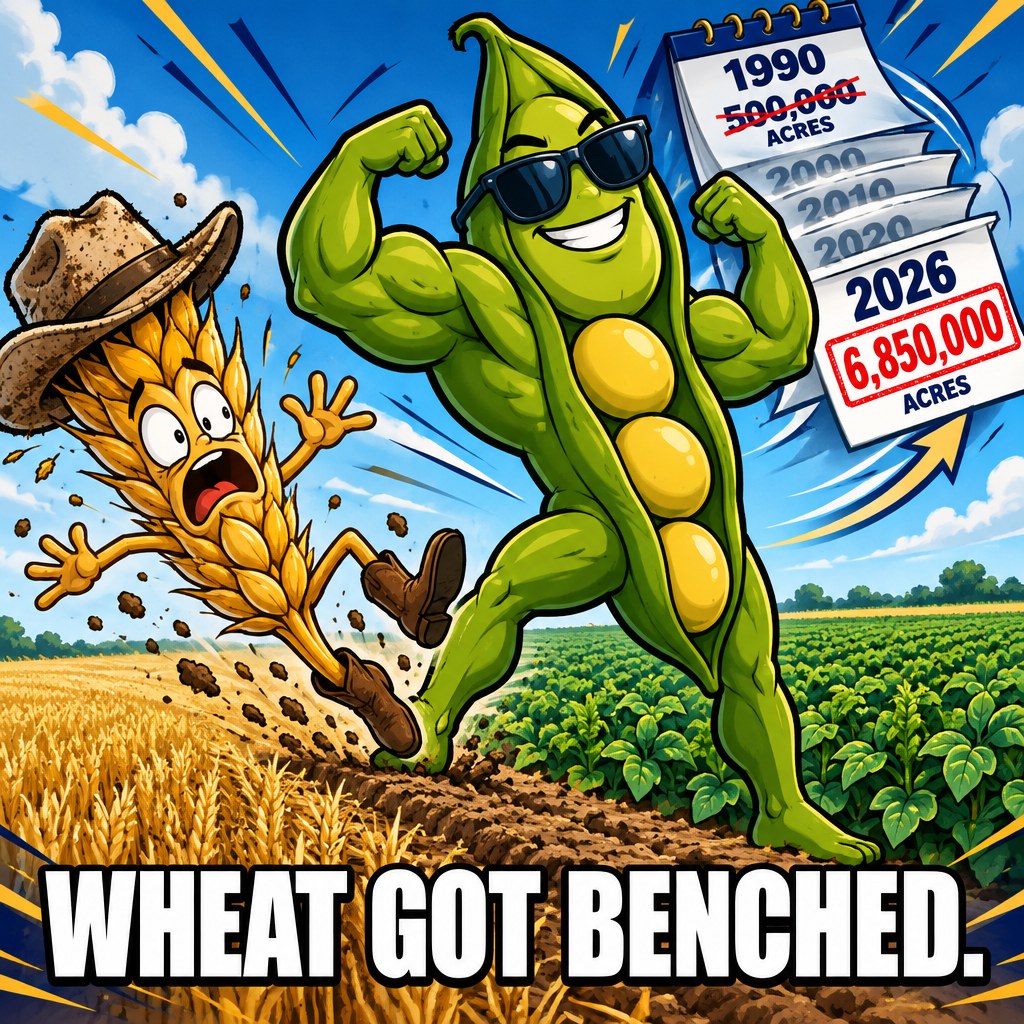
North Dakota did not always grow soybeans. In 1990 the state had about 500,000 acres of them — a rounding error next to wheat, barley, and sunflowers. By 2000 that had nearly quadrupled to 1.9 million acres, and the expansion kept going: 2026's planted acreage is 6.85 million, roughly 13 times the 1990 total. The shift concentrated in the Red River Valley, where soil and rainfall finally started looking like classic Corn Belt row-crop ground instead of small-grain country. (Agweek — How a region known for its wheat and grasslands turned toward corn and soybeans)
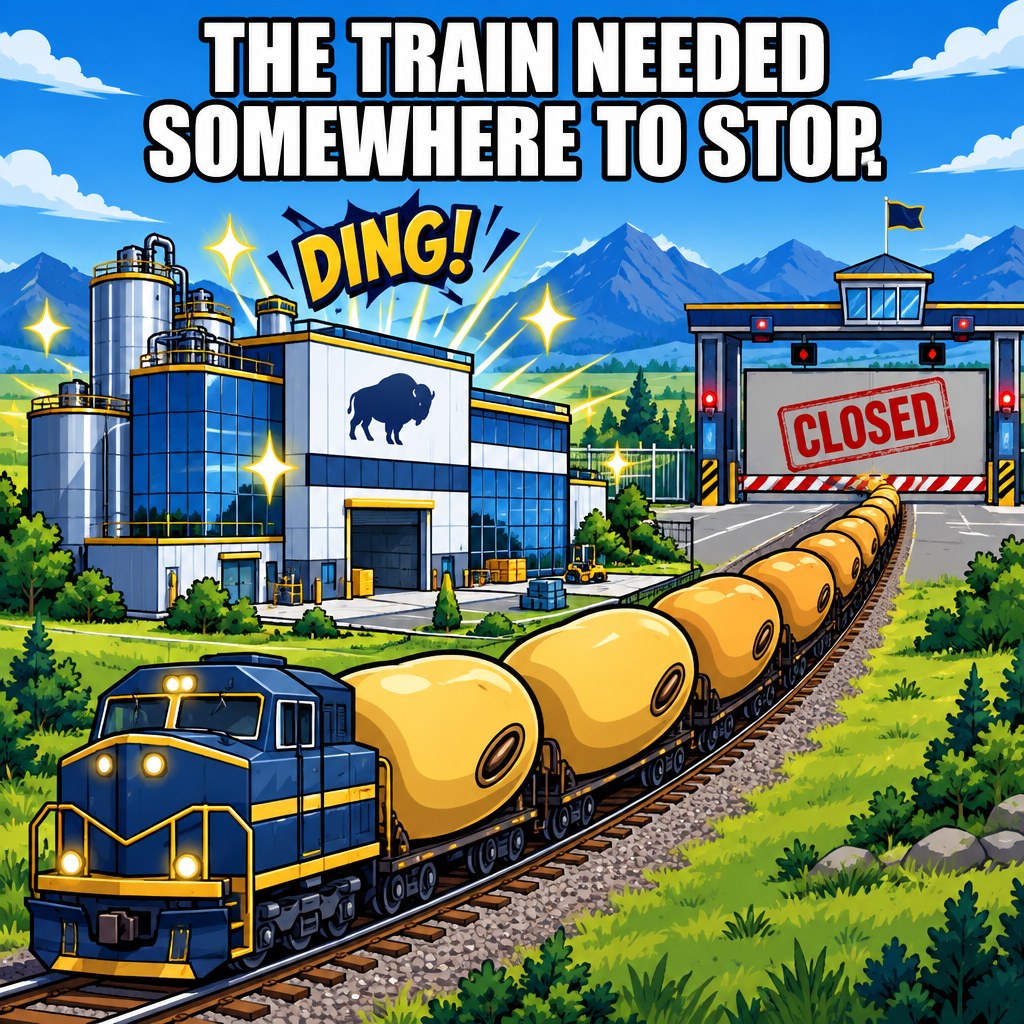
For almost the entire time North Dakota was becoming a serious soybean state, it had nowhere to process the crop. Roughly 95% of North Dakota soybeans left the state whole, by rail, mostly bound for export. That worked fine until it didn't: during the 2018-19 US-China trade war, North Dakota soybean farmers found themselves holding a crop with a shrinking export outlet and no local plant to sell into instead. Green Bison — a $350 million, 150,000-bushel-per-day joint venture between ADM (75%) and Marathon Petroleum (25%) — broke ground specifically to close that exposure, and started receiving soybeans for its first harvest in September 2023. (North Dakota Monitor / Agweek reporting on Green Bison's opening; Marathon Petroleum — Green Bison Production Facility begins operations)
So the actual question this article is testing isn't "is local processing good." It's "now that North Dakota has bet real capital on closing its export-dependency gap, does that bet pay off in a year where the crop itself came in smaller and lower-yielding than any of the last three."
How This Connects
open_with Drag nodes to rearrange, tap one for the evidence behind it — pinch or scroll to zoom.
The Two Federal-and-State Levers Pointing the Same Direction (For Once) — and the One Still Missing
Most of these articles find a policy tension. This one mostly doesn't — which is itself worth noting. The 2026 revision to the Section 45Z Clean Fuel Production Credit removed an indirect-land-use-change penalty that had been suppressing soybean oil's value as a renewable-diesel feedstock; the practical effect is that generic soybean oil's renewable-diesel credit value roughly doubled, from about $0.21 to about $0.50 per gallon. That credit is paid to the fuel producer — Marathon/Green Bison, in this case — not to the farmer who grew the bean. Separately, North Dakota's own Bank of North Dakota expanded its Farm Financial Stability and Grain Inventory loan programs to a combined $500 million in March 2026, specifically for producers who had an operating shortfall in 2024 or 2025, at a fixed 3.75% rate on BND's share. Both levers point toward "make it easier to keep growing and selling soybeans in North Dakota in a stressed year." (American Farm Bureau — 45Z Clean Fuel Production Credit; North Dakota Industrial Commission — $100M additional loan funding announcement)

What's missing is the connective tissue between them. A bigger federal credit for Green Bison's soybean oil doesn't automatically become a better cash basis for the grower delivering beans to that plant — that depends on whether Green Bison's procurement pricing actually passes any of that credit value upstream, which is a negotiated, plant-specific number nobody publishes. And the BND loan programs help a stressed producer regardless of whether Green Bison exists at all — they're a general farm-finance backstop, not a Green-Bison-specific one. Both are real. Neither one, by itself, answers whether the local-crush bet specifically is what's cushioning a North Dakota grower in 2026, versus just "North Dakota agriculture has more support this year than it otherwise would."

The Numbers So Far
That's the actual shape of the "stressed year" the dossier's question is testing against: not a collapse, but the lowest yield of a four-year run happening in the same season as the most acres ever planted — total production (203.7M bu) still comes in below all three prior years (218.7M, 245.6M, 223.9M) despite the extra acres.
Where This Is Happening
What NDSU's Own Extension Office Is Actually Telling Growers Right Now
This is the closest thing to a ground-truth data point this pass found, and it cuts against reading Green Bison and the 45Z credit as the headline story for an actual North Dakota grower's 2026 bottom line. NDSU Extension's own February 2026 crop budget release led with a blunt diagnosis from farm management specialist Ron Haugen: "Inputs and ownership costs are flat to somewhat higher, but lower commodity prices are the main contributor to the lower profitability. It's a revenue problem." That's a state Extension office naming price, not processing capacity or tax credits, as the thing actually squeezing growers this year. (NDSU Extension and Ag Research News — Crop budget projections show low returns for 2026)
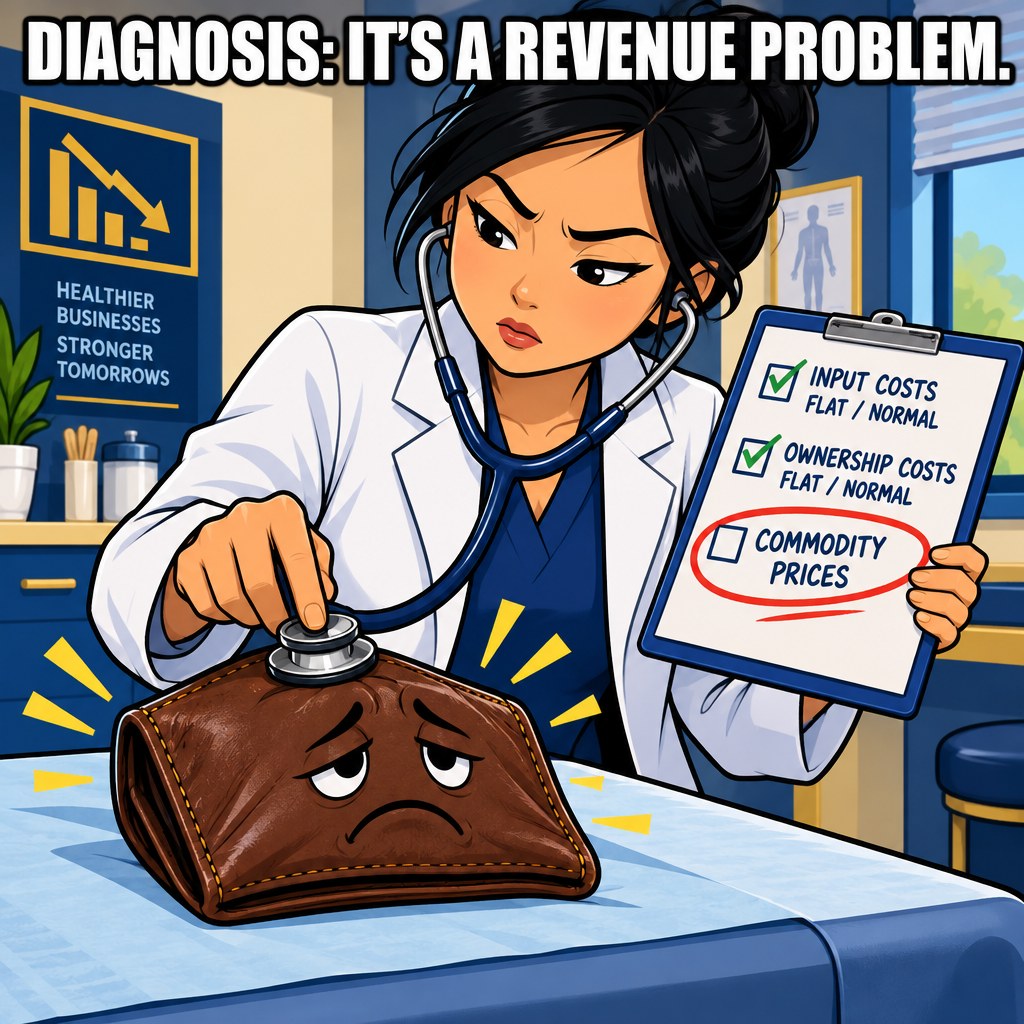
That doesn't mean Green Bison and the 45Z credit are irrelevant — it means they're operating on a different part of the system (basis, demand, and processor economics) than the part NDSU is flagging as the acute 2026 pain point (price). Whether a stronger local basis is actually offsetting some of that price pain is exactly the unmeasured question this article keeps running into.
Methodology
This pass combined USDA NASS's North Dakota state agriculture overview pages for 2023 through 2026, ADM's and Marathon Petroleum's own Green Bison facility disclosures and July 2026 expansion announcement, North Dakota Industrial Commission / Bank of North Dakota program announcements, USDA's 2026 canola acreage reporting, American Farm Bureau and farmdoc daily coverage of the 2026 Section 45Z guidance, and NDSU Extension's own February 2026 crop budget release. It explicitly did not do: obtain Green Bison's actual annual throughput or utilization rate (only nameplate capacity is public), pull a historical local soybean basis series for the Spiritwood/Jamestown area before and after 2023, determine Green Bison's real procurement radius, or interview a North Dakota Soybean Council representative, an ADM/Green Bison operator, a Bank of North Dakota loan officer, or a producer directly. Those are exactly the inputs the "North Dakota Crush + Finance Resilience Graph" described in this investigation's artifacts would need to move from a structural comparison to a real answer.

Moral of the Story
If you're a North Dakota soybean grower: the loudest 2026 signals (a tax-credit rule change, a plant expansion announcement, a $500M state finance program) are all real, but none of them is a substitute for knowing your own local cash basis this fall versus the last few years. That's the one number that would actually tell you whether the local-crush bet is showing up in your price, and it's worth asking your elevator directly rather than assuming a national headline answers it for you.
If you're a lender (Bank of North Dakota or a local ag lender): the Farm Financial Stability and Grain Inventory programs exist because NDSU's own Extension office is calling this a revenue problem, not an input-cost or processing-capacity problem — worth confirming a borrower's stress is actually price-driven before assuming a local-basis story explains it away.
If you're North Dakota Soybean Council, Northern Canola Growers, or ADM/Green Bison: the single most useful public dataset that doesn't exist yet is a local basis series for the Spiritwood/Jamestown corridor spanning before and after 2023 — that's the one number that would let anyone outside the plant's own books actually test whether local crush capacity changed grower economics, instead of just changing where the trucks go.
Related Research
This connects to the same "does the announced fix actually reach the grower" question running through today's other two flagship pieces — the Bootheel's irrigation-economics decision and Central Valley dairy's compliance-capital gap — all three are the same underlying pattern: a real structural event or investment, and an unmeasured question about who actually captures the value or bears the cost at the farm level.
Where This Stands
Investigating
Our Best Guess So Far
North Dakota's local soybean-crush investment, a 2026 federal tax-credit rule change favoring soybean oil, and a $500M state farm-finance backstop are all real and mostly pulling in the same direction — but none of the public data yet shows whether any of that value actually reaches a grower's local cash basis in a lower-yield year, versus simply cushioning the state's agricultural economy in general. This is a hypothesis to test against real local-basis, plant-utilization, and lender data, not a conclusion.
What Got Us Asking This
- linkUSDA NASS — North Dakota State Agriculture Overview, 2023-2026 — Soybean yield fell from 35.5 bu/ac (2023) to 37.5 (2024) to 34.5 (2025) to 30.0 bu/ac (2026), a four-year low, even as planted acreage rose to a record 6.85M acres; 2026 total production (203.7M bu) is the lowest of the four years.
- linkMarathon Petroleum / ADM — Green Bison Soy Processing — $350M joint venture (ADM 75%, Marathon Petroleum 25%) in Spiritwood, ND — North Dakota's first dedicated soybean crush plant, 150,000 bu/day nameplate capacity, ~600M lb refined soybean oil/year, opened for the 2023 harvest. No public throughput/utilization data.
- linkADM — July 30, 2026 crush-capacity expansion release — Investments at 4 US plants including Spiritwood unlock ~700,000 metric tons (25M+ bushels) of added annual crush demand; Spiritwood's operational-optimization work targeted for completion mid-2028, not immediate.
- linkNorth Dakota Industrial Commission — 2026 Farm Financial Stability Program expansion — $100M added March 2026, bringing combined 2026 Farm Financial Stability + Grain Inventory Loan support to $500M at a 3.75% fixed BND-side rate for producers with 2024-25 operating shortfalls.
- linkNDSU Extension and Ag Research News — 2026 crop budget projections — "It's a revenue problem" — NDSU's Ron Haugen attributes 2026's low projected crop returns to lower commodity prices, not input costs, which were flat to only modestly higher.
How This Connects
The Physical Side
Green Bison's Spiritwood, ND crush plant (150,000 bu/day nameplate) sits inside a soybean-growing region that grew from 500,000 acres (1990) to 6.85M acres (2026) but historically exported ~95% of its crop whole, by rail.
The Money Side
A 2026 Section 45Z guidance change roughly doubled the renewable-diesel credit value of Green Bison's soybean oil output; separately, BND/NDIC pushed $500M into farm-finance backstops for 2024-25 shortfalls — two real capital levers, neither one yet shown to connect to grower-level basis.
The Day-to-Day Work
ADM (75%) and Marathon Petroleum (25%) own Green Bison; North Dakota Soybean Council and Northern Canola Growers Association sit as connector/advocacy organizations; Bank of North Dakota and local ag lenders hold the finance relationship with growers.
The Data/Systems Side
Production, plant nameplate capacity, the tax-credit change, and the state finance program are all well-documented. What's missing: actual plant utilization, historical/current local basis, procurement radius, and canola-vs-soybean acreage economics for an individual grower.
Who We'd Like to Talk To
- North Dakota soybean growers
- North Dakota Soybean Council
- Green Bison / ADM / Marathon Petroleum
- Northern Canola Growers Association
- Bank of North Dakota / local ag lenders
- NDSU Extension
What We Still Need
- Green Bison's actual annual throughput/utilization vs. its 150,000 bu/day nameplate capacity — not publicly disclosed
- A historical local soybean basis series for the Spiritwood/Jamestown corridor, before and after the 2023 plant opening
- Green Bison's real procurement radius and how it's shifted since the July 2026 expansion announcement
- Canola-vs-soybean acreage economics for a representative eastern North Dakota grower in 2026
- A direct conversation with a North Dakota Soybean Council representative, an ADM/Green Bison operator, a Bank of North Dakota loan officer, or a producer — zero interviews conducted so far
What We'll Build From This
- North Dakota Crush + Finance Resilience Graph — nodes for counties, soybean/canola acres and yield, elevators, Green Bison, canola processors, renewable-diesel offtake, meal buyers, rail, and BND/local lenders; scenarios comparing no-local-crush vs. operating/expanded crush under normal and low-yield production years
Sources
- linkUSDA NASS — North Dakota State Agriculture Overview, 2026
- linkUSDA NASS — North Dakota State Agriculture Overview, 2025
- linkUSDA NASS — North Dakota State Agriculture Overview, 2024
- linkUSDA NASS — North Dakota State Agriculture Overview, 2023
- linkGreen Bison Soybean Processing — official site
- linkADM — To Expand North America Crush Capacity Amid Strong Biofuel Demand (July 30, 2026)
- linkNorth Dakota Industrial Commission — NDIC announces $100M additional loan funding for BND 2026 Farm Financial Stability Program
- linkAgweek — How a region known for its wheat and grasslands turned toward corn and soybeans
- linkAgweek — Crushing it: North Dakota ready to ride wave of demand for soybean oil and meal
- linkAmerican Farm Bureau Federation — 45Z Clean Fuel Production Credit
- linkNDSU Extension and Ag Research News — NDSU crop budget projections show low returns for 2026