Working colony bot
Harvesters, upgraders, builders, spawn logic, Memory, and role-based behavior.
They do not just watch lessons. They build roles, automate decisions, debug failures, use Git checkpoints, and explain how the colony system works under tournament pressure. Screeps gives them something to protect and improve while they learn real architecture habits.
Harvesters, upgraders, builders, spawn logic, Memory, and role-based behavior.
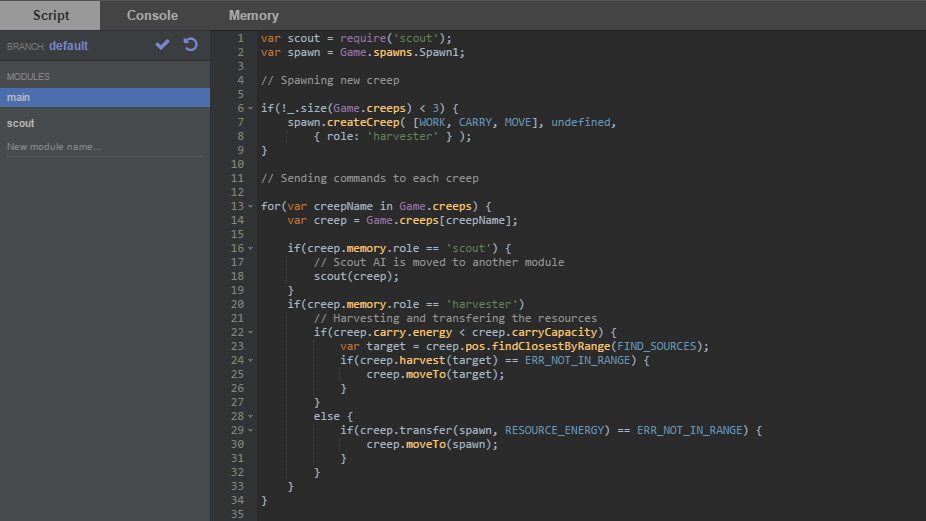
Git commits, README notes, bug reports, diffs, and recoverable development checkpoints.
Students tune their colony for AutoNateAI capture-the-flag and explain what they would scale next.

Nathan Baker studied Computer Science at the University of Michigan and has spent the last five years building real software, AI workflows, and software architectures inside organizations where clarity and reliability matter.
He also taught Computer Security at the University of Michigan as an instructional aide. That mix of industry engineering and hands-on teaching shapes the program: students learn fundamentals, but they also learn how modern engineers plan, debug, use Git, collaborate with AI, and explain systems.
New cohorts run every so often. The next cohort opens Monday, August 3, 2026. Live sessions begin Tuesday, August 4, 2026. Includes Screeps setup help, cohort workspace access, Git repo guidance, Codex workflow coaching, dedicated AutoNateAI Discord access, and tournament-day support.
Because Screeps keeps running, students see the same pressures real software faces: changing state, feedback loops, dependencies, automation, failure recovery, and performance under competition.
Students meet the world, map the colony system, and see their first code become visible behavior they can protect and improve.
Set up Screeps, connect the development workflow, and understand the colony as a software system with inputs, decisions, outputs, and feedback.
Learn how variables store colony information and how state helps the bot remember what is happening each tick.
Students turn repeated actions into reusable behaviors and teach the colony to make choices when conditions change.
Learn how functions package repeatable behavior so the colony code becomes easier to scale.
Use conditionals, comparisons, and simple validation so the colony can make decisions.
Students learn how real builders protect progress, investigate failures, and recover working versions when a live system breaks.
Use Git to save bot progress, compare changes, write useful commits, and recover from broken colony behavior.
Learn how to inspect errors, logs, stuck creeps, idle spawns, broken memory, and unclear AI suggestions before changing code.
Students connect game objects, persistent memory, and role-based design to how software systems communicate, remember, and divide work.
Understand APIs by reading Screeps game objects, method calls, JSON-like data, and the interface between student code and the game world.
Organize data so the colony can track creep roles, tasks, energy needs, and room priorities.
Students use automation and AI support to improve the bot while staying responsible for the decisions their system makes.
Learn how automation uses triggers, rules, and repeated actions to reduce manual work and scale the colony.
Use Codex to plan Screeps features, generate code, explain errors, and review work while keeping student understanding first.
Students tune a battle branch and test the system against another colony under competitive pressure.
Connect the Screeps bot pieces into a clear architecture and prepare the colony for AutoNateAI capture-the-flag rules.
Battle student colonies head-to-head in AutoNateAI capture-the-flag, explain the architecture, review tradeoffs, and identify the next version.