Michigan Has a Billion-Pound Apple Crop. Can Storage and AI Protect Grower Margin?
With Michigan's 2026 apple crop running near its historical average in size but national wholesale box prices down roughly 28-36% over three years while H-2A labor costs have grown to 60-70% of that same wholesale price, how much of a Michigan grower's margin can controlled-atmosphere storage and AI-enabled packing routing actually protect — and how much sits upstream of anything a packing line can touch?
Short Answer
I grew up in Michigan, and "big apple crop" was always framed as good news — more fruit, more work, more money moving through West Michigan. What I actually found chasing this question is that the size and quality of this year's crop is almost beside the point. The number that decides whether a Michigan apple grower makes money in 2026 isn't bushels — it's what fraction of the wholesale price per box survives past labor cost before it reaches the farm. Right now, most of it doesn't. Status: investigating — the crop-quality story is well documented, but the packout-level and storage-occupancy numbers that would tell us exactly how much CA storage and AI sorting can actually claw back aren't public yet.
Why This Crop Landed on a Lake-Effect Coincidence, Not a Plan
West Michigan grows apples for a reason that has nothing to do with soil chemistry or subsidy design: Lake Michigan. The prevailing westerlies pick up heat and moisture off 22,000 square miles of open water and dump it back onto the strip of land running from Benton Harbor up through Grand Rapids to Traverse City — warming the ground in spring just enough to delay bud break past the worst frost risk, then cooling it in fall just enough to slow ripening into a long, even harvest window. That lake-effect strip is why Michigan, not Ohio or Indiana next door, became the country's second-largest apple state, and it's why "Fruit Ridge" — the row of townships just north of Grand Rapids where Riveridge Packing sits — became one of the most concentrated commercial-apple footprints in the country. None of that geography changed this year. What changed is everything downstream of the orchard.

How This Connects
open_with Drag nodes to rearrange, tap one for the evidence behind it — pinch or scroll to zoom.
Every node on the right two-thirds of that diagram is a capital and information problem, not a production one. The crop is fine. What happens to the dollars after the crop is picked is the actual story.
The Policy Lever That's Actually Helping, and the One That Isn't Enough
Here's the tension this question turns on. In October 2025, the Department of Labor rewrote how it calculates H-2A Adverse Effect Wage Rates — moving from a single statewide farm-labor survey number to an occupational, skill-level-based system. For Michigan in 2026, that produced entry-level and experienced H-2A rates of $13.73 and $16.15 an hour, and MSU Extension estimates it will save Michigan growers roughly $33 million in the first half of fiscal year 2026 relative to what the old formula would have charged. That's a real, current, favorable policy signal — a genuine break in a labor-cost trend that had otherwise risen roughly 57-61% over the prior decade.
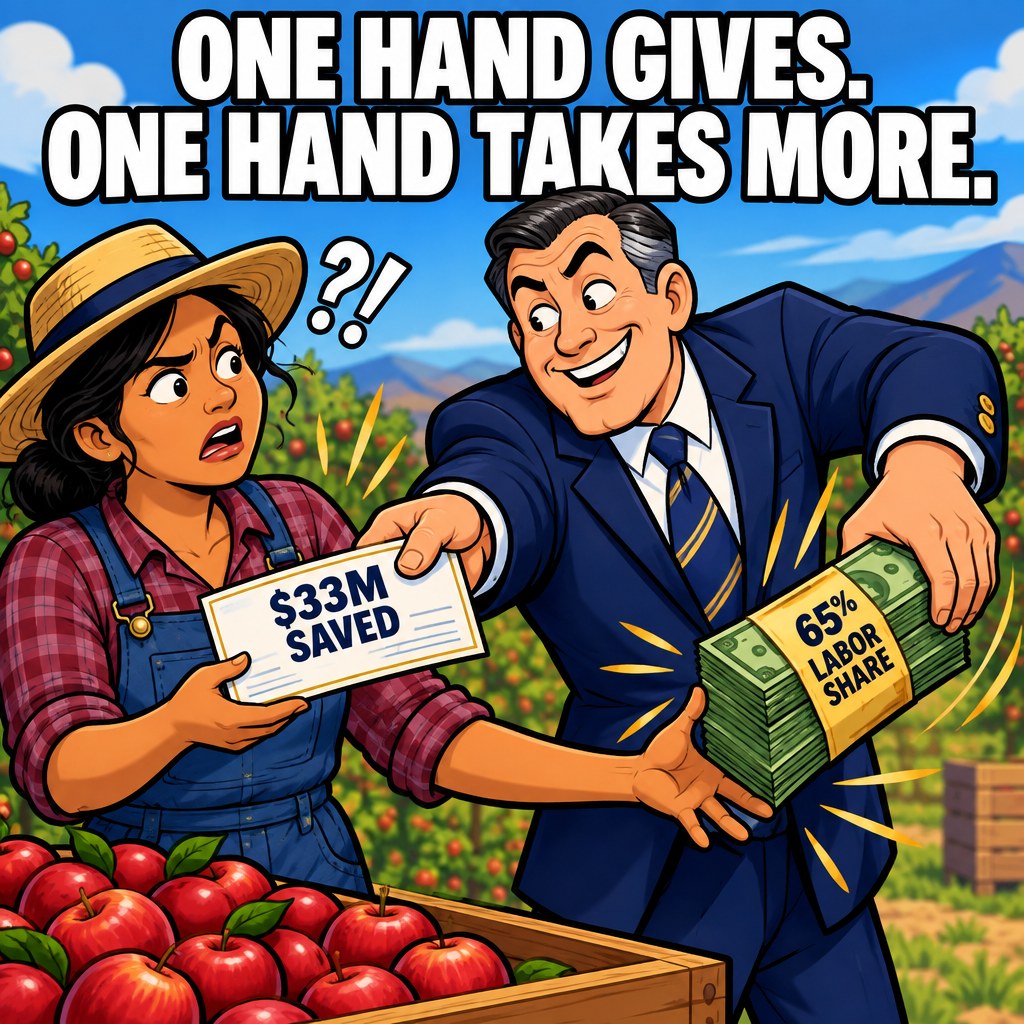
It is not, on its own, enough to fix the margin problem, and the data says so directly. USApple's own numbers show H-2A-related labor expense has grown from roughly 40% of the average wholesale price per box in 2013 to 60-70% of it in 2026 — a shift in *what share of the box price labor eats*, not just in the hourly wage. Slowing the rate of wage growth doesn't reverse a decade-long shift in that ratio, especially while the box price itself is falling. Two levers, both real, pointing in different directions: one is Washington easing the cost side, the other is national oversupply squeezing the revenue side at the same time.
Storage and AI sorting live entirely on the left side of that second chart's problem — they can shift how much of a grower's fruit earns the fresh-pack price instead of the processing price, which matters, but they don't touch the line climbing underneath it.
Where This Is Happening
The Ground Truth: A Real Farm's Numbers
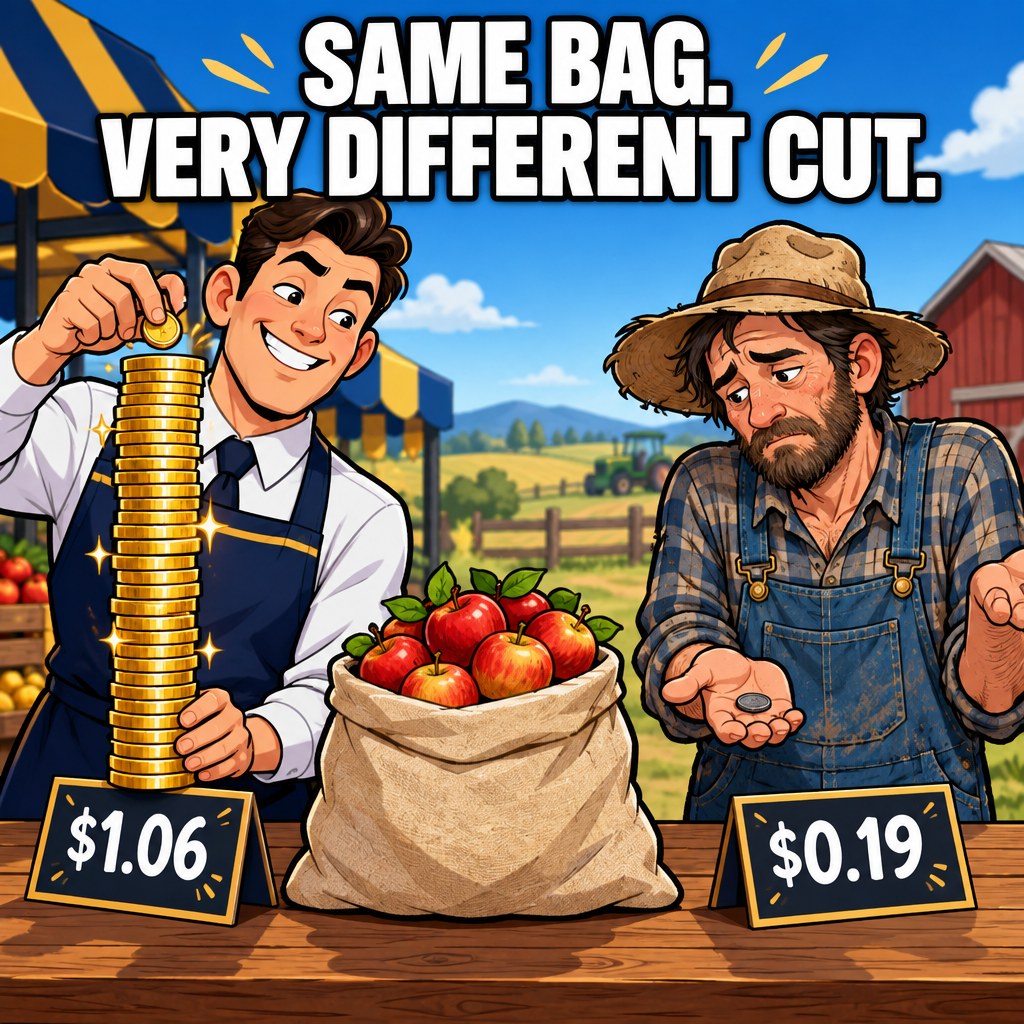
This is the part that should end any "billion pounds must mean a good year" read of this crop. Crain's Grand Rapids Business reported that for a roughly 45-acre Michigan apple farm, 2026's combination of low wholesale pricing and high labor cost pencils out to a projected loss of $135,495 for the season. The Michigan Apple Committee's own retail-margin example, cited in that reporting, shows a retailer earning $1.06 on a $2.99, 3-pound bag of apples — while the grower who grew them earns $0.19. That split isn't a storage problem or an AI-sorting problem. It's a supply-chain-margin problem sitting downstream of everything Riveridge's packing line can touch.
Methodology
This round pulled from USDA/NASS's 2026 Michigan overview, the Michigan Apple Committee's own August 2026 crop-quality release, MSU Extension's September 2 and September 10, 2026 statewide apple maturity reports (variety-by-variety starch/firmness/Brix/color data and CA storage thresholds), USApple's 2026/27 national crop and margin reporting via FreshFruitPortal, Farm Credit East's May 2026 Apple Outlook, GreenStone Farm Credit Services' own 2025 harvest commentary (used for its typical framing of grower cash-flow and storage strategy, clearly dated as 2025, not assumed current), Crain's Grand Rapids Business's 2026 reporting on grower losses, and MSU Extension's H-2A wage-rate reporting. It does not include 2026 CA-storage occupancy by facility, packout percentage by grade/variety for this specific crop, Riveridge's own throughput or AI-sorting ROI figures, or a direct conversation with a Michigan grower, packer, or GreenStone loan officer — those four gaps are the real next phase of this investigation, not an afterthought.
Moral of the Story
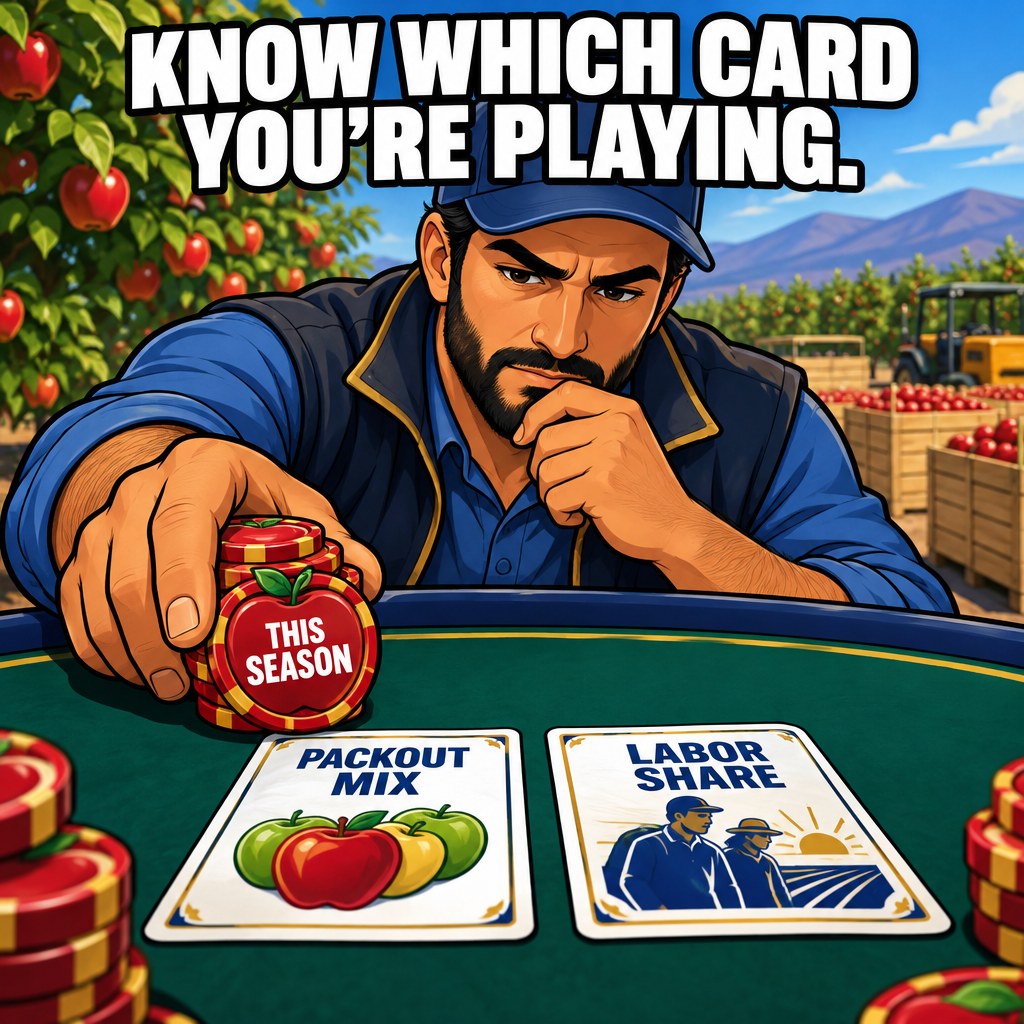
A big, high-quality crop is not the same thing as a profitable one, and in 2026 Michigan apple growers are living the gap between those two sentences in real dollars. Storage and AI sorting are real tools — they move fruit toward the fresh-market packout instead of the processing bin, and that's worth real money at the margin — but they're solving a packout problem while the bigger problem is a price-and-labor-share problem sitting one layer above them.
A few concrete moves that fall out of that:
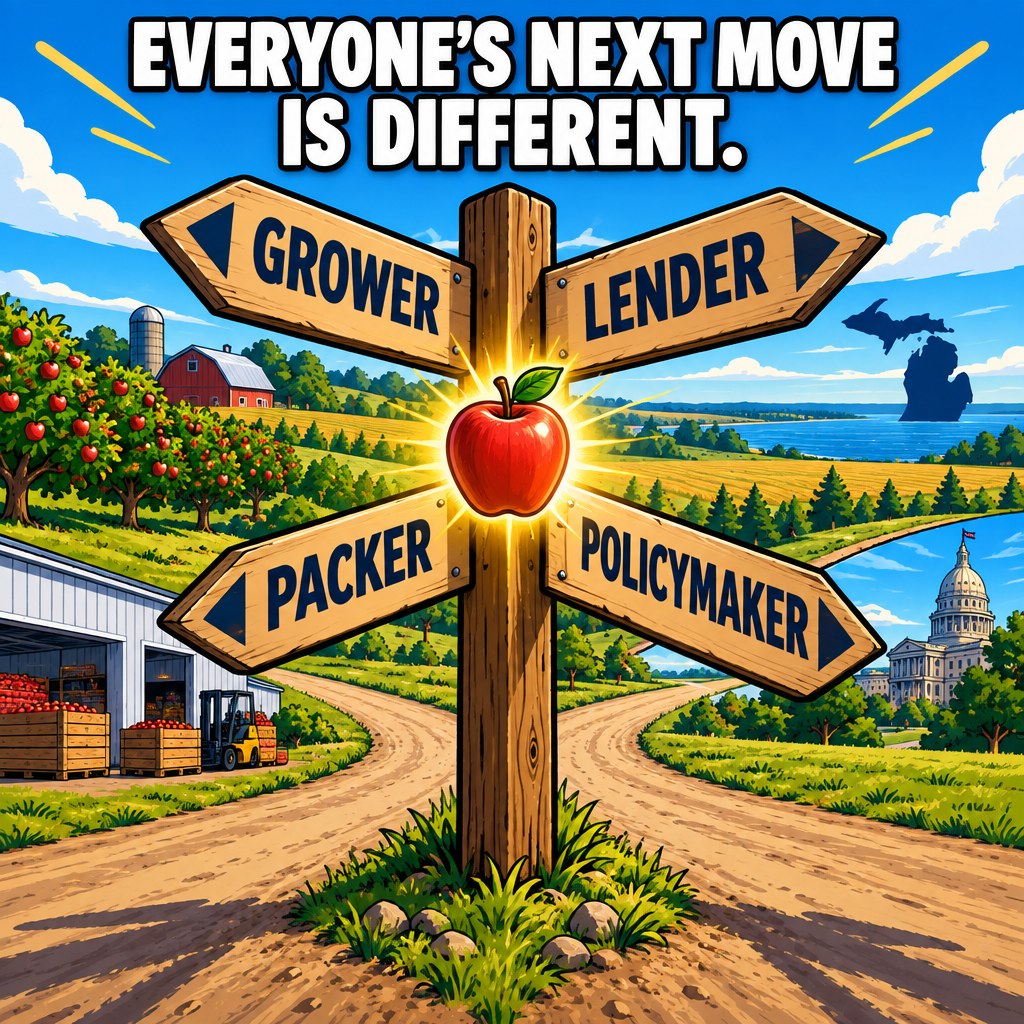
- If you're a grower, don't let "the crop looks great" set your financial expectations for the season — run your own numbers against the Michigan Apple Committee's cited $0.19-per-3-lb-bag grower split and the 60-70% labor-cost-share figure before you commit to a storage-vs-processing call, and ask your packer directly what packout percentage they're actually seeing by variety this year, not last year.
- If you're a lender (GreenStone or otherwise), the more useful 2026 renewal question isn't "how big is the crop" — it's "what's this grower's actual packout mix and their exposure to the wholesale-price decline," since Farm Credit East's own May 2026 outlook already says current pricing "is not sustainable without changes in costs, pack-out, demand or supply."
- If you're a packer or the Michigan Apple Committee, the AI/storage story is genuinely compelling, but publishing even a rough 2026 packout-by-variety or CA-occupancy number would do more to help growers plan than another crop-quality press release — that's the exact gap this investigation hit first.
- If you're a policymaker watching H-2A, the October 2025 AEWR methodology change is real relief on the rate of labor-cost growth, but it isn't reversing labor's climbing share of the box price — those are two different problems, and treating the first as a fix for the second is the mistake to avoid.
Related Research
The structured fields below this narrative — what got us asking this, who we'd like to talk to, what we still need, and our sources — carry the parts of this investigation that update independently of the write-up above.
Where This Stands
Investigating
Our Best Guess So Far
If controlled-atmosphere storage and AI-enabled sorting mainly affect which share of a grower's crop reaches the fresh-market packout versus the processing channel, they can meaningfully improve a grower's return at the margin — but they can't reverse a structural shift in which labor cost, not storage cost, now consumes 60-70% of the wholesale price per box. This is a hypothesis built from national USApple/Farm Credit East reporting and one Michigan-specific loss example, not a verified Michigan-specific packout-to-margin figure.
What Got Us Asking This
- linkUSDA/NASS — Michigan 2026 State Overview — Lists Michigan's 2026 apple crop at 1.05 billion lbs (≈25M bushels).
- linkMichigan Apple Committee — 2026 crop-quality release, Aug 24 2026 — Executive director Diane Smith: crop expected above the USDA 25M-bushel estimate, exceptional size/color; Michigan's own historical average is 27.2M bushels/year.
- linkMSU Extension — Statewide Apple Maturity Report, Sep 10 2026 — Variety-level starch/firmness/Brix/color data across four regions; McIntosh running up to 18 days ahead of normal harvest timing, most varieties 11-24 days early.
- linkFreshFruitPortal — USApple labor-cost-share report, May 28 2026 — USApple VP of Insights Chris Gerlach: H-2A-related expenses now run 60-70% of average wholesale price/box, up from ~40% in 2013; wholesale prices down ~23% from the 2023/24 peak.
- linkFarm Credit East — 2026 Apple Outlook, May 19 2026 — National apple supply (263-275M bushels) growing faster than profitable-price demand; labor now "the number one cost of production"; current pricing "not sustainable without changes in costs, pack-out, demand or supply."
- linkCrain's Grand Rapids Business — Michigan apple growers face mounting losses, 2026 — A 45-acre Michigan apple farm projected to lose $135,495 this season; Michigan Apple Committee retail-split example: retailer earns $1.06, grower earns $0.19, on a $2.99 3-lb bag.
How This Connects
The Physical Side
Orchards → harvest crews → bins → CA storage rooms → pre-sort/pack → fresh-pack or processing → retail — all sitting on Fruit Ridge and Michigan's other lake-effect growing districts, whose climate (not policy or capital) is why apples grow here at all.
The Money Side
Harvest labor (increasingly the largest single cost), storage energy, inventory financing through lenders like GreenStone, and the packout split between fresh-pack and processing salvage value all compete for the same box-price dollar — a dollar that's fallen ~28-36% over three seasons.
The Day-to-Day Work
Growers, Riveridge and other Fruit Ridge packers, the Michigan Apple Committee, GreenStone Farm Credit Services, and the retailers who capture over 5x the grower's own margin on a bag of apples per the Michigan Apple Committee's own cited example.
The Data/Systems Side
MSU Extension's variety-by-variety maturity/storage data is genuinely public and detailed — what's missing is the next layer down: 2026 CA-storage occupancy, packout percentage by grade/variety, and any measured AI-sorting ROI, none of which is published yet.
Who We'd Like to Talk To
- Michigan apple growers deciding storage vs. fresh-pack vs. processing routing
- Riveridge Packing operations team
- Michigan Apple Committee (Diane Smith)
- GreenStone Farm Credit Services credit officers
- MSU Extension fruit/storage research team
What We Still Need
- 2026 CA-storage occupancy by facility or region
- Packout percentage by grade/variety for the actual 2026 crop, not a maturity-report proxy
- Riveridge's own throughput or AI-sorting-ROI figures, if the company will share any
- A Michigan-specific version of the Crain's $135,495 loss example — different farm sizes, different storage-access archetypes
- A direct conversation with a Fruit Ridge grower, GreenStone loan officer, or Michigan Apple Committee staff
What We'll Build From This
- A variety-by-variety fresh-pack vs. CA-storage vs. processing margin comparison, once real 2026 packout data exists
- A grower-facing break-even calculator for CA storage cost against the current wholesale price trend
What We Found
Michigan's 2026 crop is, by the state's own historical average, an ordinary-to-slightly-below-average year in size — not the record the 'billion-pound crop' framing implies — and the real margin threat isn't crop size at all. National USApple reporting shows H-2A-related labor expense has grown from roughly 40% of the average wholesale price per box in 2013 to 60-70% of it in 2026, while that box price itself has fallen roughly 28-36% over three seasons on national oversupply. A October 2025 DOL rule change that lowers the rate of Michigan's H-2A wage growth is real relief, but it doesn't reverse that cost-share climb. Crain's Grand Rapids Business's real farm example — a 45-acre operation projected to lose $135,495 this season, against a retail-vs-grower margin split of $1.06 to $0.19 on a bag of apples — shows the mechanism playing out in real numbers. Storage and AI sorting can shift packout mix at the margin, but the 2026 CA-occupancy and packout data that would show exactly how much margin they're actually protecting isn't public yet, which is why this stays "investigating."
Sources
- linkUSDA/NASS — Michigan 2026 State Overview
- linkMichigan Apple Committee — Michigan Apple Crop Expected to Be High Quality
- linkMichigan Apple Committee — Current Michigan Apple Industry Issues
- linkMSU Extension — Michigan Statewide Apple Maturity Report, September 2, 2026
- linkMSU Extension — Michigan Statewide Apple Maturity Report, September 10, 2026
- linkMSU Extension — Michigan's H-2A Wage Offers in First Half of Fiscal Year 2026
- linkFreshFruitPortal — Labor consumes excessive 60-70% of US apple growers' wholesale price
- linkFreshFruitPortal — USApple reports 2026 national crop and margin data
- linkFarm Credit East — 2026 Apple Outlook: High Supply with Tight Margins
- linkGreenStone Farm Credit Services — Financial Performance
- linkGreenStone Farm Credit Services — Strong Apple Harvest Expected in Michigan (2025 context)
- linkCrain's Grand Rapids Business — Michigan apple growers face mounting losses despite bumper crop
- linkRiveridge Packing